Blog
Attribution Models for B2B SaaS: What Each Measures and Where It Fails
Attribution models compared by deal size, sales cycle and buying group. What first-touch, last-touch, U-shaped and W-shaped each measure and where they fail.
Sales and marketing alignment for B2B SaaS ABM: agree the buying group, account list and pipeline metrics before launch, with sourced benchmarks.
 Ishan ManchandaNov 22, 2026

Attribution models compared by deal size, sales cycle and buying group. What first-touch, last-touch, U-shaped and W-shaped each measure and where they fail.
Learn how to scale account based marketing campaigns by migrating accounts from 1:1 to 1:few before 1:many, with triggers, capacity math and metrics.

Build an intent data workflow that ties each signal to a named owner, action and deadline, then judge campaigns on pipeline per account, not clicks.
Request a quote and our experts will contact you within 24 hours with tailored solutions and pricing.
Last updated: Nov 22, 2026
By the ABM for B2B SaaS Editorial Team. Last updated October 28, 2026.
Sales and marketing alignment in B2B SaaS account-based marketing (ABM) means both teams agree, before launch, on which target accounts to work, who sits in each buying group, and which pipeline events count as progress. Picture a common scenario. Sales asks for "air cover" on a named account list. Marketing launches. The dashboard reports 600 accounts engaged, and the pipeline stays empty. This guide covers what the two teams need to settle first, which numbers bridge engagement to pipeline, and how to keep the list trusted. It builds on firmographic fit and target account selection.
Key Takeaways
- Sales and marketing alignment in ABM is a written agreement on the account list, the buying group roles that count, and the pipeline events that mark progress.
- "Air cover" on a named account list only works once both teams agree what marketing will not start until sales has signed off.
- Forrester's 2026 research counts 13 internal stakeholders and nine external influencers per typical buying decision, so single-persona campaigns leave gaps.
- Account-to-opportunity rate against holdout accounts is a better shared measure than accounts engaged.
- Sales ignores target account lists that are too large, unexplained or changed without evidence.
Sales and marketing alignment is a written agreement on three things: the named target account list, the buying group roles that count as coverage at each account, and the pipeline events that mark progress. Many teams lack even a shared definition of ABM: nearly 20% of firms have not defined what it means internally (Forrester via destinationCRM, 2025).

Alignment is not a monthly meeting or a shared Slack channel. It is a set of decisions with named owners. Each decision below needs one answer that both teams can repeat.
| Decision | Marketing owns | Sales owns |
|---|---|---|
| Which accounts are targets | Fit and intent evidence | Final approval and re-tiering requests |
| Who counts as coverage | Reaching each role with relevant content | Meetings with each role |
| What counts as progress | Engagement thresholds per tier | Meeting and opportunity acceptance |
| What happens after a signal | Surfacing the signal | Acting on it by a set deadline |
The payoff shows up in the research. Forrester's 2024 State of ABM Survey found that "those who reported hitting or exceeding their growth goal were most likely to apply best practices of an ABM approach" (destinationCRM, 2025). Shared definitions are one of those practices.
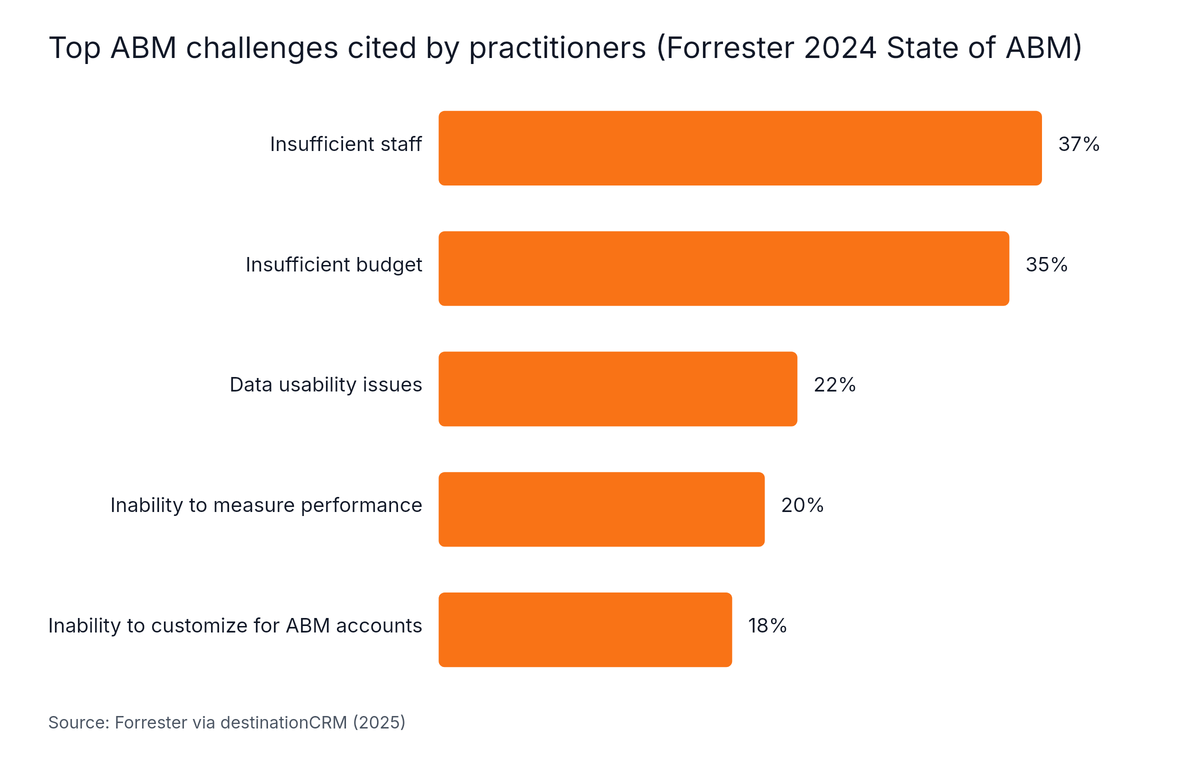
The same survey lists the challenges practitioners name most. Insufficient staff leads at 37%, followed by insufficient budget at 35%, data usability issues at 22%, inability to measure performance at 20% and inability to customize for ABM accounts at 18% (Forrester via destinationCRM, 2025). Measurement and customization are alignment problems as much as resource problems.
Source: Forrester via destinationCRM, 2025
ABM is now mainstream, which raises the cost of getting this wrong. Nearly 80% of surveyed organizations are executing ABM and 47% integrate demand generation with ABM (Demand Gen Report, 2026). Most teams also work without heavy tooling. Two-thirds treat ABM as a core go-to-market alignment motion, yet only 22% run it on a dedicated ABM platform (N.Rich, 2025). Most work from LinkedIn, a CRM and spreadsheets. That survey has 107 respondents and is vendor-published. Agreement has to live in documents and routines, not software.
Air cover is marketing activity, such as ads, content and events, aimed at a named account list so sales conversations start warmer. It fails when the two teams have not agreed the buying group or the pipeline definitions first. Forrester names the cause: "Misalignment across marketing, sales, and ABM limits effectiveness" (Forrester, 2026).

Air cover is a common trigger for an ABM program, and the request usually arrives with a list and a deadline. Marketing should hold the launch until four items are written down:
Forrester's 2024 survey found lack of sales buy-in is a named top challenge for 18% of ABM practitioners, and 20% cite inability to measure performance (Forrester via destinationCRM, 2025). Both are what air cover without agreement produces.
If the campaign is live, pause new spend on the weakest tier rather than the whole program. Hold one working session with sales to confirm the roles and the stage definitions. Then restate last month's results on those definitions. Accounts that look engaged under marketing's definition often look quiet under sales' definition. That gap is the finding. It is worth reviewing with the analysis of why 600 engaged accounts produce zero SQLs.
A buying group is the set of people at one target account who influence, evaluate or approve a purchase. For ABM, define it by naming the roles that count as coverage. Forrester's 2026 research reports 13 internal stakeholders and nine external influencers in a typical decision (Forrester, 2026), counted separately, not summed.

Published counts differ because surveys define the group differently. Gartner's May 2025 survey of 632 buyers gives a range of five to 16 people across up to four functions. It also found 74% of buyer teams in "unhealthy conflict" (Gartner, 2025). Choose one definition and apply it to every account.
| Role | Question it answers | Coverage signal |
|---|---|---|
| Economic buyer | Is there budget and priority? | Meeting held or sponsor named |
| Champion | Who will argue for it internally? | Repeat contact with sales |
| Technical evaluator | Does it work in our stack? | Trial, demo or technical call |
| Security and legal | Can it pass review? | Review request opened |
| Procurement and finance | What are the terms and cost? | Introduced before late stage |
In verticals with heavy ABM use, such as cybersecurity and FinTech, security and compliance reviewers often join the group. Name them in the role list from the start.
Buying group size grows with contract value. These are published ranges from GrowthSpree (2026), with no stated sample.
| Deal size (ACV) | Stakeholders | Sales cycle |
|---|---|---|
| $25K to $100K | 5 to 8 | 49 to 84 days |
| $100K to $250K | 7 to 10 | 84 to 126 days |
| $250K to $1M | 10 to 15 | 126 to 180 days |
The same published ranges put procurement in 62% to 78% of US enterprise deals and 85% to 94% of Indian enterprise deals. Late-stage surprises usually mean nobody reached security, finance or procurement early.
Audit findings (GrowthSpree, June 2026): A LinkedIn audit of 56 accounts and $9.4M in ad spend found decision-makers received 33% of budget against a target of 60% or more. Non-buying job functions caused 30% of wasted spend, and individual contributors and entry-level staff consumed 36%.
Those figures bear directly on role coverage. Budget that reaches analysts and entry-level staff never reaches the economic buyer, security or procurement. A buying group definition without a matching targeting rule changes nothing. The best-practices guide to ABM for B2B SaaS covers the wider program.
Sales and marketing should share account-to-opportunity rate (the share of target accounts producing an opportunity) and pipeline per account. Agreed thresholds bridge engagement to them: buying group roles engaged, meeting held, opportunity created. Each threshold has an owner and a target. Only 26% of teams call their ABM program successful (N.Rich, 2025).

Write these definitions into the CRM so both teams report from the same fields. Set the thresholds per account tier and review them after one full sales cycle.
| Stage | Agreed definition | Owner | Rule |
|---|---|---|---|
| Engaged | A set number of buying group roles engaged | Marketing | Reported, never a goal on its own |
| Meeting held | Seller meets at least one role | Sales | Logged within a set number of days |
| Opportunity created | Sales accepts a qualified need | Sales | Counted in account-to-opportunity rate |
| Returned to marketing | No progress after an agreed window | Sales | Account moves down a tier or out |
A marketing qualified account (MQA) is a target account whose engagement has crossed a threshold that both teams agreed in advance. A sales qualified account (SQA) is one sales has accepted and is working, typically after a meeting. The thresholds only help when they are written down and shared.
Holdout accounts are a matched set of accounts that receive no ABM treatment and serve as the comparison group. Pipeline per account in the treated set, set against the holdout set, shows what the program added. The measurement guide for pipeline per target account walks through the setup.
Cost per sales-qualified lead (SQL) gives finance a second check. GrowthSpree (2026, published ranges, no stated sample) sets targets of $1,000 to $3,000 for $15K to $50K annual contract value (ACV) contracts. It sets $3,000 to $8,000 for $50K to $150K, and $8,000 to $20,000 for $150K and above.
A service-level agreement (SLA) is a written commitment stating what each team will deliver, by when, and how it will be checked. For ABM, write it per account, not per lead:
The schedule below is illustrative, not a benchmark. It shows what a pilot on one account tier could review each week, using the stage definitions above.
| Pilot window | Review focus | Decision to record |
|---|---|---|
| Days 1 to 30 | Role map per account, list owner named, stage fields live in the CRM | Which roles count as coverage |
| Days 31 to 60 | Accounts that changed stage, signals with no sales action | Who acts on each signal, by when |
| Days 61 to 90 | Roles engaged versus meetings held, accounts with no progress | Which accounts move down a tier or out |
Each weekly session runs on three questions: which accounts moved, which signals went unanswered, and which list changes have written evidence.
Sales teams ignore a target account list when they did not help build it, cannot see why accounts are on it, or cannot work its size. Lists of 500 to 2,000+ named accounts are common at companies that should run 100 to 300 (GrowthSpree, 2026; practitioner view, no sample stated).

The same source recommends tier sizes. Treat them as published ranges, not as a standard.
| Tier | Recommended size | Treatment |
|---|---|---|
| 1:1 | 10 to 50 accounts | Bespoke content and outreach per account |
| 1:few | 50 to 200 accounts in 5 to 15 clusters | Content per cluster |
| 1:many | 200 to 500 accounts | Programmatic tactics |
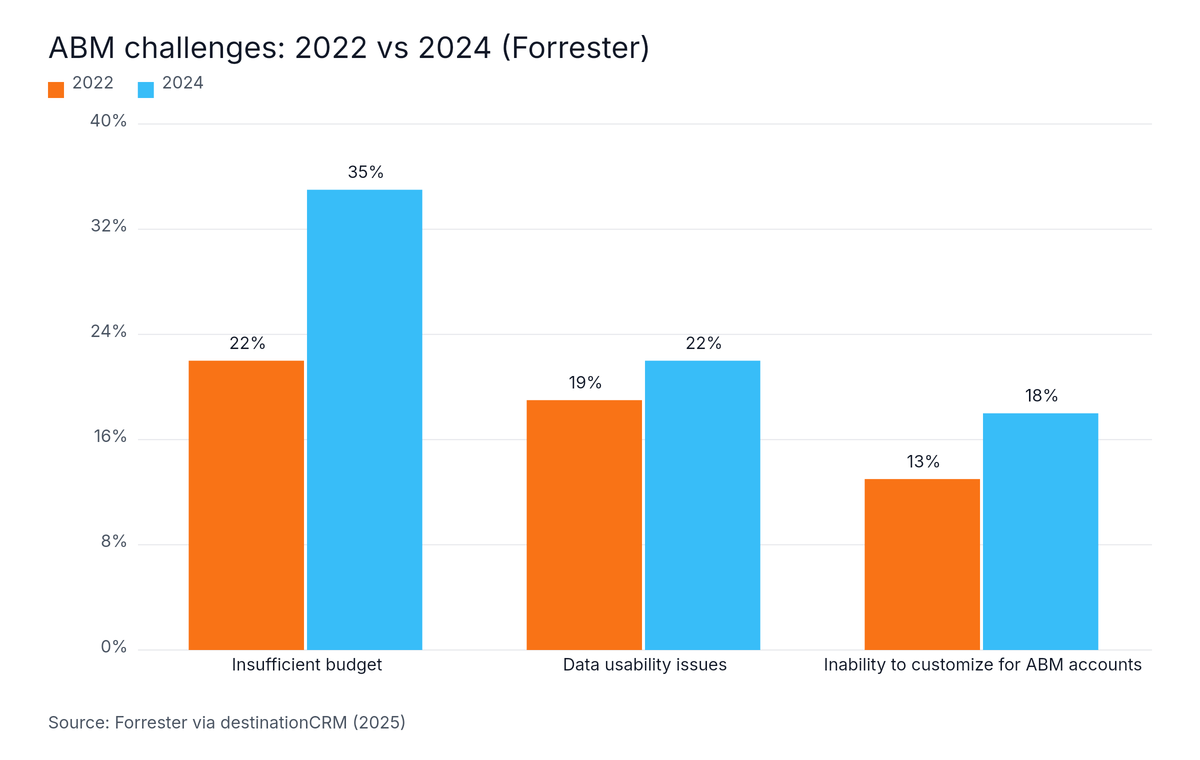
Resourcing is where lists break. Insufficient budget rose from 22% of practitioners in 2022 to 35% in 2024. Data usability issues rose from 19% to 22%, and inability to customize for ABM accounts from 13% to 18% (Forrester via destinationCRM, 2025).
Source: Forrester via destinationCRM, 2025
Reps trust a list when changes follow rules. Set these:
Fit comes first. An ideal customer profile (ICP) built from closed-won accounts keeps the list from becoming a market map.
ABM for B2B SaaS guidance holds that account-based marketing typically pays only when annual contract value (ACV) exceeds $15K and at least one seller works named accounts. Below that, formal sales and marketing alignment is not worth the overhead. Staffing is the most common limit: 37% of ABM practitioners cite insufficient staff (Forrester via destinationCRM, 2025).
Three limits apply:
Align sales and marketing in an ABM program by writing down four decisions before launch: who owns the target account list, which buying group roles count as coverage, what pipeline events mark progress, and what sales does when an account crosses a threshold. Then review accounts together weekly and judge results on pipeline per account.
A typical B2B buying decision involves 13 internal stakeholders and nine external influencers in Forrester's 2026 research, counted separately. Gartner's May 2025 survey of 632 buyers gives a range of five to 16 people across up to four functions. The counts differ because the surveys define the group differently, so choose one definition and keep it.
An account-based marketing service-level agreement should include marketing deliverables per account tier, sales actions on named signals with an owner and a deadline, the stage definitions that move an account from engaged to pipeline, and a weekly review cadence. It should also say who may add, remove or re-tier accounts and on what evidence.
Sales and marketing should review ABM target accounts together weekly during launch and the first full sales cycle, using a short agenda: accounts that changed stage, signals with no action, and requested list changes. Weekly reviews catch coverage gaps in the buying group while there is still time to act on them.
Alignment is a short set of written decisions, not a shared mood. Five points to take away:
For attribution once several touches hit one account, read crediting pipeline across channels. To test your own list and definitions with an outside view, Meet with an expert. A free consultation. Bring your target account list and brainstorm the next step with an ABM expert.
Written by
Ishan Manchanda
Ishan Manchanda is co-founder of GrowthSpree, a B2B SaaS marketing consultancy founded in 2017 that has managed $60M+ in ad spend across 300+ B2B SaaS companies. He focuses on demand generation, go-to-market strategy and pipeline growth, and has been featured in Silicon Valley Times, SaaS Mag and the Unbounce podcast.