Request a quote and our experts will contact you within 24 hours with tailored solutions and pricing.
Last updated: Oct 19, 2026
Demand Generation for B2B SaaS: What It Covers and Where ABM Fits
ABM for B2B SaaS Editorial Team - Last updated 13 October 2026
Editorial note: ABM for B2B SaaS is an independent publication. Content is produced by the editorial team and reviewed against named sources. Every figure in this article names its source. Ranges without a stated sample are labeled as published ranges. No platform is recommended by default.
Demand generation for B2B SaaS is the set of marketing programs that build awareness, interest, and intent across a defined buyer audience, covering content, SEO, paid media, and outbound sequences, with the goal of creating a pipeline of potential buyers before they contact a vendor.
Here is the structural problem that surfaces at Series A and later. A demand generation program optimised for lead volume tends to attract companies too small to buy at the target deal size. When the first $50,000 or $100,000 contracts appear in the pipeline, the channel mix, the metrics, and the account qualification logic all need to change. That is where account-based marketing (ABM) enters the picture. This page defines what B2B SaaS demand generation covers, at what annual contract value (ACV) ABM becomes the right complement, and how the channel mix and measurement model should shift as a company moves upmarket.
Key Takeaways
B2B SaaS demand generation covers awareness, consideration, and intent across a broad buyer audience. Account-based marketing (ABM) is the named-account layer applied where ACV makes multi-stakeholder investment worthwhile.
The ACV threshold where ABM begins to pay is approximately $25,000. Below $15,000, the cost of account-level outreach typically exceeds the contract return.
Buying committees are larger than most programs assume. Forrester's State of Business Buying 2026 raised the typical B2B buying group to 22 people (13 internal, 9 external).
Pipeline generated is the primary metric for 62% of B2B SaaS marketing teams (Benchmarkit / Emergence Capital, 2025). Engagement scores are not a substitute.
Published ranges indicate common ABM lists run 500 to 2,000 or more named accounts at companies that should run 100 to 300 (GrowthSpree, June 2026; published ranges, no sample stated).
What Is Demand Generation for B2B SaaS and How Does It Differ from ABM?
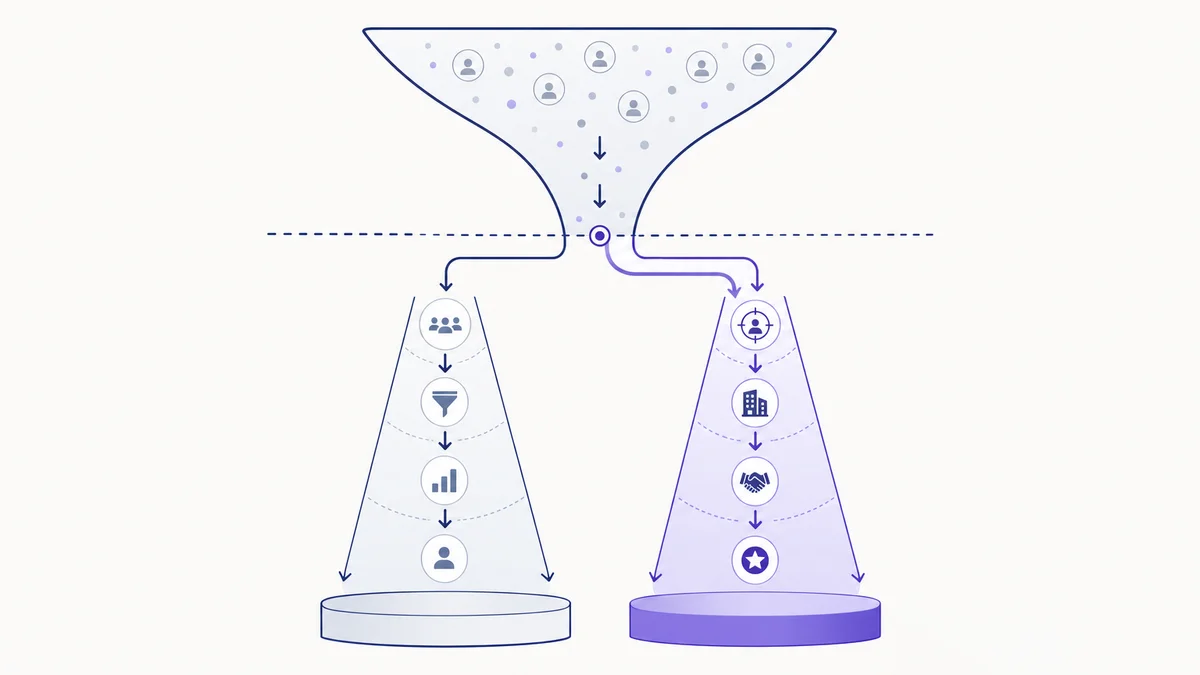
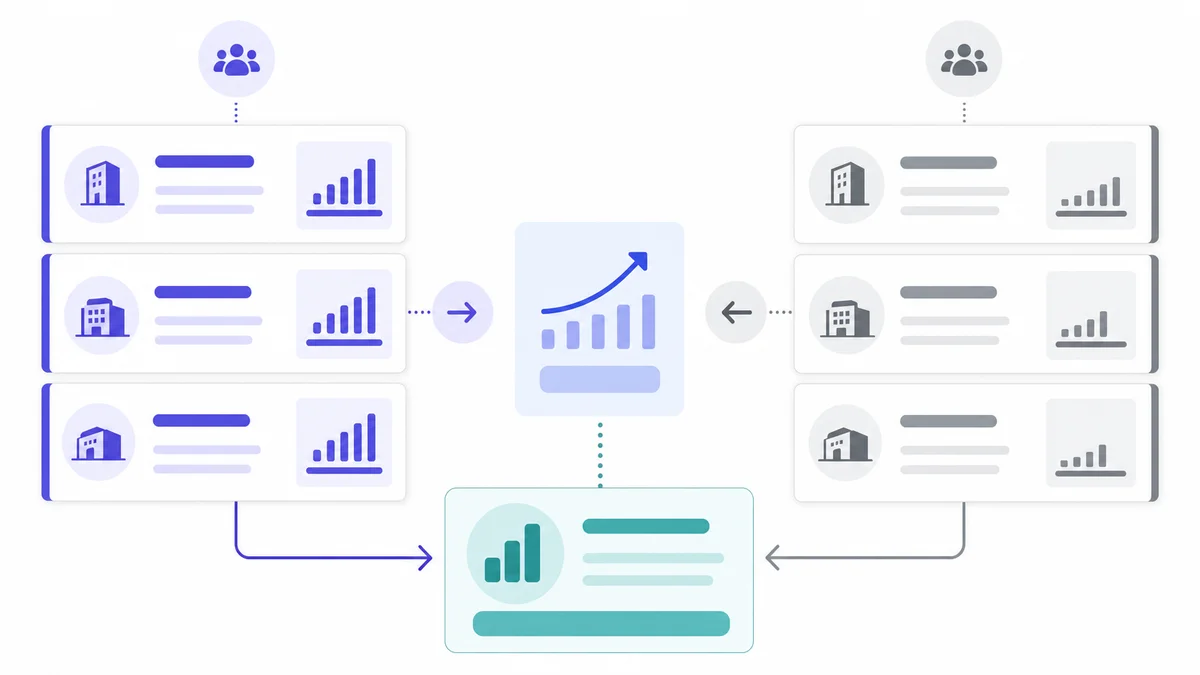
Demand generation for B2B SaaS is the set of marketing programs that build awareness, interest, and intent across a defined buyer audience, covering content, SEO, paid media, and outbound sequences. Account-based marketing (ABM) is the named-account layer applied where annual contract value (ACV) makes multi-stakeholder investment worthwhile. Most B2B SaaS companies run both, with ABM concentrated on the accounts with the highest deal-size potential.
Split funnel diagram separating broad demand generation from named-account ABM at the $25K ACV threshold
Demand generation is any coordinated set of marketing activities designed to build awareness and preference in a defined market. It asks: how many qualified buyers entered the pipeline?
Account-based marketing (ABM) is a go-to-market approach that selects a specific list of named companies as target accounts. It coordinates outreach across the whole buying group at each account. It measures success on account-to-opportunity conversion and pipeline per account. It asks: how many target accounts became opportunities?
That distinction matters at Series A and later. Broad demand generation fills the top of the funnel. ABM concentrates resources on the accounts where deal size justifies the cost of multi-stakeholder outreach.
A 2025 survey of 75 B2B SaaS demand generation leaders found that 78% of practitioners say the function has fundamentally changed over the past three years, with 46% citing revenue alignment as the primary driver (Demand Loops, 2025). That accountability pressure pushes teams toward account-level metrics and, eventually, account-based marketing.
How ABM and Demand Generation Work Together
Most B2B SaaS companies do not choose between demand generation and ABM. They run demand generation across the broader market while applying ABM to the highest-fit accounts. Think of it as two concentric circles: demand generation creates the outer ring of market awareness; ABM concentrates resources on the inner ring.
"The question for 2026 isn't whether to do ABM, but how to do it exceptionally well." (Twelfth Agency, 2026)
At What Deal Size Does ABM Make Sense Alongside Demand Generation?
Account-based marketing (ABM) alongside demand generation makes financial sense for B2B SaaS companies when annual contract value (ACV) reaches approximately $25,000. Below $15,000, the cost of multi-stakeholder reach per account typically exceeds the contract return. Buying-group-level ABM targeting achieves 2 to 3x higher win rates than lead-centric targeting, based on an analysis of 429,634 ad campaigns (Piperocket.digital, August 2026).
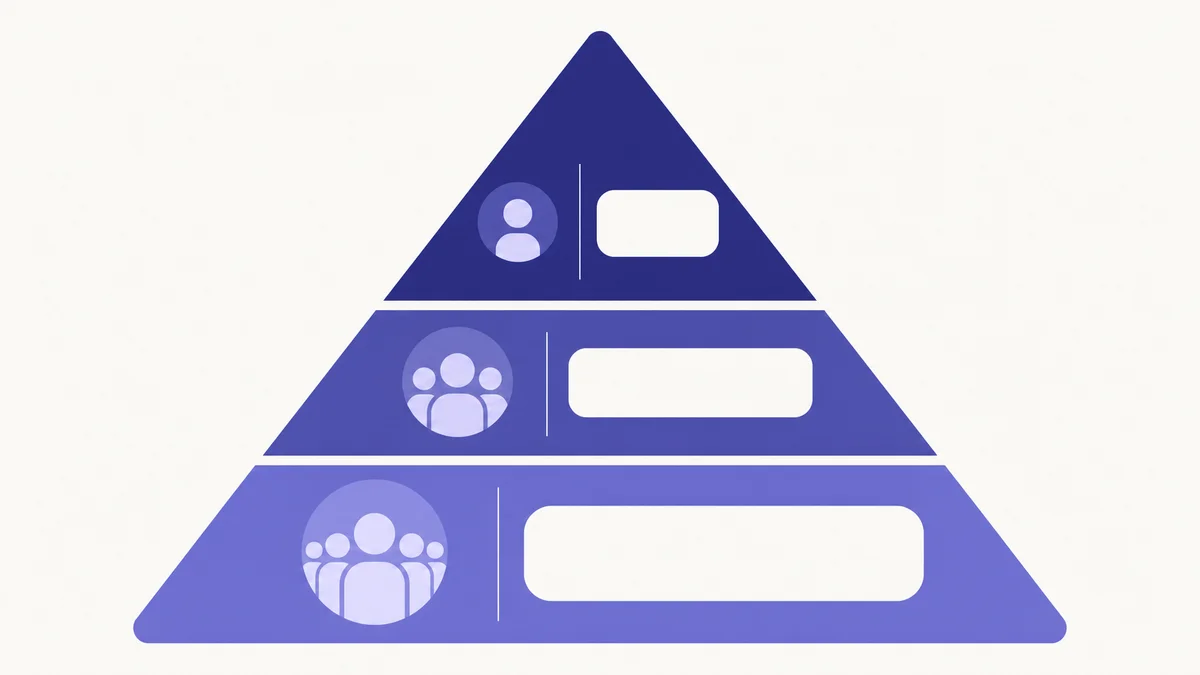
Three-tier ABM account pyramid showing 1:1, 1:few, and 1:many tier sizes with account count ranges
The deal-size threshold matters because ABM spending per account is fixed regardless of list size. LinkedIn clicks for B2B SaaS run $8 to $25 by vertical (GrowthSpree LinkedIn Audit, June 2026; no public URL; no sample stated). When a deal is worth $10,000, paying $15 per click to reach five stakeholders across 50 accounts rarely produces a positive return. When a deal is worth $150,000, the same cost structure is defensible.
GrowthSpree SQL Benchmarks (April 2026; no public URL; no sample stated): Target cost per sales-qualified lead (SQL) is $1,000 to $3,000 for $15K-$50K ACV contracts. For $50K-$150K ACV contracts, the target rises to $3,000 to $8,000. For contracts above $150K, the target is $8,000 to $20,000.
ACV Bands and Recommended Marketing Mix
ACV Band
Recommended Mix
Target Cost per SQL
$15K to $50K
Search + LinkedIn + entry ABM
$1,000 to $3,000
$50K to $150K
Multi-channel ABM + search
$3,000 to $8,000
$150K and above
Full ABM + branded search + display
$8,000 to $20,000
Source: GrowthSpree SQL Benchmarks, April 2026; no public URL; no sample stated.
The $25K ACV mark is the practical inflection point. Below it, broad demand generation with tight ideal customer profile (ICP) targeting is usually more efficient. Above it, buying committee size and sales cycle length make ABM economics viable.
What Does B2B SaaS Marketing Look Like for a Company Moving Upmarket From Self-Serve?
When a B2B SaaS company moves upmarket from self-serve, the marketing motion must shift from lead volume to account fit. Content and SEO continue as the awareness layer. The channel mix expands to LinkedIn matched-account campaigns and sales development representative (SDR) sequences that marketing coordinates. The ideal customer profile (ICP) tightens, excluding companies too small to reach target ACV, and the primary metric shifts from marketing-qualified leads to pipeline per target account.
Self-serve to enterprise is the transition a B2B SaaS company makes when it adds a sales motion to what was previously a product-led growth (PLG) model. It targets larger accounts that require vendor evaluation, buying-committee sign-off, and negotiated contracts.
The signals that this transition is underway are recognisable. Inbound leads arrive from companies too small to buy at the new target price. Sales asks for account-specific air cover. The first $50,000 or more contracts appear alongside ten smaller ones.
Four Things That Must Change at Once
ICP compression. The ideal customer profile (ICP) narrows to the firmographic bands that close at the target ACV. Leads from companies below a revenue or headcount threshold exit the scoring model.
Channel reallocation. Budget shifts from broad audience targeting toward account-specific reach. Spend on content syndication reduces; spend on LinkedIn matched-company campaigns increases.
Buying-group coverage. Outreach must reach multiple roles at each target account. A program built around a single persona misses the economic buyer, procurement, and security evaluators who appear at later deal stages.
Metric redesign. Marketing-qualified lead (MQL) volume gives way to account-to-opportunity rate as the headline metric. The question changes from "how many leads did marketing generate?" to "how many target accounts became opportunities?"
Sales and marketing spend runs at 47% of revenue at VC-backed SaaS companies as of the 2025 median, converging near 33% for companies above $100M ARR (Benchmarkit via Webtonic, 2025). The upmarket transition is the point where that spend demands more deliberate allocation between demand creation and demand capture.
How Does the Buying Committee Affect B2B SaaS Demand Generation?
The buying committee in B2B SaaS deals is larger than most demand generation programs assume. Forrester's State of Business Buying 2026 raised the typical B2B buying group to 22 people, 13 internal and 9 external (Forrester via EndataSite, 2026). Published ranges show 5 to 8 stakeholders at $25K-$100K deals, rising to 10 to 15 at $250K-$1M deals (GrowthSpree, published ranges, no sample stated).
Horizontal bar chart of buying-group stakeholder counts by B2B SaaS deal size band
A demand generation program that reaches one persona per company addresses one member of a group that, at $250,000 or more deals, numbers between 10 and 15 people. The champion your content reached may be genuinely enthusiastic. Procurement, security, finance, and the economic buyer still have to say yes.
Buying Committee Size by Deal Size
Deal Size
Stakeholders
Sales Cycle
Procurement Involvement (US)
$25K to $100K
5 to 8
49 to 84 days
62% to 78%
$100K to $250K
7 to 10
84 to 126 days
62% to 78%
$250K to $1M
10 to 15
126 to 180 days
62% to 78%
Source: GrowthSpree, published ranges, no sample stated. Indian enterprise deals: 85% to 94% procurement involvement.
The practical implication: content strategy must address the questions of all committee roles, not only the end user. Channel strategy must reach the economic buyer and procurement. Those roles often do not respond to the same content or channels as practitioners.
GrowthSpree LinkedIn Audit (June 2026; 56 accounts, $9.4M in ad spend analyzed; no public URL; no sample stated): Decision-makers received only 33% of LinkedIn ad budget against a target of 60% or more. Non-buying job functions caused 30% of wasted spend. Individual contributors and entry-level staff consumed 36% of budget. 20% of spend reached firms under 50 employees.
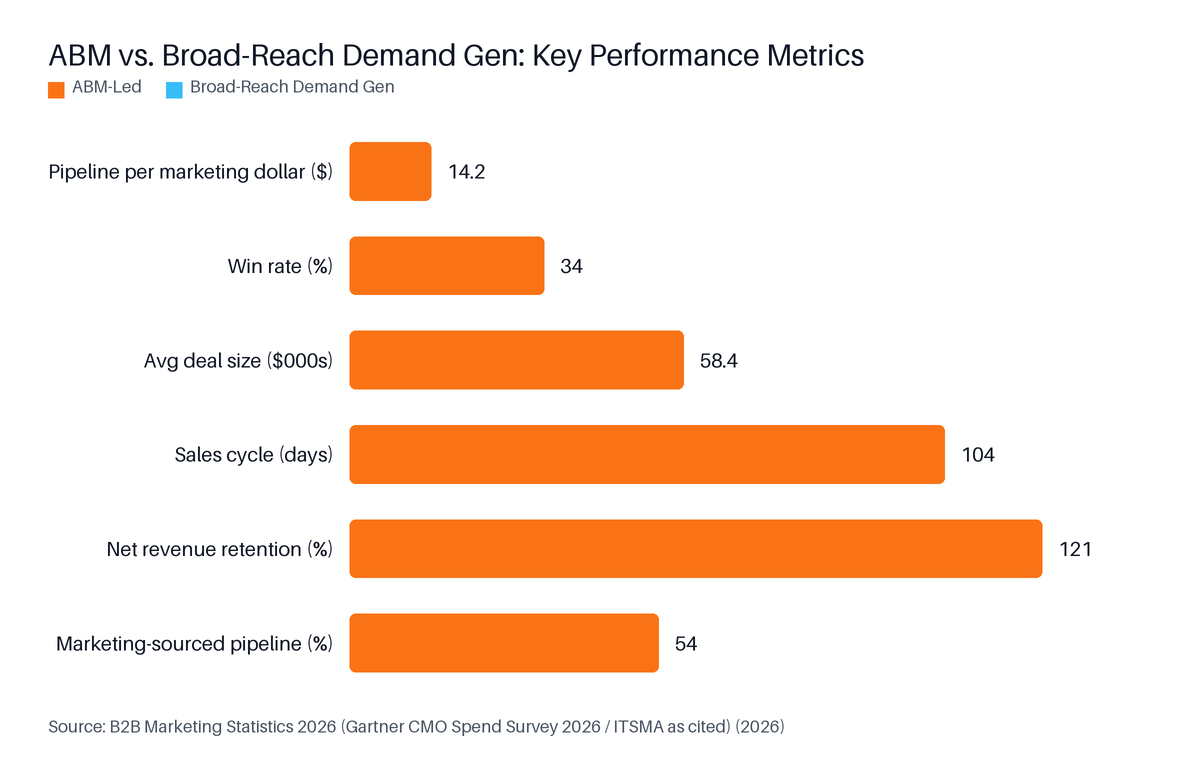
Horizontal Bar chart: ABM vs. Broad-Reach Demand Gen: Key Performance Metrics. Highest: Net revenue retention (%) at 121.
What Does B2B SaaS Content Marketing Involve at a Strategy Level?
B2B SaaS content marketing at a strategic level means mapping content to buying-committee roles, not only to search volume. A pillar-and-spoke architecture anchors authority on key topics. Supporting content addresses the distinct questions of economic buyers, technical evaluators, and end users. Buyers reach vendors at 61% of their journey, so most evaluation happens before first contact (6sense via Webtonic, 2025 Buyer Experience Report). Content absent from that window does not reach buyers when it matters.
B2B SaaS content marketing is the practice of creating and distributing content to build market awareness, educate buying-committee members, and support sales at named target accounts across a full enterprise buying cycle.
Three decisions come before writing a word:
Who is the content for? Each piece maps to a buying-committee role: the economic buyer evaluating ROI, the technical evaluator assessing security and integration, the end user evaluating usability.
What stage of the journey does it serve? Pre-awareness content that shapes category thinking differs from late-stage content addressing procurement objections.
How is it distributed? Ungated content on well-indexed pages serves the dark funnel. Gated content captures contact details but misses the 61% of buyer research that happens before first vendor contact.
Forrester's State of Business Buying 2026 found that 94% of business buyers now use AI during their buying process (Forrester via EndataSite, 2026). Pre-contact brand presence is now a primary demand generation lever. If a product does not appear in AI-generated answers to buying-stage questions, it may not reach the shortlist before the shortlist forms.
Content Mapped to Buying-Committee Roles
Buying-Committee Role
Primary Question
Content Type
Preferred Format
Distribution Channel
Economic buyer
What is the ROI and business risk?
Business case, benchmark report
Long-form article, one-pager
LinkedIn, executive events
Technical evaluator
How does it integrate, and is it secure?
Integration guides, security docs
Technical docs, comparison page
SEO, direct outreach
End user
Will this make my job easier?
Product walkthroughs, use-case posts
Video, short article
SEO, product newsletter
Procurement
What are the contract terms and vendor risks?
Vendor FAQ, compliance summary
PDF, structured FAQ page
SDR email, direct mail
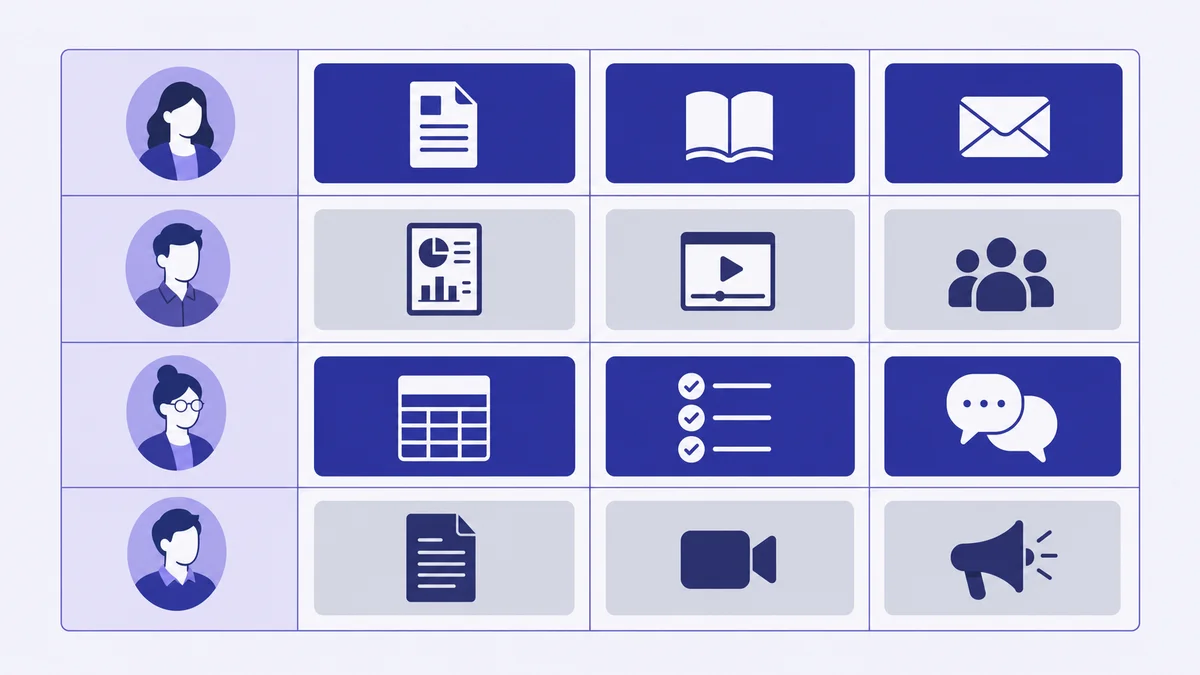
Content matrix grid mapping buying-committee roles to content type, format, and distribution channel
How Should B2B SaaS Teams Measure Demand Generation and ABM on Pipeline?
Pipeline generated is the primary metric for 62% of B2B SaaS marketing teams, ahead of opportunities generated at 51% and new ARR bookings at 36%, per Benchmarkit's 2025 survey (Benchmarkit / Emergence Capital, 2025). For ABM specifically, the right metrics are account-to-opportunity rate and pipeline per target account, compared against holdout accounts that received no ABM treatment. Engagement scores are activity metrics. They do not demonstrate contribution to revenue.
B2B Software and SaaS companies spend 11.4% of revenue on marketing, the highest of any tracked industry per Gartner's CMO Spend Survey 2026 (via DigitalApplied, 2026). Yet 59% of CMOs say their budget is insufficient to execute their strategy (Gartner 2025 CMO Spend Survey, via OmniBound, 2025). That gap makes pipeline attribution the decisive internal argument.
The Three Metrics That Actually Matter
Holdout accounts are a matched set of accounts that receive no ABM treatment, held as a control group. Pipeline from ABM-treated accounts, compared against the holdout group over the same period, isolates ABM's contribution from baseline market activity.
Account-to-opportunity rate is the percentage of target accounts that convert into a sales opportunity within a defined period. Tracked by account tier (1:1, 1:few, 1:many), it shows which level of investment produces returns.
Pipeline per target account is the total pipeline value attributable to a named account over a rolling window. Divided by the cost of reaching that account across all channels, it produces a cost-per-opportunity figure the board can evaluate.
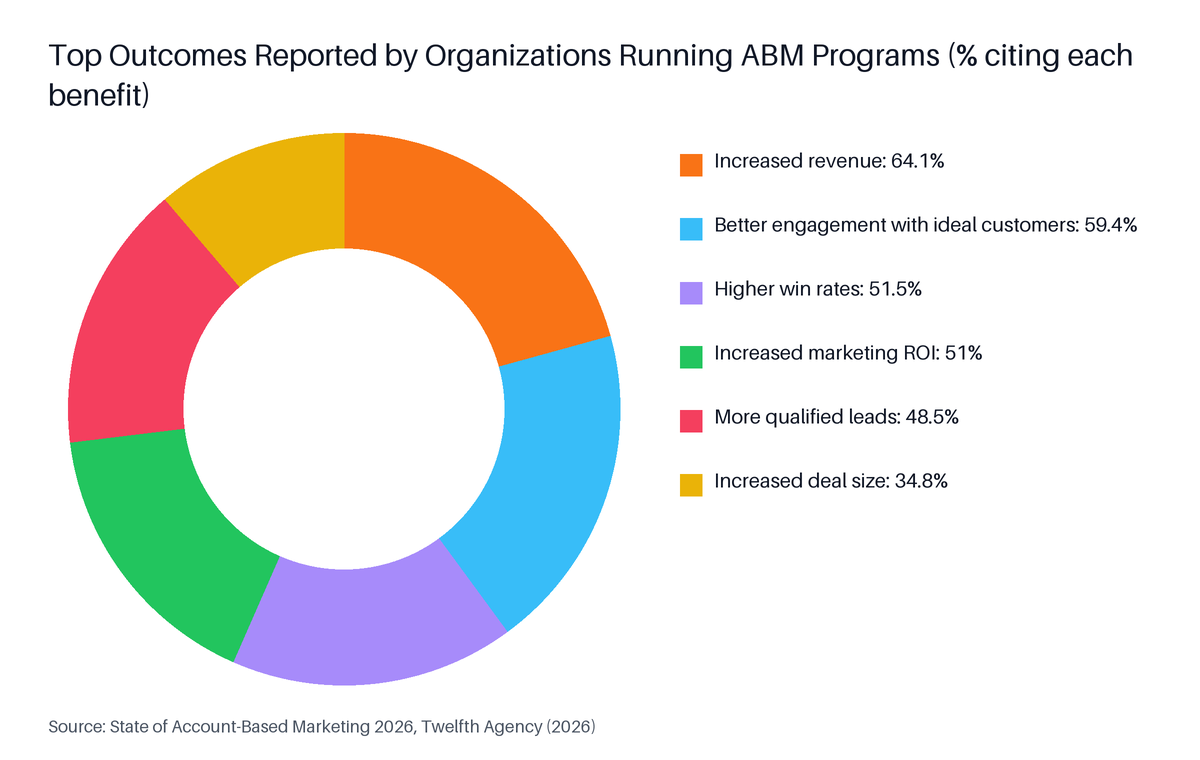
Donut chart: Top Outcomes Reported by Organizations Running ABM Programs (% citing each benefit). Highest: Increased revenue at 64.1%.
Sales cycle length sets the minimum evaluation window. Published benchmarks: 49 to 84 days for $25K-$100K deals, 84 to 126 days for $100K-$250K deals, and 126 to 180 days for $250K-$1M deals (GrowthSpree, published ranges, no sample stated). Evaluating ABM on pipeline before at least one full sales cycle completes will produce misleadingly low numbers.
Pipeline measurement model comparing ABM-treated target accounts against holdout accounts showing pipeline lift
When Is ABM Alongside Demand Generation Not Worth It?
Account-based marketing (ABM) is not worth adding when ACV is below $15,000, when no seller works named accounts, or when the target account list exceeds what the team can sustain. Published ranges indicate common ABM lists run 500 to 2,000 or more named accounts at companies that should run 100 to 300 (GrowthSpree, June 2026; published ranges, no sample stated). Every program must justify its cost against pipeline produced.
Sales and marketing spend runs at 47% of revenue at VC-backed SaaS companies as of the 2025 median (Benchmarkit via Webtonic, 2025). That figure makes efficient allocation between demand generation and ABM a board-level question, not a marketing preference.
Specifically, ABM alongside demand generation is likely the wrong investment when:
ACV is below $15,000. The cost of multi-stakeholder reach per account exceeds the contract value in most verticals.
No sales team works named accounts. ABM requires sales coordination. Without a seller following up on account-level signals, marketing spend on named accounts produces awareness but rarely pipeline.
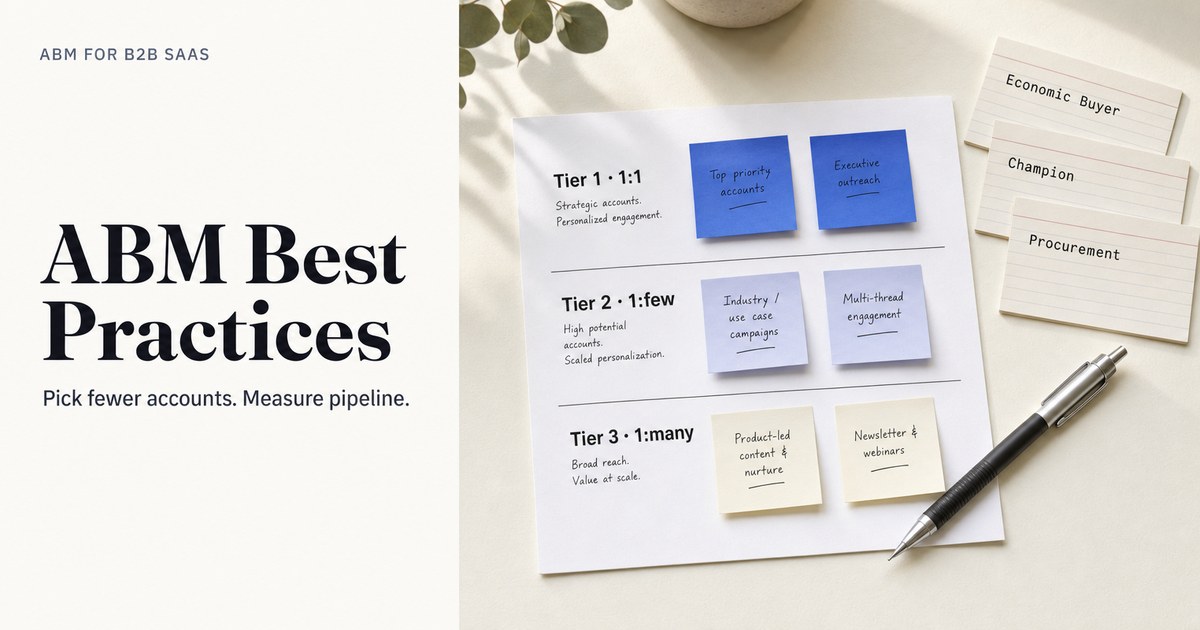
The account list is unmaintainable. Recommended tier sizes are 10 to 50 accounts for 1:1 treatment, 50 to 200 in 5 to 15 clusters for 1:few treatment, and 200 to 500 for 1:many (GrowthSpree, June 2026; published ranges, no sample stated). Lists larger than these tiers spread budget too thin for real treatment.
The ICP is undefined. Without a clear ideal customer profile (ICP), account selection defaults to firmographic guessing. Lists built this way become market maps, not working account sets.
The honest answer to "should we add ABM?" is: only when deal size makes the cost viable, a seller can work the accounts, and the list is small enough to treat properly.
Frequently Asked Questions
What is demand generation for B2B SaaS?
Demand generation for B2B SaaS is the set of marketing activities that create awareness and interest in a product among a defined audience, building a pipeline of potential buyers before they contact a vendor. It includes content marketing, SEO, paid channels, events, and outbound sequences. Unlike lead generation, demand generation focuses on shaping market awareness and category preference, not only collecting contact details.
Which marketing channels work best for B2B SaaS companies running ABM alongside demand generation?
For B2B SaaS companies running demand generation alongside account-based marketing (ABM), the highest-pipeline channels are LinkedIn matched-company advertising, branded and non-branded search, and direct sales outreach coordinated with marketing sequences. LinkedIn reaches buying groups at named accounts but requires tight exclusions: across 56 audited accounts, individual contributors and entry-level staff consumed 36% of LinkedIn budget (GrowthSpree LinkedIn Audit, June 2026; no public URL; no sample stated). SEO and content underpin awareness before any paid channel engages.
What does B2B SaaS growth marketing include and where does ABM fit in the mix?
B2B SaaS growth marketing includes the full range of activities from top-of-funnel awareness through retention and expansion: SEO, paid acquisition, product-led growth loops, lifecycle email, and customer marketing. Account-based marketing (ABM) fits as the targeted layer applied to the highest-value account tier, where the cost of multi-stakeholder outreach is justified by annual contract value (ACV) above roughly $25,000.
What does B2B SaaS marketing look like for a company moving upmarket from self-serve?
For a B2B SaaS company moving upmarket from self-serve, marketing must shift from volume metrics to account-level metrics. SEO and content continue to build awareness, but the channel mix adds LinkedIn matched-account campaigns, SDR sequences coordinated with marketing, and buying-group coverage across multiple stakeholder roles. The ideal customer profile (ICP) tightens to exclude companies too small to reach the target annual contract value (ACV).
What does B2B SaaS content marketing involve at a strategy level?
B2B SaaS content marketing at a strategic level means mapping content to buying-committee roles, not only to search volume. A pillar-and-spoke architecture anchors authority on core topics; supporting content addresses the distinct questions of economic buyers, technical evaluators, and end users. Ungated content builds trust across the 61% of the buyer journey that happens before vendor contact, per the 6sense 2025 Buyer Experience Report.
Which demand generation channels produce the best pipeline for B2B SaaS companies?
For B2B SaaS companies, branded and non-branded search captures in-market demand most efficiently. LinkedIn reaches buying-group members at named accounts. Content-driven SEO builds awareness before intent signals appear. Pipeline generated is the primary metric for 62% of B2B SaaS marketing teams (Benchmarkit / Emergence Capital, 2025). Channel effectiveness depends heavily on annual contract value: higher ACV justifies more expensive account-specific reach.
Conclusion
B2B SaaS demand generation and account-based marketing (ABM) are not competing approaches. They are tools applied at different deal sizes and different account-list sizes. Demand generation builds market awareness and fills the pipeline across a broad audience. ABM concentrates that effort on a defined list of named companies where deal size justifies the cost of reaching the whole buying group.
The practical guidance is direct. Run demand generation across your market. Add ABM when ACV reaches $25,000 or above and a seller is working named accounts. Keep the account list to a size the team can sustain: 100 to 300 accounts for most teams, tiered into 1:1, 1:few, and 1:many treatments. Measure on pipeline per target account and account-to-opportunity rate, not engagement scores. Compare results against holdout accounts. Evaluate after at least one full sales cycle.
If the first enterprise contracts have appeared in the pipeline and inbound leads are arriving from companies too small to buy, the next step is defining the target account list with the right firmographic and intent filters.
A free consultation. Bring your target account list and brainstorm the next step with an ABM expert.