lead enrichmenttarget account enrichmentwaterfall enrichment
Lead Enrichment for ABM: Filling Firmographic and Contact Gaps in Target Account Records
Fill firmographic and contact gaps in a 150-account ABM list. Compare lead enrichment approaches by speed, run a 100-contact pilot, and pick what fits.
Request a quote and our experts will contact you within 24 hours with tailored solutions and pricing.
Lead Enrichment for ABM: Filling Firmographic and Contact Gaps in Target Account Records
Lead enrichment is appending missing firmographic, technographic and contact data to a record from outside sources; for 150 target accounts, native CRM fill plus a CSV append is the fastest route.
A list of 150 target accounts with missing contacts forces sales into manual prospecting before account-based marketing (ABM) can start. An agency study puts the median ABM list at 87 accounts (Visionary Marketing, 2026), so 150 is already above average. This guide ranks enrichment approaches by speed of return, shows which data to fill first, and gives a pilot test a small team can run before paying for anything. It builds on the basics of firmographic data.
Key Takeaways
Lead enrichment for a 150-account list works fastest in this order: native CRM fill, a CSV append from one provider, then waterfall or manual research for top-tier accounts.
Account-level firmographic fields should be filled before contact data, because they decide account tier.
In one vendor-run benchmark reported in 2026, a waterfall tool showed only a small coverage edge over the best single source.
A pilot of about 100 known contacts, scored on verified coverage, tests any enrichment provider before purchase.
At least 23% of email lists degrade each year (ZeroBounce, 2026), so contacts need re-verification before each campaign.
By the ABM for B2B SaaS Editorial Team. Last updated October 28, 2026. Sourcing rules are on the Methodology page.
Which lead enrichment approach fills target account gaps fastest?
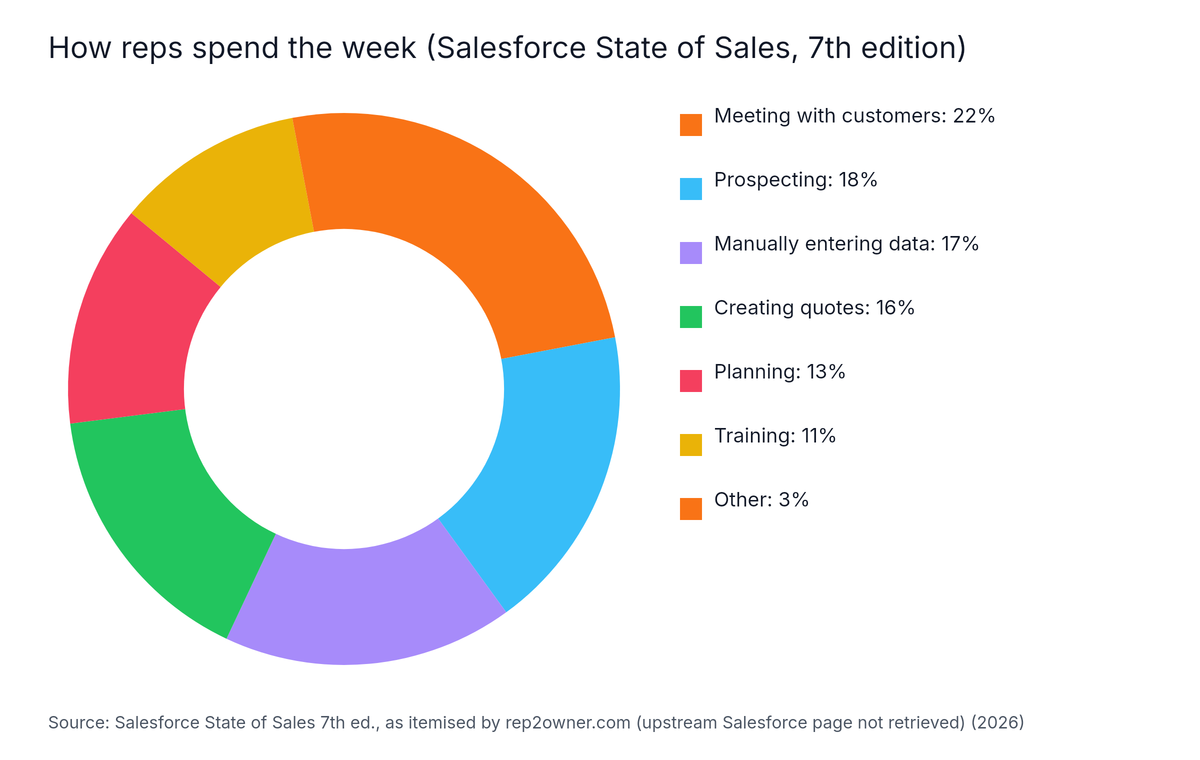
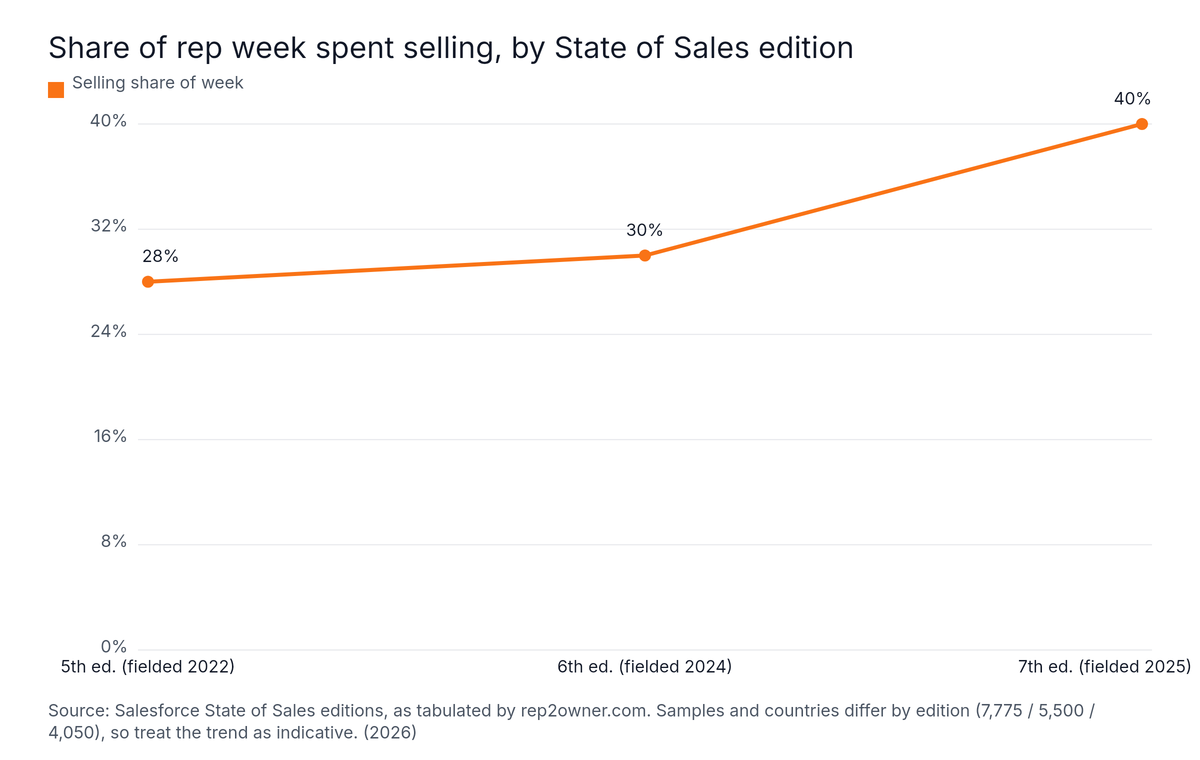
Lead enrichment approaches differ mainly in setup time. For 150 target accounts, the fastest order is native CRM fill, then a CSV append from one provider, then waterfall or manual research. Speed matters because reps spend only about 40% of the week selling, per the Salesforce State of Sales 7th edition (rep2owner.com summary, 2026). The first two return records the same day; the last two take days.
Isometric conveyor carrying account folders past three stations that fill in data cards
The table sequences five approaches. Speed labels are an editorial assessment for a list of this size, not measured results.
Approach
Data it fills
Speed of return (editorial estimate)
Setup effort
Best for
Native CRM enrichment
Firmographics, some contacts
Same day
Low
Teams whose CRM already includes it
CSV append from one provider
Firmographics, emails, titles
Same day to 2 days
Low
Mostly firmographic gaps
Waterfall enrichment
Emails, phones
Days
Medium
Contact gaps after a single pass
Manual research
Buying group roles, context
Days per tier
High, per account
1:1 accounts
No tool, sales-owned fill
Only what reps already know
Immediate, thin
None
Fewer than 50 accounts
Lead enrichment differs from lead scoring: enrichment adds missing fields to a record, while scoring ranks records using fields that already exist. Each row maps to a "choose X when" decision below. Teams weighing paid software can compare it in the ABM platform and software comparison.
Why are target account records incomplete, and what does it cost to leave them that way?
Target account records stay incomplete because CRM data decays and is rarely maintained: in the 2025 survey, 76% of CRM users said less than half of their organization's CRM data is accurate and complete (Validity, 2025). Gaps push sales into manual prospecting, and 37% of those users report losing revenue directly because of poor data quality (Validity, 2025).
Isometric spreadsheet grid with several empty cells highlighted beside a small file cabinet
The Validity survey covered 602 CRM users and administrators in the U.S., U.K. and Australia, so it describes CRM data in general, not ABM lists. The ABM-specific picture is similar: "data quality, accuracy and availability are perceived as the top challenges for ABM in both regions" (Informa TechTarget, 2026).
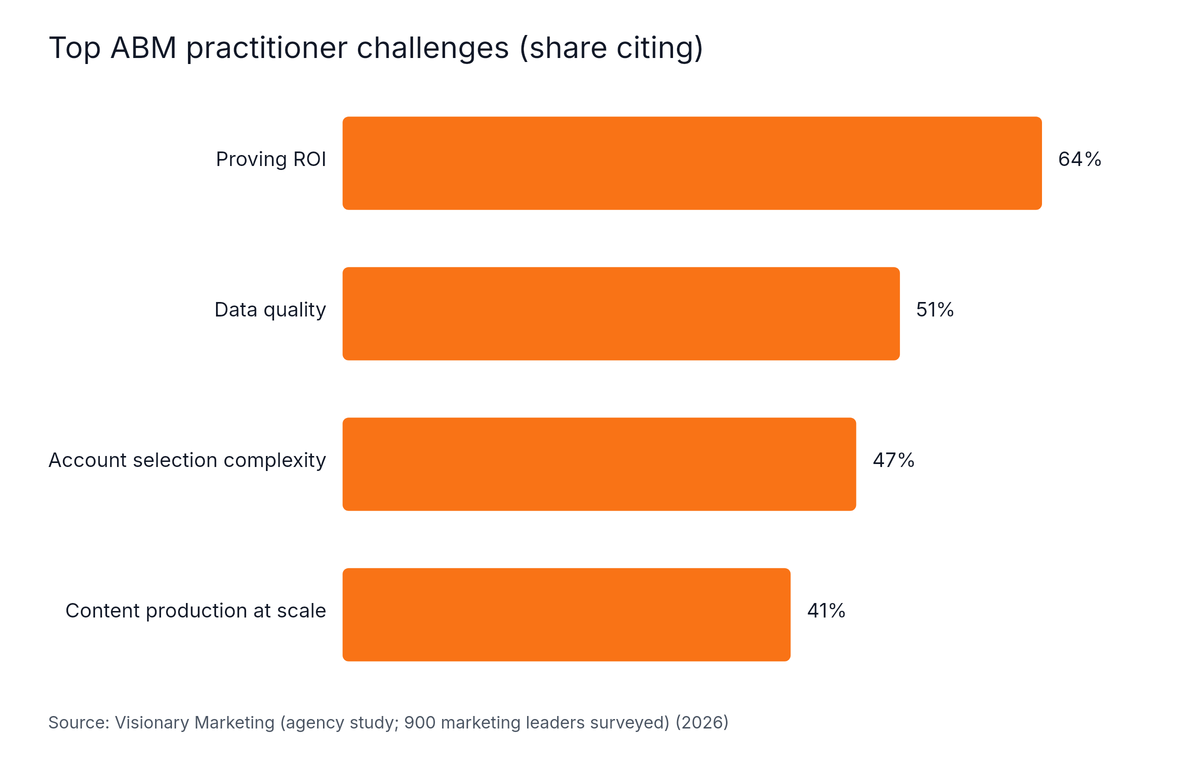
In the agency-run Visionary Marketing study (4,840 accounts plus a survey of 900 marketing leaders), 64% of ABM practitioners cite proving ROI as a challenge, 51% cite data quality, 47% account selection complexity and 41% content production at scale (Visionary Marketing, 2026). Treat it as indicative, since an agency ran it.
Horizontal Bar chart: Top ABM practitioner challenges (share citing). Highest: Proving ROI at 64%.
Manual prospecting costs selling time. In the Salesforce State of Sales 7th edition, reps spend about 40% of the week selling and 60% on non-selling work. Prospecting takes 18% of the week and manual data entry 17%, against 22% for meeting customers (rep2owner.com summary, 2026). The upstream Salesforce page was not retrieved, so these figures come through that secondary summary.
Donut chart: How reps spend the week (Salesforce State of Sales, 7th edition). Highest: Meeting with customers at 22%.
Selling share has risen across editions: 28% in the fifth edition (fielded 2022), 30% in the sixth (2024) and 40% in the seventh (2025). Sample sizes differ by edition, so read the trend as indicative.
Line chart: Share of rep week spent selling, by State of Sales edition. Highest: 7th ed. (fielded 2025) at 40%.
Should you enrich accounts or contacts first for ABM?
Account-level enrichment comes first. Firmographic data is company-level information such as size, industry, region and funding, and it decides which target accounts sit in which account tier. Fill those fields for all 150 companies, then enrich contacts for the top tier, since data quality is a challenge for 51% of ABM practitioners (Visionary Marketing, 2026).
Isometric two-layer stack with company buildings on top and small contact cards beneath
The two data types fail in different ways, which changes how each is filled.
Data type
Typical failure
How to fill
Verification needed
Firmographic (size, industry, region)
Missing or outdated fields
Bulk CSV append or CRM fill
Spot check
Technographic and trigger data
Patchy coverage
Provider append, manual check for tier 1
Spot check
Contact (email, phone, title)
Wrong, stale or catch-all
Provider lookup, then verification
Required before sending
Buying group roles
Single contact per account
Manual research
Human review
How many contacts does each account need?
The number depends on deal size, and the published ranges below carry no stated sample.
Published ranges: BC26 (B2B SaaS Buying Committee Size Benchmarks 2026, GrowthSpree) gives buying groups of 5 to 8 stakeholders in $25K to $100K deals, 7 to 10 in $100K to $250K deals, and 10 to 15 in $250K to $1M deals. These are published ranges, not study findings, and no sample is stated.
Separately, ABM26 (a June 2026 practitioner argument, no sample) says lists of 500 to 2,000+ named accounts are common while 100 to 300 is workable. For 150 accounts at 5 to 8 contacts each, the target is roughly 750 to 1,200 records.
Which enrichment approach should you choose, and when?
The right lead enrichment approach depends on team size, list size and where the gaps sit. A 150-account list is above the median of 87 accounts in an agency study (Visionary Marketing, 2026), so choose native CRM enrichment if your CRM includes it, a CSV append for firmographic gaps, a waterfall for contact gaps, and manual research under 50 accounts.
Isometric branching path with five small stations leading to different doorways
Choose native CRM enrichment when your CRM already includes it. Clearbit now ships inside HubSpot, its free tools closed on 30 April 2025, and its enrichment is included without credits on paid HubSpot plans, according to Keiro Labs (vendor-reported, 2025). Teams outside HubSpot need another source.
Choose a CSV append from one provider when the gaps are mostly company fields. Upload the 150 domains, map the returned columns, and review the result the same day.
Choose a waterfall when a single provider leaves too many contacts blank. Waterfall enrichment is a method that queries several data providers in sequence until one returns a usable record.
Choose manual research when the account is 1:1 or the list is under 50. A person finds the buying group roles that no database lists.
Choose no tool when the list is a single tier that reps already know well.
Meet with an expert. A free consultation. Bring your target account list and brainstorm the next step with an ABM expert. Meet with an expert
Often the gain is small. In a vendor-run benchmark of 14 tools on 5,000 B2B contacts, the one waterfall product measured reached 87.1% coverage against 86.4% for the best single source, with 4.0% false positives against 0.9% (Cleanlist, 2026). The reporting page notes that no independent party has tested the vendors on the same input.
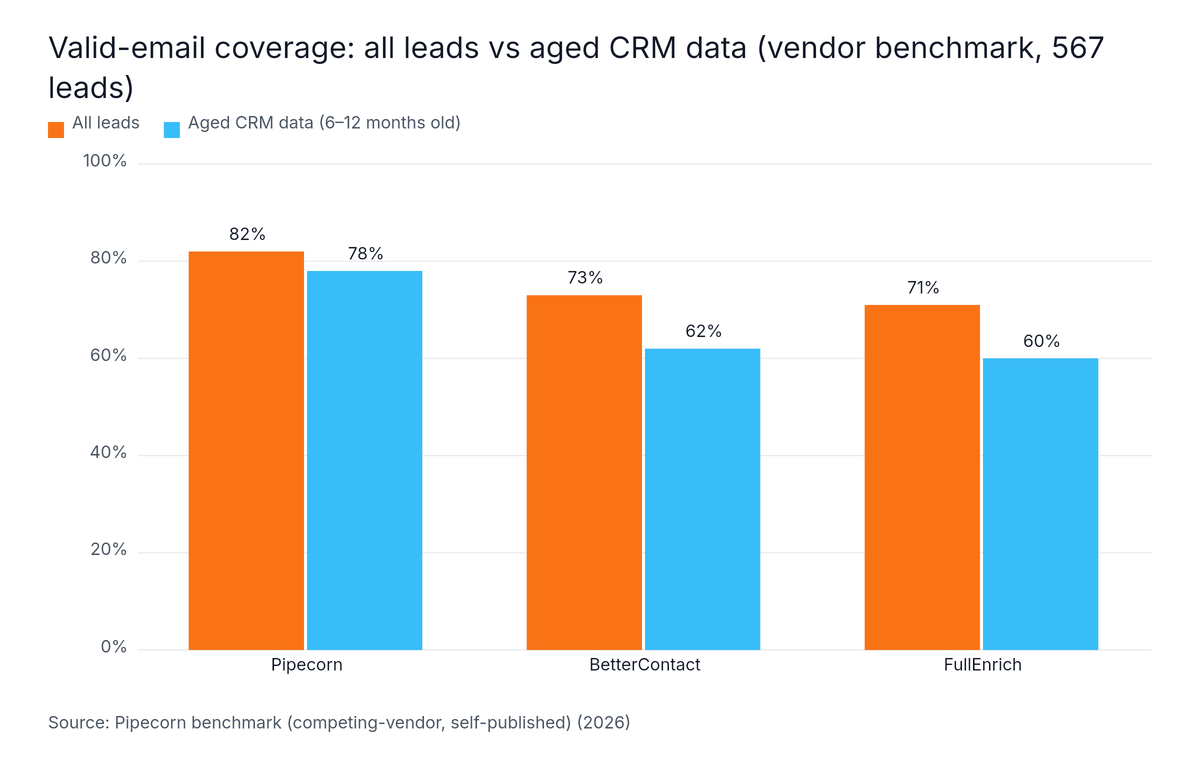
A second vendor benchmark of 567 B2B leads shows how freshness affects results. Valid-email coverage on aged CRM data (6 to 12 months old) was 78% for Pipecorn, 62% for BetterContact and 60% for FullEnrich (Pipecorn, 2026). On all leads, the same three tools reached 82%, 73% and 71% (Pipecorn, 2026). A competing vendor ran it, so use it only to see that stale records widen coverage gaps, not to rank tools.
Grouped Bar chart: Valid-email coverage: all leads vs aged CRM data (vendor benchmark, 567 leads). Highest: Pipecorn at 82%.
How do you test an enrichment provider and keep records fresh?
Test an enrichment provider by running about 100 known contacts, or one account slice, through the tool and measuring verified coverage, meaning emails that pass verification and are not unconfirmed catch-all addresses, rather than raw match rate. Then re-verify before every campaign send, because at least 23% of email lists degrade each year (ZeroBounce, 2026).
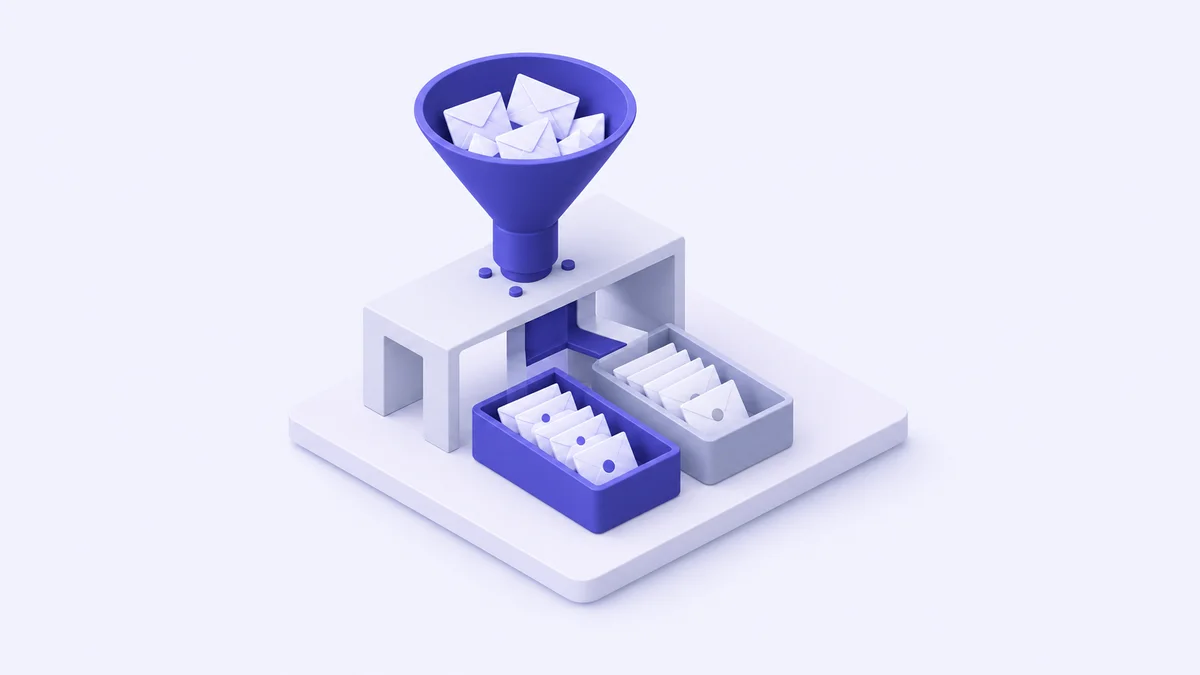
Isometric testing bench with envelopes passing through a filter into two trays
How to run the pilot
Pick 100 contacts whose correct details you already know, or one full account slice.
Run them through the provider and record every returned email and phone.
Verify each email and mark catch-all addresses separately.
Divide verified, non-catch-all results by 100 to get verified coverage, the share of records whose emails pass verification and are not unconfirmed catch-all addresses.
Repeat with a second provider only if the first falls short for your top tier.
A catch-all address is an email address on a domain that accepts all mail, so it can look valid and still bounce. ZeroBounce found 2.6 billion invalid emails and more than 1 billion catch-all addresses in 2025 (ZeroBounce, 2026). A found email is a candidate, not a deliverable address.
How often should you re-enrich or re-verify?
"Nearly one in four email addresses in a company's database becomes invalid or risky within a year" (ZeroBounce, 2026). The share fell from 28% in the prior report to 23%, but the dataset covers all list types and is vendor-held, not B2B-only. No independent current figure exists for B2B contact decay.
A workable cadence for a 150-account list:
Before every campaign send: re-verify the emails for the tier being contacted.
Each quarter: refresh firmographic fields, which change slowly, for the full list.
On a trigger: re-check an account after a funding round or a champion's departure.
Ownership: assign one named owner, in sales or marketing operations, to run each pass.
How much does it cost to enrich 150 target accounts?
Enriching 150 target accounts means roughly 750 to 1,200 contact records at 5 to 8 contacts per account, a range drawn from the BC26 published buying group sizes for $25K to $100K deals. Provider pricing varies, so no single cost holds. Clay's billing split in March 2026 means failed lookups do not consume credits (Orevia News, 2026).
The same report says Clay split billing into Data Credits and Actions on 11 March 2026, and that marketplace data is reported 50 to 90% cheaper. The same workflow can cost more or less depending on design. Use the pilot to price your own list rather than trusting a headline rate.
Cost driver
What to estimate
Why it matters
Record count
150 accounts times 5 to 8 contacts
Sets the number of lookups
Failed lookups
Share of lookups returning nothing
Some tools do not charge for these
Verification
One check per email before sending
Catch-alls need separate handling
Tier depth
Full buying group for tier 1 only
Keeps lower tiers cheap
Staff time
Hours of manual research
Often the largest hidden cost
Fewer contacts for lower tiers keeps spend in line with the 1:1, 1:few and 1:many split. Stop enriching once each tier has a minimum usable record: one verified contact for 1:many, a partial buying group for 1:few, and a full map for 1:1.
Who is lead enrichment for a 150-account list not for?
Lead enrichment for a 150-account target list is not for teams without an agreed ideal customer profile (ICP), because enriching the wrong companies only adds cost. It also fits poorly when the list outgrows the team: ABM26 practitioner ranges put workable lists at 100 to 300 accounts, yet lists of 500 to 2,000+ are common. Privacy-sensitive regions need legal review.
No agreed ICP: fix the target accounts first. Enriching 150 poor-fit companies produces clean records for deals that will not close, and in the 2025 survey 37% of CRM users already reported losing revenue to poor data quality (Validity, 2025).
Privacy-sensitive regions: UK, EU, India and APAC contacts carry sourcing and retention rules, including GDPR in Europe. This page gives no legal advice.
Thin sales coordination: enriched contacts only help if a seller or sales development representative (SDR) owns the follow-up. Data quality is a challenge for 51% of ABM practitioners (Visionary Marketing, 2026), and clean data without an owner decays again.
Frequently Asked Questions
What is the fastest way to fill missing contacts for a short list of target accounts?
The fastest way to fill missing contacts for a short list of target accounts is to use enrichment built into your CRM, then run a CSV append through one data provider for the gaps that remain. Both can return records the same day. A multi-provider waterfall or manual research takes days, so reserve them for the top account tier.
Is waterfall enrichment worth it for a small list?
Waterfall enrichment is usually not worth it at first for a small list. A vendor-run benchmark reported by Cleanlist in 2026 found only a small coverage edge over the best single-source tool, with more false positives. Start with one provider and add a second only if a pilot of about 100 contacts shows gaps.
What happened to Clearbit, and what replaces it?
Clearbit now ships inside HubSpot: its free tools closed on 30 April 2025, and its enrichment is included without credits on paid HubSpot plans, according to Keiro Labs (vendor-reported, 2025). Teams that do not use HubSpot need another source, and a CSV append from one provider is the closest same-day substitute.
How does GDPR affect enriching contacts at UK and EU target accounts?
GDPR applies when you enrich contacts at UK and EU target accounts, so document a lawful basis such as legitimate interest, where the data came from, and how long you keep it. Rules differ by country and by provider. This site gives no legal advice, so confirm the approach with counsel before sending.
How do you check an enrichment provider's real match rate before buying?
To check an enrichment provider's real match rate before buying, run about 100 contacts whose correct details you already know through the tool and measure verified coverage, meaning emails that pass verification and are not unconfirmed catch-alls. Raw match rate overstates results, because catch-all addresses look valid but can still bounce.
Conclusion
Lead enrichment for a 150-account list is a sequencing problem, not a tooling contest. Fill the gaps in order of speed, and stop once the top tier has usable records.
Start with native CRM fill, then one CSV append.
Enrich account fields before contacts, and contacts for the top tier first.
Add a waterfall only if a pilot shows a real coverage gap.
Verify every email and flag catch-all addresses before sending.
Name an owner and re-verify before each campaign.
Next step: run the 100-contact pilot this week, then launch the first campaign on the tier that passes. Once pipeline starts to form, best practices for B2B SaaS ABM cover what to build next.
Written by
Ishan Manchanda
Ishan Manchanda is co-founder of GrowthSpree, a B2B SaaS marketing consultancy founded in 2017 that has managed $60M+ in ad spend across 300+ B2B SaaS companies. He focuses on demand generation, go-to-market strategy and pipeline growth, and has been featured in Silicon Valley Times, SaaS Mag and the Unbounce podcast.
 Ishan ManchandaNov 10, 2026