Blog
Attribution Models for B2B SaaS: What Each Measures and Where It Fails
Attribution models compared by deal size, sales cycle and buying group. What first-touch, last-touch, U-shaped and W-shaped each measure and where they fail.
Define a target account list, score accounts on fit and intent, size each tier to your team's hours and cut a 500-name list to one you can sustain.
 Ishan ManchandaNov 10, 2026

Attribution models compared by deal size, sales cycle and buying group. What first-touch, last-touch, U-shaped and W-shaped each measure and where they fail.
Published ranges for splitting B2B SaaS marketing budget across ABM, demand generation, and brand, with sources, sample status, and a tier-first method.
Fix account based marketing LinkedIn targeting: measure waste, exclude non-buyers, cover the buying group and scale from 50 to 200 target accounts.
Request a quote and our experts will contact you within 24 hours with tailored solutions and pricing.
Last updated: Nov 10, 2026
By the ABM for B2B SaaS Editorial Team. Last updated October 28, 2026. Sources and ranges are explained on the Methodology page.
A target account list (TAL) is the named set of companies an account-based marketing (ABM) program focuses its sales and marketing effort on, chosen by fit and intent and sized to the team that works it. Most teams get the last part wrong. Lists built from gut feel or sales requests swell to 500 or 2,000+ names that three people cannot work. Learning how to build an ABM target account list means fixing that: define the list, pick accounts on evidence, and size it from team hours. This guide gives a six-step build, a worked hours-to-accounts example, an illustrative scoring model, a way to negotiate with sales, and a refresh cadence. It sits within the wider set of account-based marketing best practices for B2B SaaS.
Key Takeaways
- A target account list is the named set of companies an ABM program works on, and it should be sized to team hours, not to market size.
- The median list in a 2026 agency study held 87 accounts, and top programmes kept lists 23% smaller than the median (Visionary Marketing, 2026).
- Target account selection works best on fit and intent together, with exclusion rules and a check that several buying group roles are reachable.
- Sales selection led list building at 70% in an October 2025 survey (Demand Gen Report, 2025), so a shared scoring rule and a tier cap keep the list from growing unchecked.
- A target account list should be refreshed at least quarterly, with set rules for moving accounts between tiers.
A target account list is the named set of companies that an account-based marketing (ABM) program works on directly, instead of marketing to a broad audience. Sales and marketing share the list, tier it by treatment, and measure pipeline per account against it. The median list in a 2026 study of 4,840 accounts held 87 accounts (Visionary Marketing, 2026).
That figure comes from one agency's 47 client portfolios, analysed from January 2024 to February 2026, so treat it as directional.

| Concept | Question it answers | Typical form |
|---|---|---|
| TAM | How many companies could buy? | A count, often thousands |
| ICP | What kind of company buys and stays? | A written description, not a count |
| Target account list | Which named companies do we work now? | A short, named list, sized to team hours |
For example, a TAM of 8,000 companies might yield a list of 150 (an illustrative figure, not a benchmark). Treating the TAM as the list is the most common sizing mistake.
Building an ABM target account list takes six steps: define the ideal customer profile, pull candidate companies, remove poor-fit exclusions, score the rest on fit and intent, tier the survivors, and cap each tier at what the team can work. In an October 2025 survey, 66% of teams used firmographic criteria and 58% used intent (Demand Gen Report, 2025).

The order matters. Exclusions before scoring keep intent signals from making a poor-fit company look attractive.
A small ABM team designs its target account list backward from capacity: divide the monthly hours available for each tier by the hours one account needs, and the result is the account count. In a 2026 agency study, 1-to-1 programmes averaged 8 accounts, 1-to-few 78 and 1-to-many 840 (Visionary Marketing, 2026).
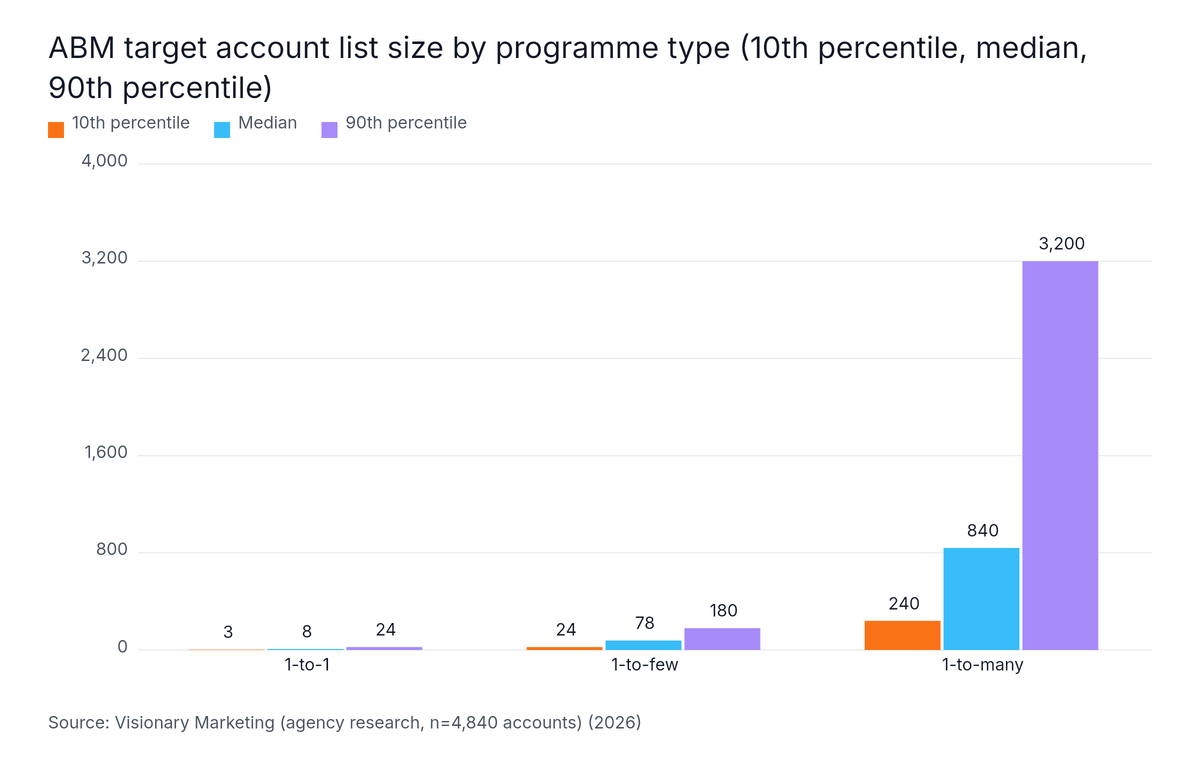
Source: Visionary Marketing (agency research, n=4,840 accounts), 2026
The grouped bar chart shows 10th percentile, median and 90th percentile list sizes by programme type. The lowest values plotted are 3 accounts for 1-to-1, 24 for 1-to-few and 240 for 1-to-many, so the averages of 8, 78 and 840 sit inside a wide spread. Smaller still tends to win: "Top-performing programmes hold their lists 23% smaller than median programmes - focus beats volume." (Visionary Marketing, 2026). Both figures are single-agency data.
Published ranges from 2026, with no stated sample, give the tier sizes below.
| Account tier | Published range | Treatment | Typical owner |
|---|---|---|---|
| 1:1 | 10 to 50 accounts | Bespoke content and outreach per account | Marketer plus named seller |
| 1:few | 50 to 200 accounts in 5 to 15 clusters | Content built per cluster | Marketer plus SDR (sales development representative) |
| 1:many | 200 to 500 accounts | Programmatic ads and email | Automated, reviewed monthly |
Published ranges: Common ABM lists run 500 to 2,000+ named accounts at companies that should run 100 to 300 (practitioner view, 2026, no stated sample).
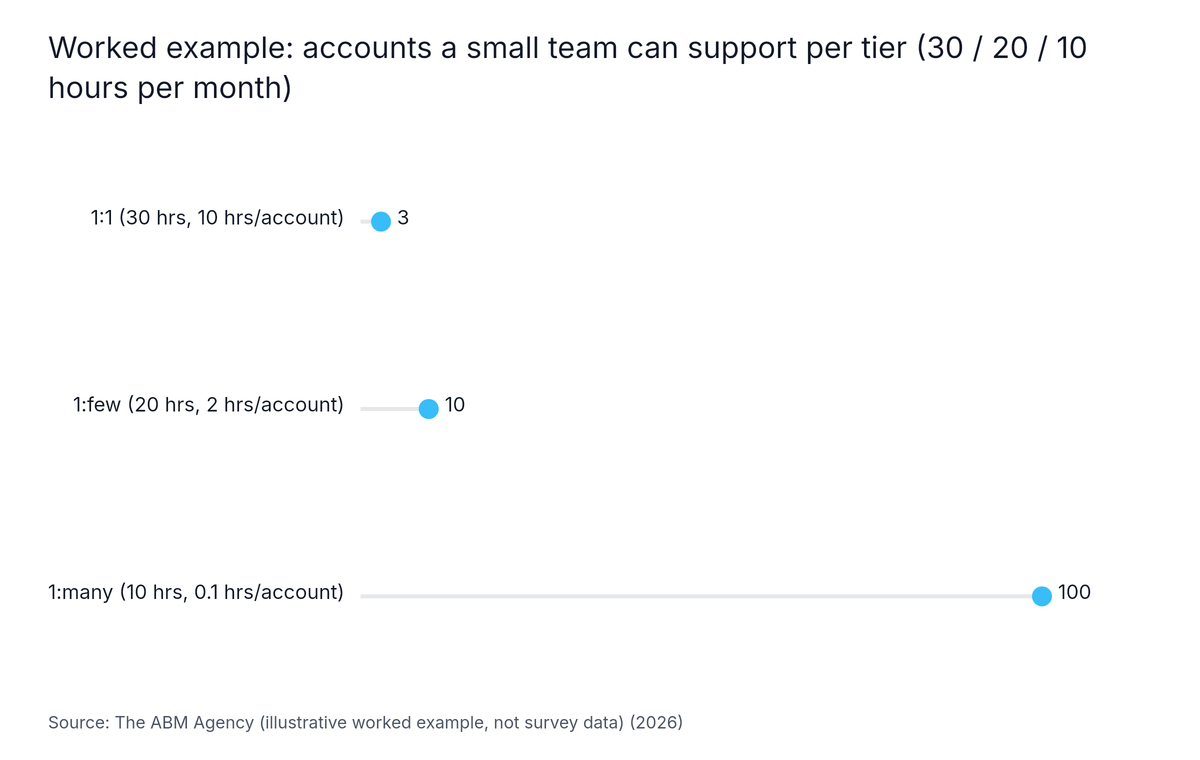
The ABM Agency framed list size by team capacity in October 2026: hours available divided by hours per account per tier. It says a one-to-three person team should run a few 1:1 accounts, a few 1:few clusters and an optional automated 1:many tier. Take a team with 60 hours a month for ABM, split 30, 20 and 10 hours across the tiers:
These per-account hours are illustrative assumptions, not survey data. Replace them with your own.
Source: The ABM Agency (illustrative worked example, not survey data), 2026
The formula is the point. Where ABM automation lowers the hours per account in 1:many, that tier can grow without a new hire.
Target accounts should be selected on fit, meaning how closely a company matches the customers that buy and stay, and intent, meaning signs it is researching a purchase now. Add exclusion rules and a buying group check: a typical purchase involves 13 internal stakeholders and nine external influencers (Forrester, 2026), so an account belongs on the list only if the team can reach several roles.

| Criterion | Type | Example signal | How to use it |
|---|---|---|---|
| Company size and industry | Fit | Employee band, vertical | Hard filter: outside the band means off the list |
| Technology in use | Fit | Complementary or competing tools | Weight high when your product needs an integration |
| Deal size potential | Fit | Estimated ACV (annual contract value) | Decides 1:1 versus 1:few placement |
| Similarity to best customers | Fit | Lookalike of retained accounts | Weight high |
| Topic research | Intent | Searches and content consumption | Promote an account a tier while the signal is fresh |
| First-party activity | Intent | Pricing page visits, repeat visits | Highest-value signal, free to collect |
| Buying triggers | Intent | Funding round, new executive, hiring | Promote and assign an owner |
| Poor-fit segment | Exclusion | Churned profile, low satisfaction | Remove regardless of intent |
Fit is stable. It changes slowly and should drive the first cut. In the October 2025 survey, technographic criteria were used by 52% of teams (Demand Gen Report, 2025), behind firmographic criteria at 66%.
An intent signal is evidence, such as topic research, website visits or review-site activity, that an account may be researching a purchase. Intent-data use rose to 67% of programmes from 32% in 2024, according to the Visionary Marketing 2026 study (Visionary Marketing, 2026). Buyer behaviour explains why: 94% of business buyers report using AI during buying, so much research happens out of vendor view (Forrester, 2026).
Signals decay, and intent should never promote a company that fails the fit filter. Free signals from the CRM, website and hiring or funding news are a sound start before paying for third-party data. Teams comparing paid options can use an ABM software comparison.
The weights and thresholds below are an editorial example for a small team, not sourced benchmarks. Adjust them to your own closed-won history.
| Score component | Points | What earns them |
|---|---|---|
| Fit: size and industry band | 15 | Inside the ICP band |
| Fit: technology | 15 | Complementary stack or integration need |
| Fit: deal size potential | 15 | Estimated ACV above your floor |
| Fit: lookalike of best customers | 15 | Matches retained accounts |
| Intent: first-party activity | 20 | Pricing or product page visits in the last 30 days |
| Intent: topic research | 10 | Third-party research signal in the last 60 days |
| Intent: buying trigger | 10 | Funding, new executive, hiring in the last 60 days |
Three rules sit on top of the score:
Forrester also found that procurement professionals are decision-makers in 53% of business buying cycles (Forrester, 2026). Gartner's May 2025 survey of 632 B2B buyers put buying groups at five to 16 people across up to four functions (Gartner, 2025). Forrester summarises the trend: "Buying groups are growing larger, procurement is becoming more influential, and trials are now essential to reducing risk" (Forrester, 2026).
Published ranges from 2026 on buying committee size, with no stated sample, show how the group grows with deal size:
| Deal size (ACV) | Stakeholders | Sales cycle |
|---|---|---|
| $25K to $100K | 5 to 8 | 49 to 84 days |
| $100K to $250K | 7 to 10 | 84 to 126 days |
| $250K to $1M | 10 to 15 | 126 to 180 days |
The practical test: can the team name and reach several roles at this company? If not, leave it off. As Jeremy Schwartz of Palo Alto Networks put it, "It’s all about adding buying group members with the right titles or more deeply qualifying the existing members with the right titles" (Forrester, 2025).
| Low intent | High intent | |
|---|---|---|
| High fit | 1:few or 1:many nurture, watch for triggers | 1:1 or top 1:few, assign a seller now |
| Low fit | Off the list | Hold in a watch pool, do not spend budget |
Our results: A June 2026 audit of 56 LinkedIn accounts and $9.4M in ad spend (study L26, published by GrowthSpree) found that decision-makers received 33% of budget against a target of 60% or more. Non-buying job functions caused 30% of wasted spend, individual contributors and entry-level staff consumed 36% of budget, and 20% of spend reached firms under 50 employees.
The audit shows why list quality is not enough on its own. A well-chosen list still fails when budget reaches the wrong roles. Write exclusion rules into the list plan on day one: non-buying job functions, entry-level seniority and companies under your employee floor.
Reconcile sales requests with data by running every nominated account through the same fit and intent score the rest of the list faces. In the October 2025 Demand Gen Report ABM Benchmark Survey, sales selection led list building at 70%, so a shared rule, a tier cap and a swap-in, swap-out process matter more than good intentions (Demand Gen Report, 2025).

Sales knows relationships and timing that no database holds. Marketing knows which segments convert. The list needs both. A workable negotiation:
Accounts that stall for a full quarter with no sales activity are first in line for demotion. The ABM measurement approach of pipeline per account then shows which nominations earned their place.
Cut an oversized list by auditing it against the ideal customer profile, scoring every name, and setting a cap per tier before deciding who stays. Published ranges (2026, no stated sample) say common ABM lists run 500 to 2,000+ named accounts at companies that should run 100 to 300, while top programmes hold lists 23% smaller than the median (Visionary Marketing, 2026).

A pilot-first path avoids a political fight:
The pilot gives the team evidence for the cap. Sales cycle length sets the floor for judging it: published ranges from 2026 put it at 49 to 84 days for $25K to $100K deals (no stated sample).
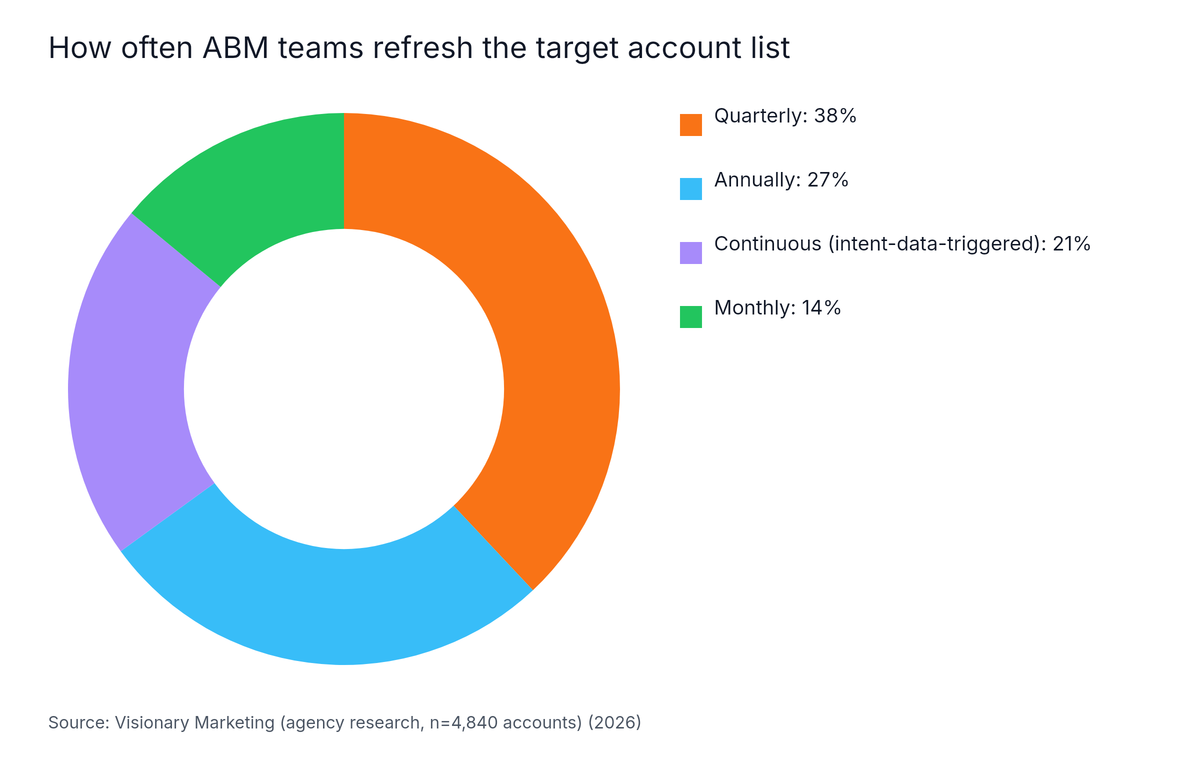
Refresh a target account list at least quarterly, and sooner when intent signals change an account's status. Quarterly is the most common cadence, used by 38% of ABM teams in a 2026 agency study, and continuous, intent-triggered refresh produced a 14% higher closed-won rate than fixed schedules (Visionary Marketing, 2026).
Source: Visionary Marketing (agency research, n=4,840 accounts), 2026
The Visionary Marketing 2026 study splits refresh cadence as quarterly 38%, annually 27% and continuous (intent-data-triggered) 21% of teams, with monthly refresh the least common at 14% (Visionary Marketing, 2026). More than a quarter of teams therefore work a list that is a year old.
Governance keeps refresh from becoming a debate:
Measure the list on account-to-opportunity rate and pipeline per account, not on accounts reached. For multi-touch accounts, ABM attribution explains how to credit channels.
Fit and intent list building suits teams with annual contract value (ACV) above $15K and at least one seller working named accounts; below that, ABM usually does not pay. That threshold is the editorial team's guidance, not a sourced finding. A typical purchase involves 13 internal stakeholders and nine external influencers (Forrester, 2026), which raises the cost of reaching each account.
Other limits to keep in mind:
Build a target account list by defining your ideal customer profile, gathering candidate companies, removing poor-fit exclusions, scoring the rest on fit and intent, and tiering the survivors. Then cap each tier at what your team can work in a month. Have sales review the draft before launch and set a refresh date, since a list that is never revisited decays.
Design the list from your team's hours, not from the size of your market. Divide the monthly hours for each tier by the hours one account needs. A team of one to three people usually supports a few 1:1 accounts, a handful of 1:few clusters and an optional automated 1:many tier. Published ranges suggest most small teams operate lists of 100 to 300.
A target account list is the named set of companies an account-based marketing program focuses on. Sales and marketing use it to direct outreach, advertising and content at the buying group inside each company, tier accounts by the treatment they receive, and measure results as pipeline per account instead of leads or impressions.
Select target accounts on fit and intent. Fit covers firmographics, technology, deal size potential and similarity to your best customers. Intent covers research signals, website visits and buying triggers. Add exclusion rules for poor-fit segments, and keep an account only if your team can reach several roles in its buying group.
A target account list works when it is small enough to run and chosen on evidence. Pick fewer accounts. Reach the whole buying group. Measure pipeline.
Next step: take the current list, count the hours the team really has, and mark every account that fails the fit gate. Then bring the result to a conversation about what to cut.
Meet with an expert: A free consultation. Bring your target account list and brainstorm the next step with an ABM expert.
Written by
Ishan Manchanda
Ishan Manchanda is co-founder of GrowthSpree, a B2B SaaS marketing consultancy founded in 2017 that has managed $60M+ in ad spend across 300+ B2B SaaS companies. He focuses on demand generation, go-to-market strategy and pipeline growth, and has been featured in Silicon Valley Times, SaaS Mag and the Unbounce podcast.
© 2026 ABM for B2B SaaS All rights reserved.