Blog
Attribution Models for B2B SaaS: What Each Measures and Where It Fails
Attribution models compared by deal size, sales cycle and buying group. What first-touch, last-touch, U-shaped and W-shaped each measure and where they fail.
Verdict-first comparison of account based marketing tools: named-account delivery, buying group reach, minimum spend and the no-platform LinkedIn path.
 Ishan ManchandaNov 15, 2026
Attribution models compared by deal size, sales cycle and buying group. What first-touch, last-touch, U-shaped and W-shaped each measure and where they fail.
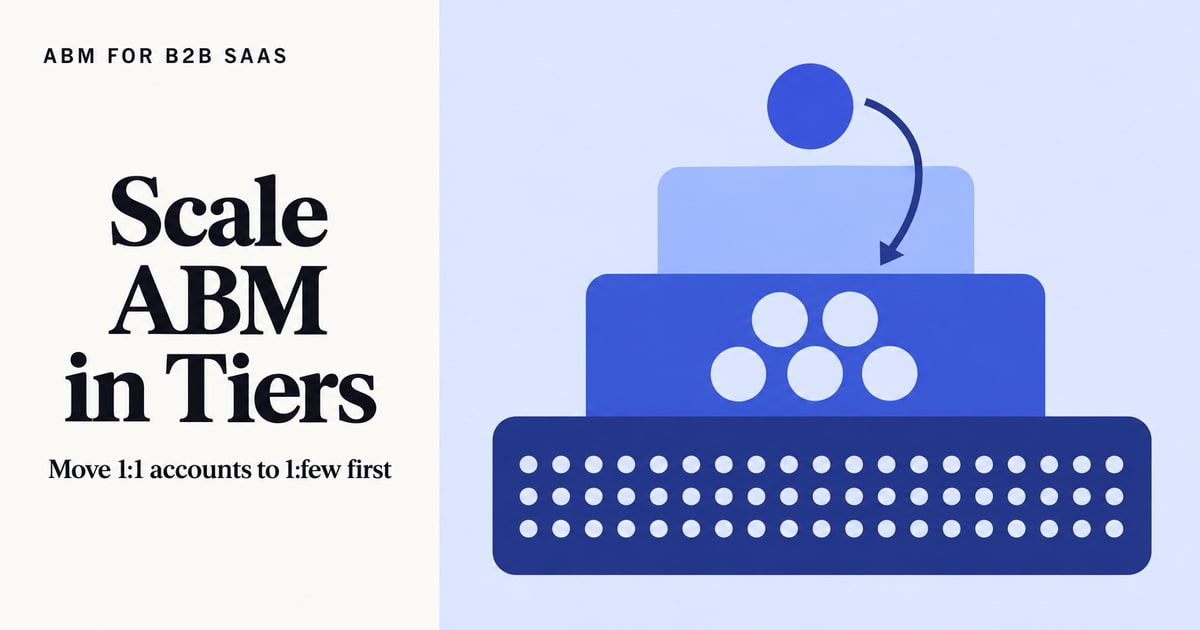
Learn how to scale account based marketing campaigns by migrating accounts from 1:1 to 1:few before 1:many, with triggers, capacity math and metrics.
Build an intent data workflow that ties each signal to a named owner, action and deadline, then judge campaigns on pipeline per account, not clicks.
Request a quote and our experts will contact you within 24 hours with tailored solutions and pricing.
ABM for B2B SaaS
Last updated: Nov 15, 2026
Account-based marketing (ABM) tools are software and channels that restrict ad delivery to named target accounts, reach the whole buying group and let a team prove pipeline per account. This guide ranks the best account based marketing tools for 2025 and 2026 on three tests: named-account reach, buying group depth and minimum viable spend. Most demos prove none of them. The usual trigger is a renewal that arrives when nobody can show what the license produced. The no-platform route of LinkedIn matched lists plus a CRM is always on the shortlist. For the wider checklist, read the ABM platform and software comparison.
Key Takeaways
- ABM tools fall into three paths: full suites, ad-focused platforms, and LinkedIn matched lists plus a CRM. Pick by named-account reach, buying group depth and minimum spend.
- LinkedIn requires a 300-member minimum audience, so a list of about 80 named accounts cannot run alone as a matched audience.
- In a June 2026 audit of 56 LinkedIn accounts, decision-makers received 33% of budget against a target of 60% or more.
- Forrester's 2026 survey puts the typical buying decision at 13 internal stakeholders and nine external influencers.
- A 60 to 90 day pilot against holdout accounts is the fairest test of any ABM platform at renewal.
By the ABM for B2B SaaS Editorial Team. Last updated October 28, 2026. Sources and method are described on the Methodology page.
A small B2B SaaS team should evaluate three paths: a full account-based marketing (ABM) suite such as Demandbase or 6sense, an ad-focused platform such as AdRoll ABM, and LinkedIn matched lists plus a customer relationship management (CRM) system. Choose by named-account reach, buying group depth and minimum spend, remembering that LinkedIn requires a 300-member minimum audience (LinkedIn Help, 2025).

Account-based marketing (ABM) is a go-to-market approach that focuses sales and marketing effort on a defined list of named companies. A matched list is an uploaded company or contact list that restricts LinkedIn ad delivery to those organisations or people. Vendor pricing is mostly quote-based as of October 2026, so no price columns appear here. Confirm features and costs on each vendor's own page and note the date you checked.
| Path | Choose it when | Named-account reach | Buying group depth | Watch for |
|---|---|---|---|---|
| Full ABM suite (Demandbase, 6sense, ZoomInfo) | Deals are large and a team owns orchestration and intent signals | Account lists across several channels | Roles inside accounts | Cost, and an unused dashboard at renewal |
| Ad-focused platform (AdRoll ABM, ABX by DemandScience) | Advertising is the main job and the team is lean | Account lists, display and programmatic | Depends on role filters | Name changes and merger roadmaps |
| LinkedIn matched lists plus CRM | List is short, deal size modest, team of one to three | Uploaded company lists on LinkedIn only | Job function and seniority filters | The 300-member audience floor |
Each line is a decision rule as of October 2026, not a feature claim.
The leading account-based marketing (ABM) platforms differ less on features than on whether they can prove pipeline at renewal. Forrester reports procurement serves as a decision-maker in 53% of buying cycles (Forrester, 2026), so a defensible renewal needs opportunities created at target accounts compared with holdout accounts, not engagement scores alone.
Holdout accounts are target accounts deliberately left out of ABM treatment so their results can be compared with treated accounts. Ask the renewing vendor for three things:
A platform that supplies only engagement scores has not answered the renewal question. The 2026 ABM Benchmark Survey names martech integration and difficulty proving ROI among the barriers teams report (Demand Gen Report, 2026). For the measurement side, see ABM measurement on pipeline per account and why engaged accounts produce zero SQLs.
Market names and owners have shifted, so confirm which product you are renewing. Every row comes from a trade guide, a secondary report, so verify it with the vendor.
| Product | Reported change | Date | Implication |
|---|---|---|---|
| RollWorks | Renamed AdRoll ABM under NextRoll | August 2025 | Review sites split across both names (Ziellab, 2025) |
| Terminus | Merged into DemandScience, now ABX by DemandScience | November 2024 | Evaluate the combined roadmap |
| Qualified | Salesforce announced it would acquire it, with closing expected in early 2026 (Autobound, 2025) | December 2025 | Closing status not verified here; check before renewing |
| Common Room | Reportedly acquired by Zoom, announced 2 July 2026 | July 2026 | Single trade source; pricing and roadmap open |
Test finalists on outcomes a demo cannot fake: delivery, role mix and opportunities. Published ranges from the 2026 B2B SaaS Buying Committee Size Benchmarks (BC26, GrowthSpree; no sample stated) put sales cycles at 49 to 84 days for $25K to $100K deals, so judge pipeline only after a full cycle. Use the same pilot for every vendor:
Check the LinkedIn floor first. With 300 member accounts required (LinkedIn Help, 2025), a small pilot list may need combined lists. For crediting multiple touches, see ABM attribution.
Account-based advertising platforms restrict delivery by serving ads only to companies on an uploaded target account list. LinkedIn Campaign Manager does this with matched lists, but LinkedIn's documentation requires a 300-member minimum audience (LinkedIn Help, 2025), and location can shrink an audience below it. A list of about 80 accounts cannot run alone.

LinkedIn will not serve a company or contact list unless it matches at least 300 members, and the list also needs at least 300 rows to upload (LinkedIn Help, 2025). Its separate upload guidance sets a minimum campaign audience of 300 member accounts and notes that location is a required facet (LinkedIn Help, 2025). LinkedIn's troubleshooting guidance says multiple lists can be combined to reach the minimum. Verify the live pages before relying on them.
When sales asks for air cover on 80 named accounts, two options work:
Programmatic B2B display is automated ad buying that serves banner and similar ads to people at named companies, identified by IP or account data. It suits short lists because it does not share LinkedIn's floor. Ask any vendor how it matches accounts and how it reports delivery by account.
Without role and size exclusions, much account-based advertising budget misses buyers. In a June 2026 audit of 56 LinkedIn accounts and $9.4M in spend, published by GrowthSpree, decision-makers received 33% of budget against a target of 60% or more, and 20% of spend reached firms under 50 employees. Named-account targeting alone does not prevent that.
Audit finding: In the June 2026 audit of 56 LinkedIn accounts and $9.4M in ad spend published by GrowthSpree (L26), decision-makers received 33% of LinkedIn ad budget against a target of 60% or more. Non-buying job functions caused 30% of wasted spend, and individual contributors and entry-level staff consumed 36% of budget.
The same audit puts LinkedIn clicks for B2B SaaS at $8 to $25 by vertical, so every click that reaches a non-buyer is expensive. The table keeps each figure in its own unit.
| Audit finding (L26, June 2026) | Figure | What it measures | Question for a vendor |
|---|---|---|---|
| Decision-makers | 33% (target 60% or more) | Share of total budget received | Can spend be weighted to decision roles? |
| Individual contributors and entry-level staff | 36% | Share of total budget | Can seniority exclusions be set on day one? |
| Firms under 50 employees | 20% | Share of total spend | Is size filtered at list upload or in the audience? |
| Non-buying job functions | 30% | Share of wasted spend, not of total spend | Can job functions be excluded? |

Whether a given vendor filters out firms under 50 employees at list upload or in the audience is not verified here, so check its own documentation. Fit rules belong upstream: build the list from firmographic data so small firms never enter it.
Buying group depth separates account-based advertising platforms once a deal involves ten or more stakeholders. Forrester's 2026 research found the typical decision includes 13 internal stakeholders and nine external influencers (Forrester, 2026). A platform that reaches only the champion at each company misses most of that group, so ask how it reaches roles, not just firms.
A buying group is the set of people inside and around a company who take part in one purchase decision. As Forrester puts it, "The typical buying decision now includes 13 internal stakeholders and nine external influencers, with that number rising for more complex or strategic purchases" (Forrester, 2026). The same analysis notes that "procurement professionals now serve as decision-makers more than half the time (53%) in the average business buying cycle." (Forrester, 2026)
Other figures from Forrester's survey of nearly 18,000 global buyers:
The internal and external counts are reported separately, so do not add them into one committee size. Published ranges from the 2026 buying committee benchmark (BC26, GrowthSpree; no sample stated) show how group size grows with deal size:
| Deal size (BC26) | Stakeholders | Sales cycle |
|---|---|---|
| $25K to $100K | 5 to 8 | 49 to 84 days |
| $100K to $250K | 7 to 10 | 84 to 126 days |
| $250K to $1M | 10 to 15 | 126 to 180 days |

Account-level tools reach a company and the roles inside it, as the large suites do. Contact-level tools serve ads to named individuals. For a 10+ stakeholder group, test whether the tool can build a role map per account tier, and whether it can reach procurement, not just the champion. See acting on intent signals for what to do once roles are reached.
The account-based advertising software market is concentrated at the top but varied below it. Gartner's 2025 Magic Quadrant names three Leaders: 6sense, Demandbase and ZoomInfo (Gartner listing, 2025). Ad-focused platforms, contact-level tools and LinkedIn matched lists do different jobs, so a few suites merit a direct test, but they are not interchangeable.
Gartner published the Magic Quadrant for Account-Based Marketing Platforms on 6 November 2025. 6sense says it ranked highest for Ability to Execute, and Demandbase says it is furthest for Completeness of Vision. Both are vendor claims. Trade coverage of the Forrester Wave for Revenue Marketing Platforms for B2B, Q1 2026, describes the category as moving from traditional ABM platforms toward broader revenue marketing suites (Autobound, 2026). That summary is secondary, so read the report before relying on it.
Treat analyst placement as a way to build a shortlist, not a verdict. It does not show delivery by account, role mix or pipeline on your list, which is what the pilot above measures.
A dedicated ABM platform is not worth it when the named-account list is short, the team is small and the deal size is modest. Published ranges (B26, GrowthSpree, April 2026, no sample stated) put target cost per sales-qualified lead (SQL) at $1,000 to $3,000 for $15K to $50K annual contract value (ACV) deals, so a platform fee must fit that budget.
The same published ranges give other target costs per SQL by ACV band:
| ACV band (B26) | Target cost per SQL |
|---|---|
| $15K to $50K | $1,000 to $3,000 |
| $50K to $150K | $3,000 to $8,000 |
| $150K+ | $8,000 to $20,000 |
Choose LinkedIn plus a CRM when:
Choose a platform when the list outgrows LinkedIn's floor, several channels must be coordinated, or sales needs account-level signals with a named owner. Vendors do not publish a minimum viable spend, so the decision rule is the pilot: ask for a quote against your list and compare it with the LinkedIn path.
Practitioner ranges from the ABM26 article (GrowthSpree, June 2026; no sample stated) say common lists run 500 to 2,000+ accounts where 100 to 300 would be workable. The same source suggests 10 to 50 accounts for 1:1, 50 to 200 in 5 to 15 clusters for 1:few and 200 to 500 for 1:many. Related reading: demand generation and where ABM fits and ABM automation without an ops hire.
Teams commonly evaluate full suites such as Demandbase, 6sense and ZoomInfo, plus ad-focused options such as AdRoll ABM (formerly RollWorks) and ABX by DemandScience. A team with a short account list should also price LinkedIn matched lists plus a CRM, and confirm every feature and price on each vendor's own page.
B2B SaaS teams can choose full account-based marketing suites, ad-focused platforms, contact-level tools such as Influ2, programmatic display partners, or LinkedIn matched lists plus a CRM. The right solution depends on list size, team size and deal size, not on feature breadth.
Shortlist one tool from each path: a full suite, an ad-focused platform, and LinkedIn matched lists plus a CRM. Three finalists tested on one identical list and one holdout set show more than ten demos. Drop any vendor that cannot report delivery by account.
No verified public evidence in the sources reviewed shows which account-based advertising platforms delivered measurable pipeline for B2B SaaS in 2025. Treat vendor case studies as claims. Ask for opportunity creation at treated accounts versus matched holdout accounts, measured on your own list.
Any software that combines a named-account list with job function and seniority filters can do it, including LinkedIn Campaign Manager. The filters matter because defaults leak budget: in a June 2026 audit of 56 LinkedIn accounts, decision-makers received 33% of spend against a 60% or higher target. Ask each vendor for role-level reporting.
Whether a given account-based advertising platform filters out firms under 50 employees is not verified here, so check each vendor's documentation. Ask if size is filtered at list upload or in the audience. The surest control is a target list built from firmographic data so small firms never enter it.
Programmatic B2B display platforms restrict delivery by matching a named-account list to people at those companies, usually by IP or account data. Demandbase and 6sense are described as running their own display networks. Ask any vendor how it matches accounts and how it reports delivery by account.
B2B demand generation teams run account-based advertising through full suites, ad-focused platforms, contact-level tools and LinkedIn Campaign Manager with a CRM holding the account list. Small teams often start with LinkedIn and the CRM, then add a platform once the list outgrows LinkedIn's audience floor.
Beyond the major suites, options include contact-level tools such as Influ2, programmatic display partners, ad-focused platforms such as AdRoll ABM, and native LinkedIn matched lists. Market ownership is shifting, with reported deals involving Terminus, Qualified and Common Room, so confirm each product's current owner before signing.
LinkedIn matched lists combined with a CRM work without a dedicated platform. The CRM holds the account list and opportunity data, while LinkedIn Campaign Manager restricts delivery to uploaded companies. LinkedIn's documentation sets a 300-member minimum audience, so lists of about 80 accounts need combined lists or a platform that serves beyond LinkedIn.
The best account based marketing tools are the ones that prove their work on your accounts. Platform choice follows list size, team size and deal size, and the no-platform path stays on the shortlist.
A free consultation is available. Bring your target account list and brainstorm the next step with an ABM expert: Meet with an expert.
Written by
Ishan Manchanda
Ishan Manchanda is co-founder of GrowthSpree, a B2B SaaS marketing consultancy founded in 2017 that has managed $60M+ in ad spend across 300+ B2B SaaS companies. He focuses on demand generation, go-to-market strategy and pipeline growth, and has been featured in Silicon Valley Times, SaaS Mag and the Unbounce podcast.