Request a quote and our experts will contact you within 24 hours with tailored solutions and pricing.
Account-Based Marketing vs. Inbound Marketing: Which Fits Your B2B SaaS Stage?
Account-based marketing (ABM) is a go-to-market approach that concentrates sales and marketing effort on a defined list of named companies, measuring success on pipeline per account, while inbound marketing is a demand-generation approach that attracts broad audiences through content and organic channels, measuring success on lead volume.
The choice between the two is a budget allocation decision. Inbound fills the top of the funnel with relatively low cost per lead. Account-based marketing targets fewer companies with higher spend per account and coordinates across the entire buying group. Neither is universally better. The right answer depends on your annual contract value (ACV), your sales cycle, and how many stakeholders sit between a first conversation and a signed contract. This page gives you the verdict by deal size so you can make the call without a discovery call.
Key Takeaways
Account-based marketing (ABM) optimises for pipeline per named account; inbound marketing optimises for lead volume across a broad audience.
ABM becomes the stronger investment when ACV exceeds roughly $25K and the deal involves five or more stakeholders.
Inbound and ABM are not mutually exclusive: many B2B SaaS companies run inbound for volume and ABM for their highest-fit named accounts simultaneously.
Sales cycle length is the minimum evaluation window for ABM: published benchmarks run 49-84 days at $25K - $100K ACV and 126-180 days at $250K - $1M ACV (BC26, published ranges, no sample stated).
Oversized target account lists are one of the most common ABM failure modes: lists of 500-2,000+ named accounts are common at companies that should run 100-300 (ABM26, published ranges, no sample stated).
What is the difference between account-based marketing and inbound marketing?
Account-based marketing (ABM) is a go-to-market approach that concentrates sales and marketing effort on a defined list of named companies, measuring success on pipeline and opportunities per account. Inbound marketing is a demand-generation approach that attracts broad audiences through content and organic channels, measuring success on lead volume. ABM is account-first and coordinated across a buying group; inbound is audience-first and pull-based.
Macro close-up of a compass needle pointing between two directions
The two approaches start from opposite assumptions about who should drive the targeting decision.
Inbound marketing lets buyers find you. Content, search engine optimisation, paid amplification, and organic social create assets that surface when a prospect searches for a problem your product solves. The audience is defined by persona and interest, not by a fixed list of companies. The metric is lead volume: how many marketing-qualified leads enter the funnel each month, and at what cost per lead.
Account-based marketing starts with the companies. A defined set of target accounts is assembled before any outreach begins, filtered by fit against an ideal customer profile (ICP). Outreach is then coordinated across the whole buying group at each account. The metric is account-to-opportunity rate: what proportion of target accounts become open sales opportunities, and how much pipeline has been created per named account.
The practical difference is directional. Inbound casts a wide net and converts whoever shows up. ABM selects the fish before it enters the water.
Side-by-side: how ABM and inbound compare across five decision factors
Account-based marketing and inbound marketing differ most sharply on four dimensions: who they target (named accounts versus broad audiences), how they reach buyers (coordinated outreach across a buying group versus pull-based content), what they measure (pipeline per account versus lead volume), and which deal sizes justify their cost. The two approaches can run in parallel, but they serve distinct budget objectives.
Macro photo of stacked paper files fanned out, labels facing up
Decision factor
Account-based marketing (ABM)
Inbound marketing
Who is targeted
Defined list of named companies (target accounts)
Broad audience defined by persona and interest
How buyers are reached
Coordinated outreach across the buying group
Content, SEO, organic and paid distribution
Primary success metric
Pipeline per account, account-to-opportunity rate
Lead volume, cost per lead, MQL conversion
Ideal deal size
ACV above $25K; typically $50K+
Any ACV; strongest ROI at lower price points
Sales coordination required
Yes: SDR and AE alignment is integral
Light: sales picks up qualified leads
Buying group coverage
Explicit: content and outreach target all roles
Incidental: whoever searches finds the content
Measurement approach
Pipeline per target account vs. holdout accounts
Lead volume and funnel conversion rates
Minimum team requirement
At least one seller working named accounts
No seller required for early-stage volume
How the buying group changes the equation
Buying group is the set of individuals at a target account who influence, block, or approve the purchase. At low deal sizes the buying group is small. As ACV rises, so does committee size, and inbound's passive reach becomes insufficient to cover all the roles that matter.
Published ranges from B2B SaaS Buying Committee Size Benchmarks 2026 (GrowthSpree, published ranges, no sample stated) show:
ACV range
Stakeholders involved
Typical sales cycle
$25K - $100K
5 to 8
49 to 84 days
$100K - $250K
7 to 10
84 to 126 days
$250K - $1M
10 to 15
126 to 180 days
When 10 to 15 stakeholders are involved and the cycle runs 126 to 180 days, a passive inbound channel that waits for each of them to find your content is not a reliable strategy. ABM coordinates outreach to every role the deal depends on.
Which motion fits your deal size and sales cycle?
Deal size and sales cycle length are the clearest indicators of which motion to prioritise. Published benchmarks show that $25K - $100K deals involve 5 to 8 stakeholders and run 49 to 84 days; $100K - $250K deals involve 7 to 10 stakeholders and 84 to 126 days; $250K - $1M deals involve 10 to 15 stakeholders and 126 to 180 days (BC26, published ranges, no sample stated). The more stakeholders and the longer the cycle, the stronger the case for account-based marketing.
Macro close-up of a funnel drawn on graph paper with a pencil tip resting beside it
The $15K - $25K ACV zone: run both
At ACV below $15K, inbound typically delivers better returns than ABM. The cost of coordinating across multiple stakeholders per account exceeds the revenue a single closed deal produces. At ACV above $25K, the inverse begins to apply.
Between $15K and $25K, both motions can coexist. Inbound generates volume from the broad market. ABM applies focused effort to the accounts with the highest ICP fit and the largest deal-size potential. This is where many B2B SaaS companies start their first ABM motion without abandoning inbound entirely.
The trigger events that shift the balance
Several situations make ABM the priority regardless of current ACV:
The first $50K+ contracts begin appearing in the pipeline and sales wants air cover on named accounts.
Inbound leads arrive consistently from companies too small to buy at your target deal size.
A funding round sets an enterprise pipeline target the board expects to see filled by a specific date.
Sales is entering a new region with a short list of target accounts and needs outreach before inbound has any reach there.
In each case, the problem is not lead volume. It is pipeline quality at specific named accounts. That is an ABM problem, not an inbound problem.
How does cost per SQL differ between ABM and inbound?
Cost per sales-qualified lead (SQL) scales sharply with deal size. For B2B SaaS contracts with annual contract value (ACV) of $15K - $50K, the target cost per SQL runs $1,000 - $3,000. At $50K - $150K ACV the target is $3,000 - $8,000. At $150K+ ACV the target is $8,000 - $20,000 (B26, GrowthSpree, April 2026). Inbound's cost per lead is lower, but SQLs from inbound at high ACVs are rarer and harder to sustain at volume.
ACV band
Target cost per SQL
Recommended motion
$15K - $50K
$1,000 - $3,000
Search + LinkedIn + ABM for top-fit accounts
$50K - $150K
$3,000 - $8,000
Multi-channel ABM + search
$150K and above
$8,000 - $20,000
Full ABM + branded search + display
Why inbound SQLs become harder at high ACV
Inbound attracts whoever is searching. At high ACVs, the total addressable market (TAM) is narrow: the number of companies that match the ICP and can afford the contract is small. Waiting for those specific companies to find your content through organic channels is slow. ABM identifies them by name and reaches the buying group directly.
GrowthSpree's data (L26, June 2026): In 56 LinkedIn accounts audited with $9.4M in ad spend analysed, decision-makers received only 33% of LinkedIn ad budget against a target of 60% or more. Non-buying job functions caused 30% of wasted spend.
That figure illustrates a common ABM execution failure: the target account list was right, but the buying-group targeting was not. The fix is precise role targeting, not a switch back to inbound.
Where ABM and inbound overlap
Account-based marketing and inbound marketing share content infrastructure: blog articles, case studies, and thought-leadership pieces produced for inbound also serve as ABM assets delivered directly to buying-group members at named accounts. The overlap is strongest in awareness and education. Where they diverge is in measurement and intent: inbound measures content reach and lead conversion; ABM measures account-to-opportunity rate and pipeline per named account.
Macro photo of a single chess piece on a board, all other pieces blurred
Content that serves both motions
Most educational content works in both directions. A piece on a specific integration challenge attracts inbound searchers and can be shared directly with the technical evaluator at a named account. A case study attracts organic traffic and becomes the asset an account executive sends to the economic buyer at a target account.
The difference is in how the asset is deployed. Inbound distributes content broadly and waits for signal. ABM selects specific buying-group members, delivers the right content to the right role, and tracks whether that account moved to an opportunity.
Where the motions genuinely conflict
The conflict emerges at the measurement layer. Inbound success is measured on lead volume and marketing-qualified lead (MQL) rates. ABM success is measured on account-to-opportunity conversion and pipeline per account using holdout accounts as a control.
Holdout accounts are a matched set of named accounts that receive no ABM treatment. Comparing pipeline created at treated accounts against holdout accounts shows whether the ABM program produced incremental results. Engagement scores and accounts reached are not outcome metrics and do not demonstrate ABM's contribution to revenue.
When a team mixes both motions, keeping measurement separate prevents one from subsidising the other's failures.
When ABM is not the right choice
Account-based marketing is not worth the investment when annual contract value falls below roughly $15K, when no seller is working named accounts, or when the total addressable market is broad enough that inbound volume alone fills the pipeline. At low price points, the cost of reaching and coordinating across multiple stakeholders per account typically exceeds the return a single closed deal produces.
Other conditions that argue against ABM
Team size below the minimum. ABM requires at least one seller working named accounts. Without sales coordination, ABM degrades into paid advertising with a short account list and no follow-through.
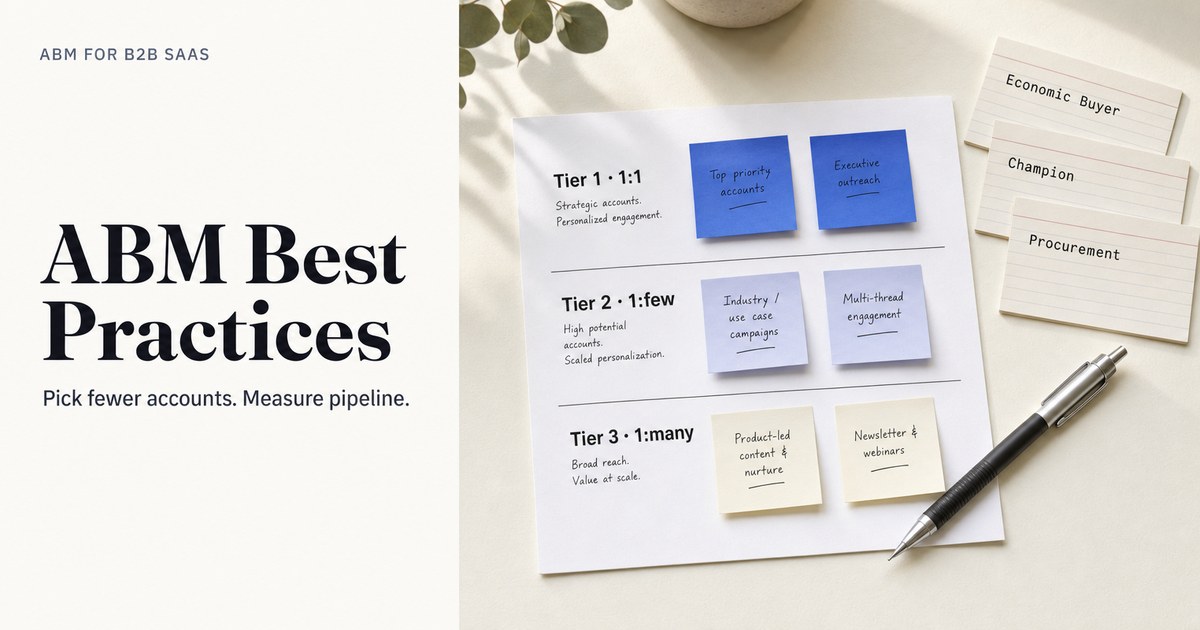
Target account list that is too large to work. Published ranges from ABM26 (GrowthSpree, June 2026, practitioner view, no sample stated) show common lists running 500 to 2,000+ named accounts at companies that should run 100 to 300. A list that large is not an ABM program; it is a broadcast campaign with a firmographic filter. Recommended tier sizes: 10 to 50 accounts for 1:1, 50 to 200 in clusters of 5 to 15 for 1:few, and 200 to 500 for 1:many.
No intent or fit signal to prioritise accounts. Without a way to distinguish accounts that are actively researching from those that are not, the program reaches accounts in equal measure regardless of purchase timing.
Short, single-stakeholder buying processes. If a single buyer makes the decision and the cycle is under 30 days, ABM's multi-role coordination adds cost without adding coverage that changes the outcome.
The verdict: choose ABM when, choose inbound when
Choose account-based marketing when ACV exceeds $25K, the sales cycle runs longer than 60 days, and five or more stakeholders are involved in the decision. Choose inbound marketing when ACV is below $15K, the buying process is short, and lead volume matters more than account-level precision. Between $15K and $25K ACV, run both in parallel: inbound for volume, ABM for the highest-fit named accounts.
Condition
Choose ABM
Choose inbound
Run both
ACV below $15K
Yes
ACV $15K - $25K
Yes
ACV above $25K
Yes
Sales cycle under 30 days
Yes
Sales cycle 60+ days
Yes
5+ stakeholders per deal
Yes
Single-stakeholder decision
Yes
TAM is narrow and defined
Yes
TAM is broad and fragmented
Yes
No seller on named accounts
Yes
The verdict is not a permanent assignment. B2B SaaS companies typically start with inbound, add ABM for their first enterprise accounts, and shift the budget mix as ACV and cycle length grow. The decision to rebalance is triggered by deal size data and pipeline quality, not by a calendar date or a headcount milestone.
Frequently Asked Questions
What is the difference between account-based marketing and inbound marketing?
Account-based marketing (ABM) targets a defined list of named companies and measures success on pipeline per account. Inbound marketing attracts broad audiences through content and optimises for lead volume. ABM is account-first and outbound-coordinated; inbound is audience-first and pull-based. The two are not mutually exclusive, but they serve different budget objectives and work best at different deal sizes.
When should a B2B SaaS company choose ABM over inbound?
Account-based marketing becomes the stronger investment when annual contract value (ACV) exceeds roughly $25K, when a sales cycle runs longer than 60 days, and when the deal involves five or more stakeholders. Below those thresholds, inbound's lower cost per lead usually delivers a better return. Above them, the named-account focus of ABM justifies the higher cost per sales-qualified lead.
Can ABM and inbound marketing run at the same time?
Yes. Many B2B SaaS companies run inbound to generate broad awareness and early-stage leads while running ABM in parallel for a focused tier of high-value named accounts. Inbound content can also support ABM by warming buying-group members at target accounts before direct outreach begins. The two motions share content infrastructure but serve different pipeline objectives.
How many target accounts should an ABM program have?
Published ranges suggest 10 to 50 accounts for 1:1 treatment, 50 to 200 accounts grouped into 5 to 15 clusters for 1:few treatment, and 200 to 500 for 1:many. Common ABM lists run 500 to 2,000 or more named accounts at companies that should run 100 to 300, making the list a market map rather than a workable program (ABM26, published ranges, no sample stated).
What is inbound marketing?
Inbound marketing is a demand-generation approach that attracts potential buyers through content, search optimisation, and organic channels, then converts them into leads. It targets audiences defined by persona and interest rather than a fixed account list. Success is typically measured by lead volume, cost per lead, and marketing-qualified lead conversion rate.
Putting the decision into practice
The account-based marketing vs. inbound marketing comparison matters at a single decision point: when a demand generation team is allocating budget and needs a rationale for where each dollar goes. Inbound optimises for lead volume and scales well when the total addressable market is large and deals close with one or two stakeholders. ABM optimises for pipeline at specific named accounts and scales when ACV is high, cycles are long, and buying committees grow to five or more people.
The clearest signal to shift budget toward ABM: inbound leads consistently arrive from companies too small to close at your target deal size. The clearest signal to keep inbound: the pipeline is healthy, the market is broad, and no seller is ready to work named accounts. Between those two states, run both at a ratio that matches your current ACV distribution.
A free consultation with an ABM expert is available for B2B SaaS teams ready to map this decision to their own pipeline data. Bring your target account list and get a view on the next step.
Meet with an expert - A free consultation. Bring your target account list and brainstorm the next step with an ABM expert.