What Account-Based Marketing Services Include: A Scope Checklist for B2B SaaS Buyers
what do account based marketing services includeaccount based marketing services scopeABM scope of work checklist
What Account-Based Marketing Services Include: A Scope Checklist for B2B SaaS Buyers
A buyer's checklist of what account based marketing services include: target accounts, tiers, buying groups, channels and measurement, with questions to ask.
Request a quote and our experts will contact you within 24 hours with tailored solutions and pricing.
What Account-Based Marketing Services Include: A Scope Checklist for B2B SaaS Buyers
Account-based marketing (ABM) services are the work a provider does to select target accounts, assign account tiers, map buying groups, activate channels and report pipeline per account, all against a written scope. Buyers who ask what account based marketing services include often get a list of activities with no owners, reports or exit terms. That gap is how contracts end up delivering activity reports instead of pipeline. This page gives a line-by-line checklist across five scope areas, so a Head of Marketing can hold two proposals side by side. It builds on the firmographic data approach used to decide which accounts belong on the list.
Key Takeaways
Account-based marketing services should cover five areas in writing: target account selection, tier assignment, buying group mapping, channel activation and measurement.
A statement of work (SOW) for ABM services must also say who owns the list, the data, the ad accounts and sales follow-up.
Published ranges for ABM tier sizes are 10 to 50 accounts for 1:1, 50 to 200 for 1:few and 200 to 500 for 1:many.
Forrester's 2026 research puts a typical B2B buying decision at 13 internal stakeholders plus nine external influencers, so mapping one champion is not enough.
ABM measurement should be pipeline per account against holdout accounts, not reach or engagement scores.
By the ABM for B2B SaaS Editorial Team. Published October 28, 2026. Sources and handling of figures are explained on the Methodology page.
What do account based marketing services include?
Account-based marketing (ABM) services include five scope areas: target account selection, account tier assignment, buying group mapping, channel activation and measurement. A complete engagement also names who owns the data, the list and sales follow-up. Buyers should demand each area in writing, because a typical buying decision involves 13 internal stakeholders plus nine external influencers (Forrester, 2026).
Five labelled folders fanned out on a desk beside a printed scope checklist with tick marks
A statement of work (SOW) is the written document that lists deliverables, owners, reports and acceptance criteria. For ABM services, the SOW is where scope lives. The table below turns the five areas into a checklist that can sit beside any proposal.
Scope area
A full-scope engagement includes
Ask before signing
Target account selection
A scored list built on fit and intent, with documented criteria
Who builds the list, and who keeps it at exit?
Tier assignment
Accounts placed in 1:1, 1:few or 1:many with written rules for moving between tiers
What does each tier receive in assets and hours?
Buying group mapping
A role map per account tier, including procurement, security and finance
How many contacts per account are covered?
Channel activation
Named channels, role and seniority targeting, exclusions set on day one
Which roles does each channel reach, and at what budget?
Measurement
Pipeline per account, account-to-opportunity rate, holdout accounts
Which reports arrive weekly and which quarterly?
Why scope is worth writing down
Adoption is wide. A Demand Gen Report 2026 ABM Benchmark Survey, re-reported by a secondary source, found nearly 80% of surveyed organizations are executing an ABM strategy (ORM Tech, 2026). Treat that as directional. When most buyers run ABM, a written scope is what lets one proposal be compared with another.
How should target account selection and tier assignment be scoped?
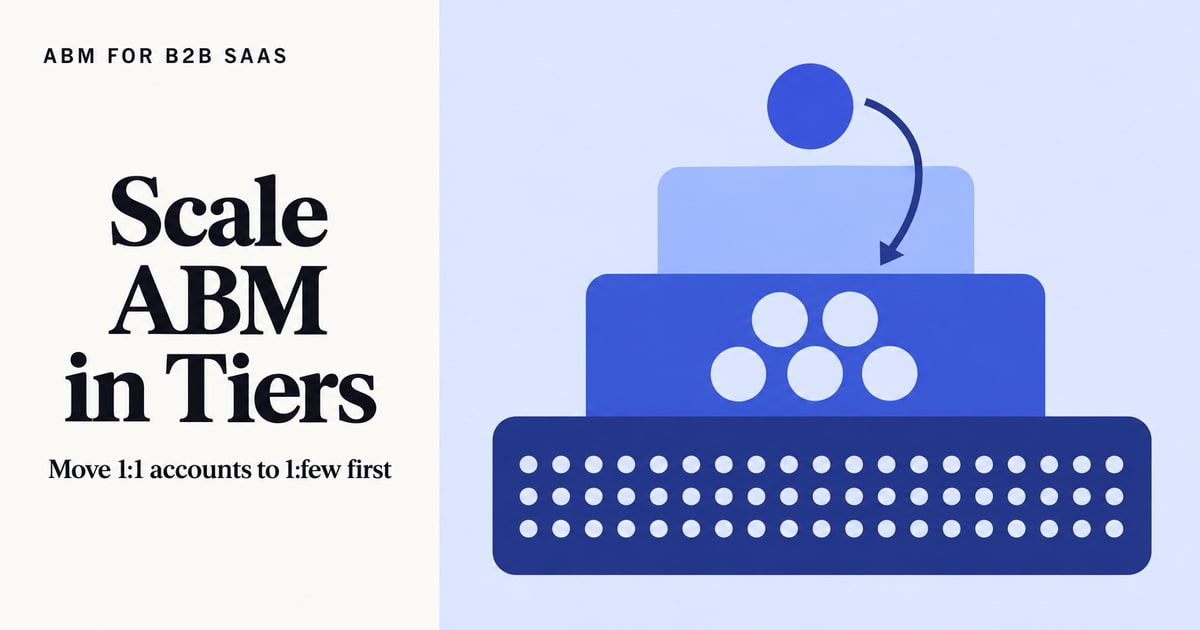
Target account selection and tier assignment should deliver a scored list built on fit and intent, with every account placed in a 1:1, 1:few or 1:many account tier. Published ranges put 1:1 at 10 to 50 accounts, 1:few at 50 to 200 in 5 to 15 clusters, and 1:many at 200 to 500 (GrowthSpree, June 2026, ABM26, no sample stated).
Three concentric rings of pins on a board representing account tiers of different sizes
An account tier is a group of target accounts that receives one level of ABM treatment. The same ABM26 source notes that common lists run 500 to 2,000+ named accounts at companies that should run 100 to 300. That is a practitioner view with no stated sample. A team of three people cannot give 1,500 accounts real treatment, which is why tiers need limits.
Tier rules also decide which accounts leave the demand generation stream. The Demand Gen Report 2026 ABM Benchmark Survey found 47% of organizations integrate ABM with demand generation (Demand Gen Report, 2026). The scope should say where that handoff sits.
What a tier table in the SOW should say
Tier
Published account range
Treatment
Deliverable to demand
1:1
10 to 50 accounts
Bespoke content and outreach per account
An account plan per account
1:few
50 to 200 accounts in 5 to 15 clusters
Shared content per cluster
One content set per cluster
1:many
200 to 500 accounts
Programmatic tactics across the list
A channel plan with exclusions
Criteria and movement rules
Tier assignment is only defensible if the criteria are written down. Ask the provider to state:
The fit criteria (firmographic and technographic) and how they are scored.
The rule for promoting or demoting an account, and how often the list is refreshed.
Who belongs in buying group mapping?
Buying group mapping should cover every role that can approve or block the deal, not one champion. Forrester's 2026 State of Business Buying puts a typical decision at 13 internal stakeholders plus nine external influencers (Forrester, 2026), and procurement acts as a decision-maker in 53% of buying cycles (Forrester, 2026).
A long meeting table with many chairs, some pulled out as if people just left
A buying group is the set of internal and external people who take part in one purchase decision. Forrester's release says: "The typical buying decision now includes 13 internal stakeholders and nine external influencers, with that number rising for more complex or strategic purchases." (Forrester, 2026) On procurement, Forrester's blog says "procurement professionals now serve as decision-makers more than half the time (53%) in the average business buying cycle" (Forrester, 2026).
Group size grows with deal size
Published ranges for B2B SaaS buying committee size show how committee size and sales cycle rise together (GrowthSpree, 2026, BC26, no sample stated).
Deal size
Stakeholders involved
Sales cycle
$25K to $100K
5 to 8
49 to 84 days
$100K to $250K
7 to 10
84 to 126 days
$250K to $1M
10 to 15
126 to 180 days
Region matters too. The same BC26 ranges put procurement in 62% to 78% of US enterprise deals and 85% to 94% of Indian enterprise deals. Forrester's public sector research reports 14 internal stakeholders on average and 18 in APAC (Forrester, 2026), though that sample is not SaaS-specific. Purchases with genAI features involve 14 members against seven without them (Forrester, 2026). That matters for B2B SaaS vendors selling AI products.
What to ask the provider
How many contacts per account will be mapped, and by which roles?
Does the map include procurement, security and finance?
Is there content for each role, or one message for everyone?
Which channels should the activation scope list?
Channel activation scope should name each channel, the roles it reaches inside target accounts and the budget it draws, because reach alone is not delivery. In 56 audited LinkedIn accounts, individual contributors and entry-level staff consumed 36% of budget, while decision-makers received 33% against a target of 60% or more (GrowthSpree, June 2026, L26).
Four coloured cables running from a patch panel to four different sockets
What we found: In the June 2026 L26 audit of 56 LinkedIn accounts, GrowthSpree analyzed $9.4M in ad spend. Non-buying job functions caused 30% of wasted spend, and 20% of spend reached firms under 50 employees.
Those figures are why exclusions belong in the SOW. The same audit puts LinkedIn clicks for B2B SaaS at $8 to $25 by vertical, so every wasted click is costly.
Channels and what each line item should state
Channel
Scope line to demand
LinkedIn
Matched company list, function and seniority filters, exclusions set on day one
Display and programmatic
Named-account audiences and frequency limits
Search
Coverage of target-account queries and brand terms
Email and SDR outreach
Sequences per role and a follow-up rule agreed with sales
Events and direct mail
Which tier receives them, and how replies are logged
Digital reach plus human validation
Buyers now research with AI. Forrester's 2026 report found 94% of business buyers use AI in the buying process (Forrester, 2026). A TrustRadius survey of 1,862 technology buyers found 94% of those who use AI for research still fact-check it (MarketScale, 2026). Channel scope should therefore include proof content, such as reviews and case material, and sales follow-through. Where tooling is in play, the ABM software comparison explains what to evaluate before signing.
How should measurement be written into the scope?
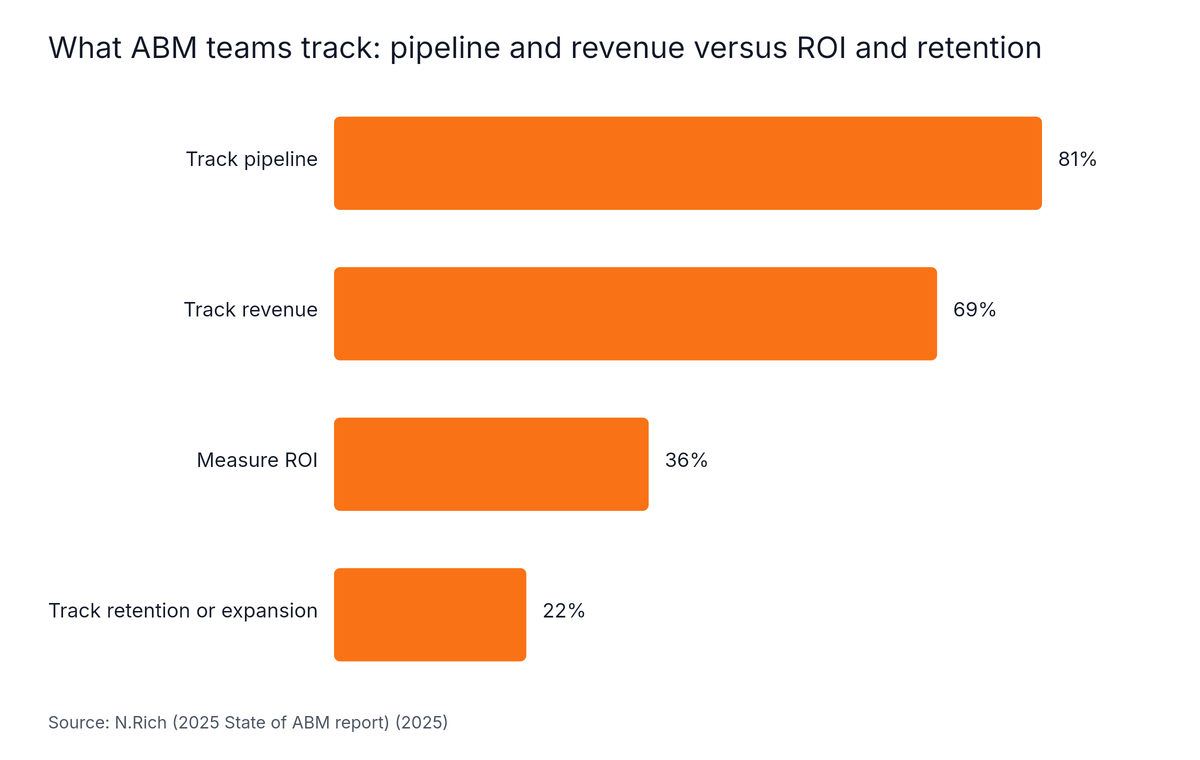
ABM measurement should be written into the contract as pipeline per account and account-to-opportunity rate, compared against holdout accounts that receive no ABM. Reach and engagement are activity metrics. In a 2025 vendor survey, 81% of ABM teams tracked pipeline and 69% tracked revenue, but only 36% measured ROI (N.Rich, 2025).
The account-to-opportunity rate is the share of target accounts that become sales opportunities in a period. Holdout accounts are a matched set that receive no ABM and serve as the comparison. The N.Rich survey is vendor-published and self-reported. It found only 22% of teams track retention or expansion (N.Rich, 2025).
Horizontal Bar chart: What ABM teams track: pipeline and revenue versus ROI and retention. Highest: Track pipeline at 81%.
Forrester describes buyers facing "A purchase journey that's more rigorous, more collaborative, and far less forgiving of claims without proof." (Forrester, 2026) Reporting should meet the same standard.
A measurement ladder for the SOW
Level
What it shows
Suggested cadence
1. Coverage
Share of mapped buying group roles reached per account
Weekly
2. Buying group engagement
Roles responding per account, by tier
Monthly
3. Opportunity creation
Account-to-opportunity rate by tier vs holdout accounts
Quarterly
4. Closed-won
Pipeline and revenue per account
Quarterly, after a full sales cycle
Metrics to refuse as headline KPIs
Impressions and accounts reached.
Marketing-qualified leads (MQLs).
Logo-level influence with no account-level pipeline.
Who owns what between the agency, your team and sales?
In an ABM services contract, the provider should own strategy, content and campaign delivery, while the client owns CRM hygiene, data access, creative approvals and sales follow-up. Writing that split down separates pipeline contracts from activity-report contracts. Gartner's May 2026 survey found buyers still turn to sales reps to validate AI-generated insights (Gartner, 2026).
A handover folder, a key and a printed list passed across a table between two hands
Sales coordination is the piece most ABM proposals leave vague. Gartner's May 2025 survey found 74% of B2B buyer teams show unhealthy conflict during the decision process (Gartner, 2025). Gartner also found that content tailored to the buying group, not the individual, drives consensus. Define follow-up as obligations, not goodwill.
Item
Provider owns
Client or sales owns
Target list
Method, scoring, refresh
Final approval; keeps the list at exit
Data and CRM
Recommendations and reports
Hygiene, access, field definitions
Ad accounts
Setup and management
Account ownership and billing access
Creative
Drafts and production
Approvals within an agreed turnaround
Follow-up
Alerts and handoff packs
Response time on engaged accounts
What drives price
No neutral pricing data exists for ABM services, and published fee ranges conflict widely. So do not accept a price as fact. Ask what sits behind it:
Number of target accounts and tiers.
Volume of creative and content assets.
Media, intent data and platform licences, which are often billed on top.
Number of regions.
Red flags and exit terms
Pricing by leads or impressions rather than account outcomes.
No sales alignment step, such as a shared list, a shared definition of "engaged" and follow-up service levels in the first 30 days.
No handover plan for lists, data and playbooks at exit.
The ABM services scope checklist on this page is not for B2B SaaS companies with annual contract value (ACV) under $15K or no seller working named accounts. ABM typically pays above that price point; below it, the cost of coordinating several stakeholders per account usually exceeds the return. Teams wanting fee quotes will not find them here, because no neutral pricing data exists.
Three further limits apply:
Volume demand generation. If the goal is lead volume across a broad audience, demand generation for B2B SaaS is the better frame, with ABM applied to the highest-fit accounts.
Independent evidence. No independent statistic on target account selection or tier effectiveness was found. Figures here on those topics are published ranges, not study findings.
Provider choice. The checklist describes what to demand, not who provides it. Platform, agency and in-house options all need the same scope.
Frequently Asked Questions
How long does it take for ABM services to show pipeline?
ABM services should not be judged on pipeline until at least one full sales cycle has passed. Published ranges put cycles at 49 to 84 days for $25K to $100K deals, 84 to 126 days for $100K to $250K deals, and 126 to 180 days for $250K to $1M deals (GrowthSpree, 2026, BC26, published ranges, no sample stated). Ask for leading indicators in the meantime.
Are media spend and platform licences included in an ABM retainer?
Media spend and platform licences are often billed on top of an ABM retainer, so the contract must say so. Ask for a written list of what the monthly fee covers, which tools and data subscriptions are extra, and who holds the ad account and data licences. Fee quotes without that scope behind them cannot be compared.
How many target accounts should ABM services cover?
ABM services should cover a list sized to the team, usually 100 to 300 target accounts for a small team. Published ranges suggest 10 to 50 accounts for 1:1, 50 to 200 in 5 to 15 clusters for 1:few, and 200 to 500 for 1:many (GrowthSpree, June 2026, ABM26, no sample stated).
Do B2B SaaS companies need an ABM platform to buy ABM services?
B2B SaaS companies do not necessarily need an ABM platform to buy ABM services. ABM can run on LinkedIn and a CRM with no dedicated platform. The decision depends on deal size, team size and whether the platform's data and orchestration justify its cost, so ask any provider to price the no-platform option.
Conclusion
A full-scope ABM engagement is easy to describe and easy to leave out of a proposal. Take these points into the next vendor call:
Require all five areas in writing: selection, tiers, buying group mapping, channel activation and measurement.
Size the list to the team, with tiers that have written rules.
Map the whole buying group, including procurement.
Make pipeline per account against holdout accounts the headline report.
Split ownership of data, ads, creative and sales follow-up before signing.
Bring a draft SOW and your target account list, and test them against this checklist. Meet with an expert at ABM for B2B SaaS: a free consultation. Bring your target account list and brainstorm the next step with an ABM expert.
Written by
Ishan Manchanda
Ishan Manchanda is co-founder of GrowthSpree, a B2B SaaS marketing consultancy founded in 2017 that has managed $60M+ in ad spend across 300+ B2B SaaS companies. He focuses on demand generation, go-to-market strategy and pipeline growth, and has been featured in Silicon Valley Times, SaaS Mag and the Unbounce podcast.
 Ishan ManchandaNov 21, 2026