Blog
Attribution Models for B2B SaaS: What Each Measures and Where It Fails
Attribution models compared by deal size, sales cycle and buying group. What first-touch, last-touch, U-shaped and W-shaped each measure and where they fail.
Account based marketing orchestration assigns a channel, message and owner to each buying group role. Role matrix, timeline and no-platform setup.
 Ishan ManchandaNov 9, 2026

Attribution models compared by deal size, sales cycle and buying group. What first-touch, last-touch, U-shaped and W-shaped each measure and where they fail.
Published ranges for splitting B2B SaaS marketing budget across ABM, demand generation, and brand, with sources, sample status, and a tier-first method.
Fix account based marketing LinkedIn targeting: measure waste, exclude non-buyers, cover the buying group and scale from 50 to 200 target accounts.
Request a quote and our experts will contact you within 24 hours with tailored solutions and pricing.
abmforb2bsaas.com
Last updated: Nov 9, 2026
By the ABM for B2B SaaS Editorial Team. Last updated October 28, 2026. Sources and sample limits are explained on the Methodology page.
Account-based marketing (ABM) orchestration is the practice of assigning a channel, a message and a named owner to every person in a target account's buying group, then sequencing those touches across the deal timeline.
Published ranges put a $100K to $250K deal at seven to ten stakeholders and an 84 to 126 day sales cycle (ABM for B2B SaaS published ranges, 2026, no sample stated). Yet many programs still aim at one champion. Then procurement, security and finance arrive late, and the deal stalls.
This guide treats account based marketing orchestration as a human operating model, not a software feature. It covers who owns each role, what each role needs and when, and how to run the plan with a customer relationship management (CRM) system and LinkedIn first. For the wider program, see the account-based marketing best practices guide.
Key Takeaways
- Account based marketing orchestration works when every buying group role at a target account has one channel, one message and one named owner.
- Procurement is a decision-maker in 53% of business buying cycles and engages from the start (Forrester, 2026), so procurement belongs in the early account plan.
- IT security review is the biggest source of delay after vendor selection in B2B software deals, cited by 39% of buyers (G2, 2026), so sales teams should send security documentation during the early stage of an account.
- A CRM record, a LinkedIn matched company list and a weekly coverage review are enough to run ABM orchestration for a small set of target accounts without a platform.
- ABM orchestration should be measured on pipeline per account and account-to-opportunity rate against holdout accounts, plus coverage by role, not accounts reached.
Account based marketing orchestration coordinates sales and marketing at one target account through a single account plan. The plan lists every buying group role, gives each role one channel, one message and one named owner, and sets touch timing across early, mid and late stages. A weekly coverage review then finds roles that nobody has reached.

ABM orchestration is the human operating model behind the account plan: named owners, defined messages and a shared timeline for every role in the buying group. Software can speed it up. It does not replace the decisions about who talks to whom.
Deal size sets how many roles the plan must cover. The ranges below are published ranges with no stated sample, so treat them as a planning guide, not a finding.
| Deal size (ACV) | Stakeholders involved | Sales cycle |
|---|---|---|
| $25K to $100K | 5 to 8 | 49 to 84 days |
| $100K to $250K | 7 to 10 | 84 to 126 days |
| $250K to $1M | 10 to 15 | 126 to 180 days |
Source: ABM for B2B SaaS published ranges (2026), no sample stated. See the Methodology page.
A champion cannot carry a group decision alone. Gartner's May 2025 sales survey found 74% of B2B buyer teams show unhealthy conflict during the decision process (Gartner, 2025). The goal shifts from persuading one person to helping the whole group agree.
Sales coordination sits inside every one of these steps. Marketing cannot assign owners alone, and sales cannot create air cover alone.
A buying group is the set of people inside and around a buyer organization who shape one purchase decision. Forrester's 2026 survey reports 13 internal stakeholders plus nine external influencers for a typical decision (Forrester, 2026). Published ranges for $100K to $250K deals say seven to ten, with no sample stated. The counts differ because each source defines the group differently.

Forrester's State of Business Buying draws on its Buyers' Journey Survey of nearly 18,000 global business buyers. Its internal and external counts are separate and should not be added into one committee size. For purchases that include genAI features, buying groups average 14 members against seven for purchases without those features (Forrester, 2026).
| Source | Count reported | What it counts | Date |
|---|---|---|---|
| Forrester, State of Business Buying | 13 internal plus nine external | Typical business purchase, internal and external counted separately | 2026 |
| Forrester, genAI purchases | 14 members vs. seven | Groups with and without genAI features | 2026 |
| ABM for B2B SaaS published ranges | 7 to 10 | $100K to $250K deals; no sample stated | 2026 |
Each count answers a different question. One source counts only people inside the buyer, another counts internal and external people separately, and a third sorts by deal size. Averages also move with the type of purchase, as the genAI row shows. No single figure is forced onto the page.
None of these figures is your number. Open your last five closed-won deals and count every person who joined a call, signed off or blocked. That count, by role, becomes the template for the account plan.
Multi-threading is building working relationships with several buying group members at one account instead of relying on one champion. It is the sales behavior that matches a group buying process. A single-threaded deal looks healthy until one of the unreached roles speaks up.
ABM orchestration maps each buying group role to one primary channel, one message and one owner, then places the role in a stage of the deal timeline. A champion gets product proof, a CFO gets cost and risk framing because 49% of software buyers saw a CFO reverse an approved deal (G2, 2026), and security and procurement get documents early.

The matrix below is a starting version. Edit the roles to match the count from your own closed deals. Every channel has a no-platform version: email and calls from a CRM task list, and LinkedIn ads on a matched company list.
| Role | Stage to engage | Primary channel | Message focus | Owner |
|---|---|---|---|---|
| Champion or end user | Early, through late | Calls, email, demo | The daily problem solved and proof it works | Account executive |
| Economic buyer or executive sponsor | Mid | Executive-to-executive email, LinkedIn ads to the title | Business outcome and timing | Account executive with an executive sponsor |
| Finance (CFO or finance lead) | Early to mid | Short business-case note, LinkedIn ads to finance titles | Cost, payback and budget fit | Marketing drafts, account executive delivers |
| Security or IT | Early | Security documentation sent by email, named technical contact | Data handling, compliance answers, review steps | Solutions engineer |
| Procurement | Early to mid | Direct email, pricing and terms one-pager | Terms, process and vendor information | Account executive with sales operations |
| Technical evaluator | Mid | Sandbox or trial, technical content | Fit with the existing stack |
Keep each message to one sentence per role, built on that role's risk, not on your feature list. A security lead worries about review time. A CFO worries about a reversal. Write the sentence the role would repeat to a colleague.
Forrester's 2026 release gives the procurement case: "Procurement professionals are decision-makers in 53% of business buying cycles, engaging from the start of the process" (Forrester, 2026). Procurement therefore needs its own message from the first weeks, not a contract attached at the end.
Channel choice is where many programs leak money. When targeting stops at the company list, budget drifts to the wrong people inside the right companies.
Our data: In a June 2026 audit of 56 LinkedIn accounts and $9.4M in ad spend, decision-makers received 33% of LinkedIn ad budget against a target of 60% or more. Individual contributors and entry-level staff consumed 36% of budget, non-buying job functions caused 30% of wasted LinkedIn spend, and 20% of spend reached firms under 50 employees.
The same audit puts LinkedIn clicks for B2B SaaS at $8 to $25 by vertical. At those prices, set function and seniority filters and exclusions on day one.
Each buying group role gets one named owner, and the owner is usually a seller, not a campaign. Forrester's 2026 survey counts 13 internal stakeholders plus nine external influencers per decision (Forrester, 2026), so ownership must be explicit. The account executive owns the champion and economic buyer, the sales development representative (SDR) opens secondary roles, a solutions engineer owns security, marketing supplies content, and customer success joins late.

| Owner | Owns | Hands off when |
|---|---|---|
| Account executive | Champion, economic buyer, procurement conversation | Contract signed, to customer success |
| SDR | Secondary roles with no contact yet | A role books a call, to the account executive |
| Solutions engineer | Security and technical evaluator | Review completed and documented |
| Marketing | Air cover, role-specific content, ad exclusions | Never fully; marketing supports every stage |
| Customer success | Proof of the handoff and references | Joins mid to late, stays after close |
| Executive sponsor | Economic buyer relationship | Deal closes or stalls |
Roles have one owner, but support is shared. Marketing can run ads that warm a finance lead while the account executive writes the business-case note. The owner is the person accountable if the role stays silent.
An account tier is a group of target accounts that receive the same level of research, content and sales effort. Published tier sizes decide how many role maps a team can keep current.
| Tier | Accounts | Orchestration depth |
|---|---|---|
| 1:1 | 10 to 50 | A custom role map and message per account |
| 1:few | 50 to 200, in 5 to 15 clusters | One role map per cluster, with account-level tweaks |
| 1:many | 200 to 500 | A shared role template and programmatic touches |
Source: ABM for B2B SaaS published ranges (2026), practitioner view, no stated sample.
The same published view notes that common lists run 500 to 2,000+ named accounts at companies that should run 100 to 300. A list that size makes owner assignment fictional. Cut the list before assigning roles.
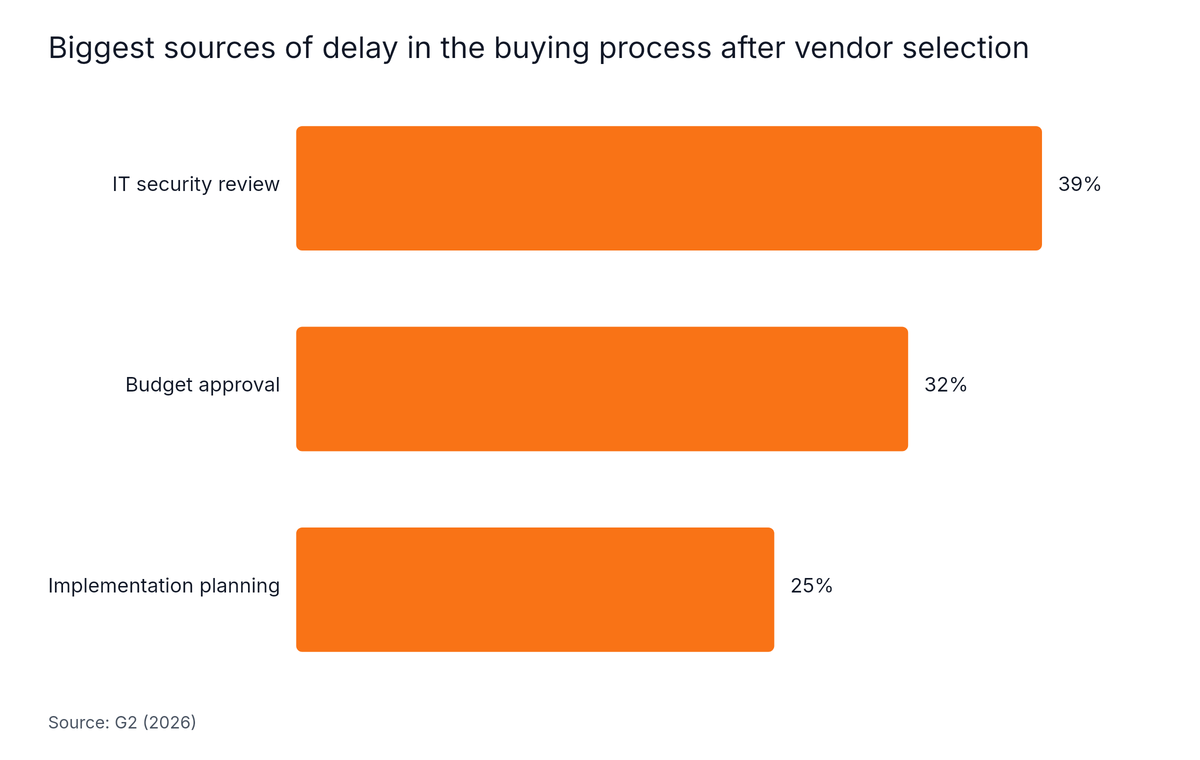
Procurement, security and finance should enter the account plan in the early stage, not at contract. Forrester reports procurement as a decision-maker in 53% of buying cycles, engaging from the start (Forrester, 2026), and G2's 2026 survey of 1,038 software buyers names IT security review as the biggest source of delay after vendor selection at 39% (G2, 2026).
Source: G2, 2026
G2's June 2026 survey found IT security review caused delay for 39% of buyers overall, budget approval for 32% and implementation planning for 25% (G2, 2026). Security review was cited more often by enterprise buyers, at 50%.
Security review is the single largest delay, so the solutions engineer should offer documentation in the early stage. Send data handling, compliance and review steps before the formal request. A review that starts early rarely lands in the last week.
Finance and CFO involvement in software buying rose from 31% to 46% in one year (G2, 2026). Nearly half of buyers (49%) say their CFO reversed a deal the buying team had already approved in the last 12 months (G2, 2026).
The same report offers the better framing: "When the case for buying is clear, the CFO can become one of the strongest sponsors in the room" (G2, 2026). That means a short business case sent early, not a pricing page sent late.
Regional ranges differ. Published ranges show procurement involved in 62% to 78% of US enterprise deals and 85% to 94% of Indian enterprise deals (ABM for B2B SaaS published ranges, 2026, no sample stated).
Give procurement a clean terms one-pager and a named account executive contact in the early or mid stage. For intent signals that show these roles starting research, the intent signals workflow shows how to attach an action and an owner to each one.
ABM orchestration without a platform runs on three shared assets: a CRM account record with one field per buying group role, a LinkedIn matched company list with function and seniority filters, and a weekly coverage review. Start with the 10 to 50 accounts of a 1:1 tier (published ranges, no sample stated). Software can automate tracking later, but owners and messages must exist first.

Demand Gen Report's 2026 ABM benchmark survey reports nearly 80% of surveyed organizations running ABM and 47% integrating ABM with demand generation, though the sample size is not public (Demand Gen Report, 2026). Wide adoption does not mean a platform is required.
| Task | No-platform version | What software can add later |
|---|---|---|
| Role mapping | One CRM field or spreadsheet column per role | Group templates and role suggestions |
| Outreach | CRM task list for each owner, plus email | Sequenced outreach across owners |
| Paid reach | LinkedIn matched company list with exclusions | Broader display and programmatic reach |
| Signal handling | A short list of signals, each with an action and an owner | Automated alerts and routing |
| Reporting | Weekly review sheet and CRM pipeline report | Group-level engagement views |
Add a tool only when a manual step starts failing, such as missed handoffs across more than 50 accounts. The ABM automation guide lists which tasks reduce manual work without a dedicated operations hire. For a buying decision, the ABM software comparison covers what to evaluate before signing.
ABM orchestration is measured on coverage and outcomes, not reach. Coverage metrics show whether each buying group role has been contacted and by whom. Outcome metrics are account-to-opportunity rate and pipeline per account, compared with holdout accounts that received no ABM treatment. Procurement is a decision-maker in 53% of buying cycles (Forrester, 2026), so contact timing by role matters.
Account-to-opportunity rate is the share of target accounts that produce at least one sales opportunity in a set period. Holdout accounts are a matched set of accounts that receive no ABM treatment and serve as the comparison group.
| Metric | What it shows | How to calculate | Type |
|---|---|---|---|
| Coverage by role | Whether each role has a contact and owner | Roles with a contact divided by roles mapped | Leading |
| Time to security or procurement contact | How early the late-stage roles are reached | Days from first touch to first contact with each role | Leading |
| Late-stage surprise rate | How often a new role appears after the mid stage | Deals with a new role late divided by deals reviewed | Leading |
| Account-to-opportunity rate | Whether accounts convert | Accounts with an opportunity divided by target accounts | Outcome |
| Pipeline per account | Value created per target account | Pipeline from target accounts divided by account count | Outcome |
The first three metrics are suggested working indicators for orchestration, not published benchmarks. Define them in your CRM before the program starts so that history exists.
Sales cycle length is the floor for any pipeline judgment. For $100K to $250K deals, the published range is 84 to 126 days (no sample stated), so a program should not be judged on pipeline before one full cycle completes.
Cost targets give a second check. Published targets are $3,000 to $8,000 per sales-qualified lead (SQL) for $50K to $150K annual contract value (ACV) contracts and $8,000 to $20,000 for $150K+ ACV contracts (ABM for B2B SaaS published ranges, 2026).
For fuller measurement design, see the ABM measurement guide.
ABM orchestration is typically not worth the effort when annual contract value (ACV) is below $15K, when no seller works named accounts, or when the target list is larger than the team can cover. Forrester's 2026 survey counts 13 internal stakeholders plus nine external influencers per decision (Forrester, 2026), a coordination load that one marketer cannot carry alone.
Multi-threading in ABM is building working relationships with several buying group members at one target account instead of relying on one champion. A single champion is risky because one person rarely controls security, finance and procurement questions, and a group decision can stall when any unreached role objects late in the deal.
ABM orchestration decides who contacts which buying group role, with what message and when. ABM automation executes tasks such as sending sequences or syncing records. Orchestration is the plan and the ownership, while automation is one way to run parts of it. A team can orchestrate with a spreadsheet and a CRM before buying any software.
Forrester's 2026 survey reports 13 internal stakeholders plus nine external influencers for a typical business purchase (Forrester, 2026). Published ranges for $100K to $250K deals say seven to ten stakeholders, with no sample stated. The numbers differ by definition and deal size, so count the people who joined calls in your last five closed deals.
Sales cycle length is the floor. Published ranges are 49 to 84 days for $25K to $100K deals, 84 to 126 days for $100K to $250K deals, and 126 to 180 days for $250K to $1M deals, with no sample stated. An ABM program should not be judged on pipeline before at least one full sales cycle has completed.
A CFO needs a short business case covering cost, payback and budget fit. A chief information security officer (CISO) needs documentation on data handling, compliance and review steps. A procurement lead needs clear pricing, terms and vendor information. Each piece should arrive early in the account timeline, before the review that depends on it.
Account based marketing orchestration comes down to five decisions made before the first touch: which accounts to work, which roles to map, who owns each role, when security, finance and procurement enter, and how results are compared with holdout accounts. Procurement is a decision-maker in 53% of buying cycles (Forrester, 2026), so early planning matters.
Start with the ten accounts that matter most and the roles you cannot yet name.
Meet with an expert
A free consultation. Bring your target account list and brainstorm the next step with an ABM expert.
Written by
Ishan Manchanda
Ishan Manchanda is co-founder of GrowthSpree, a B2B SaaS marketing consultancy founded in 2017 that has managed $60M+ in ad spend across 300+ B2B SaaS companies. He focuses on demand generation, go-to-market strategy and pipeline growth, and has been featured in Silicon Valley Times, SaaS Mag and the Unbounce podcast.
© 2026 abmforb2bsaas.com All rights reserved.


| Solutions engineer |