Account Based Marketing Definition: What ABM Means for B2B SaaS Teams
account based marketing definitionwhy is account based marketing importantwhat is account-based marketing
Account Based Marketing Definition: What ABM Means for B2B SaaS Teams
Account based marketing definition in plain terms, plus when ABM beats demand generation for B2B SaaS, by deal size, team size and buying group.
Ishan ManchandaNov 22, 2026
Last updated: Nov 22, 2026
Account Based Marketing Definition: What ABM Means for B2B SaaS Teams
By the ABM for B2B SaaS Editorial Team (byline to confirm). Last updated October 28, 2026. Sources and method are described on the Methodology page.
Account-based marketing (ABM) is a go-to-market approach in which a B2B SaaS company concentrates sales and marketing effort on a defined list of named target accounts and measures success on pipeline per account. That is the account based marketing definition in one sentence. The harder question is when it pays. Vendor pages often treat ABM as right for everyone and inseparable from a software purchase. The honest answer turns on annual contract value and team size, not platform choice. This guide gives the plain definition, the numbers behind it and the cases where broad demand generation wins. For how accounts get chosen, start with .
Account-based marketing (ABM) means working a defined list of named target accounts across the whole buying group and measuring pipeline per account.
Forrester's 2026 research puts the typical B2B buying decision at 13 internal stakeholders and nine external influencers.
ABM tends to pay when annual contract value is high enough to fund per-account work; practitioner guidance puts the floor near $20,000 to $30,000, as a range to model.
A B2B SaaS ABM program should usually run 100 to 300 target accounts, tiered as 1:1, 1:few and 1:many.
In a June 2026 audit of 56 LinkedIn accounts, decision-makers received 33% of budget against a target of 60% or more.
What is the definition of account-based marketing?
Account-based marketing (ABM) is a go-to-market approach that focuses sales and marketing effort on a defined list of named companies, called target accounts, rather than a broad audience. It coordinates outreach across the whole buying group and measures pipeline created, not engagement scores. In Demand Gen Report's 2026 benchmark survey, 84% of respondents use ABM to drive revenue (Demand Gen Report, 2026).
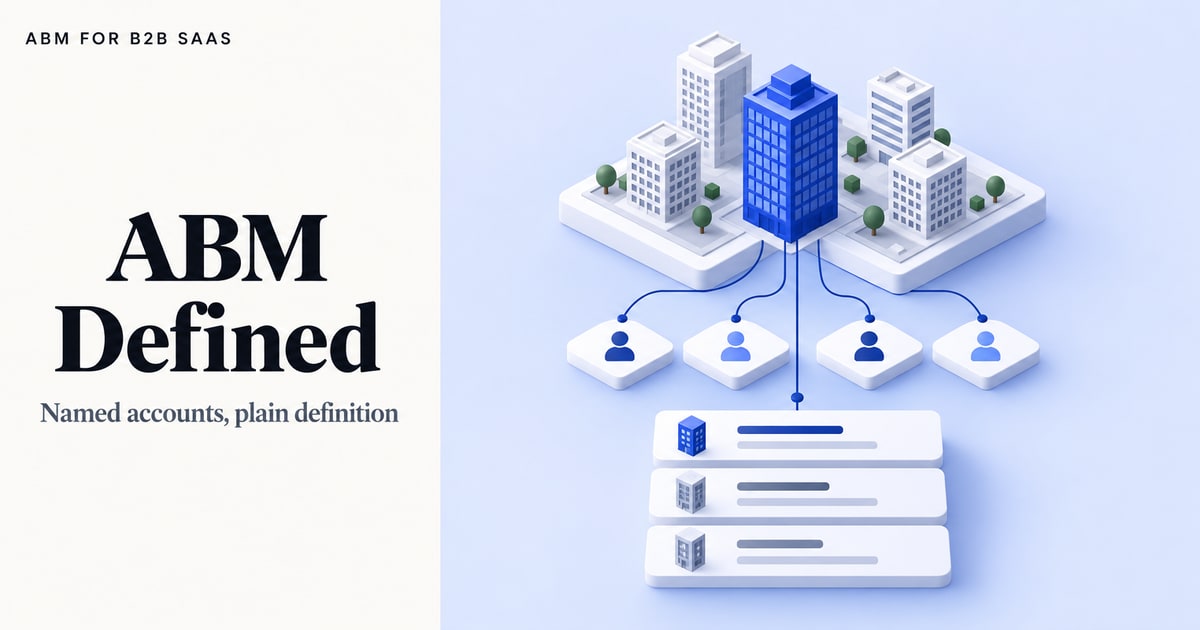
Isometric illustration of a short list of office tower models on a platform, one highlighted and linked to small desk blocks
Three terms carry most of that definition:
Target accounts are the named companies a program chooses to work, selected on fit and intent rather than on reach.
A buying group is the set of stakeholders inside one company who take part in a purchase decision. Many teams also call it the buying committee.
Pipeline per account is the primary outcome measure: opportunities and pipeline created at each target account, not accounts reached.
The same survey found 47% of respondents integrate ABM with demand generation (Demand Gen Report, 2026). ABM is usually a layer on top of broader programs, not a replacement.
The three ABM tiers
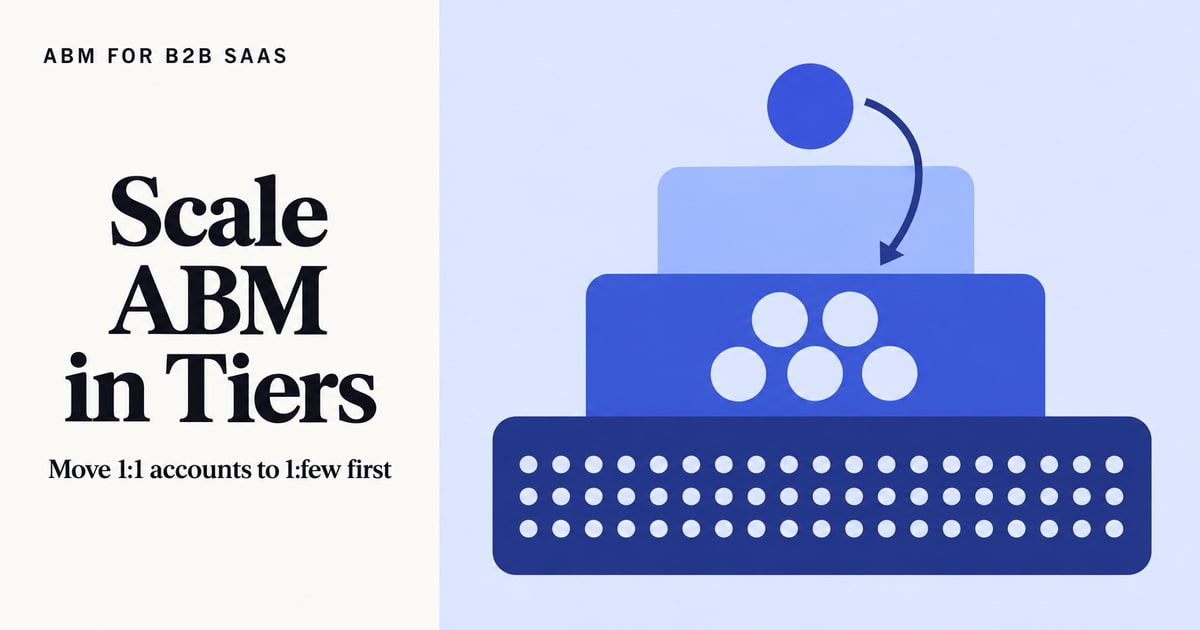
ABM programs split target accounts into account tiers by how much effort each one gets. The tier sizes below are published ranges from GrowthSpree's June 2026 article "Most B2B SaaS ABM Programs Are Spray-and-Pray With Lipstick", a practitioner argument with no stated sample.
Tier
Accounts
Treatment
1:1
10 to 50
Bespoke content and outreach per account
1:few
50 to 200, in 5 to 15 clusters
Shared content per cluster of similar accounts
1:many
200 to 500
Programmatic tactics across a broader named list
Why does account-based marketing matter for B2B SaaS buying groups?
Account-based marketing matters for B2B SaaS because purchases are made by groups, not individuals. Forrester's 2026 State of Business Buying survey of nearly 18,000 buyers puts the typical decision at 13 internal stakeholders and nine external influencers (Forrester, 2026), so a motion aimed at one lead misses most of the decision.
Isometric illustration of a long meeting table with many empty chairs around a single office tower model
As Forrester put it in January 2026, "The typical buying decision now includes 13 internal stakeholders and nine external influencers" (Forrester, 2026). Three more figures show why single-contact lead generation falls short:
Buyers in groups of six or more mostly see value in the larger group: 94% (Forrester, 2026).
Procurement professionals are decision-makers in 53% of business buying cycles (Forrester, 2026).
Buying groups for purchases that include genAI features run to 14 members, against seven for purchases without them (Forrester, 2026).
Published ranges from GrowthSpree's 2026 B2B SaaS Buying Committee Size Benchmarks (no stated sample) show the same pattern by deal size:
Deal size
Stakeholders
Sales cycle
$25K to $100K
5 to 8
49 to 84 days
$100K to $250K
7 to 10
84 to 126 days
$250K to $1M
10 to 15
126 to 180 days
Larger contracts draw more people. That is the core case for working the account instead of the lead. It also explains why ABM and inbound marketing fit different stages.
When does ABM beat broad demand generation?
Account-based marketing beats broad demand generation when annual contract value (ACV) is high enough to fund per-account work and a team can staff it. DemandScience's practitioner guidance, a rule of thumb with no stated sample, puts the floor at roughly $20,000 to $30,000 in annual average deal size (DemandScience, 2026), though other sources cite $10K to $50K.
Annual contract value (ACV) is the yearly revenue a customer contract is worth. It sets how much effort one account can justify.
A break-even test, not a fixed number
No source gives a fixed threshold backed by a stated sample, so model it. Compare expected return per account (ACV x win rate x gross margin) with the cost of working that account. If the first figure does not clearly exceed the second, the account belongs in a broader motion. The inputs are your own; the threshold is a range, not a rule.
A sales-qualified lead (SQL) is a lead sales has accepted as worth pursuing. Target cost per SQL rises with deal size, which shows how much effort a larger contract can carry. These are targets from GrowthSpree's 2026 SaaS Google Ads Benchmarks, with no stated sample:
ACV band
Target cost per SQL
$15K to $50K
$1,000 to $3,000
$50K to $150K
$3,000 to $8,000
$150K+
$8,000 to $20,000
ABM and demand generation side by side
Factor
ABM fits
Broad demand generation fits
Deal size
High ACV, many stakeholders
Low ACV, few stakeholders
Market
Small, nameable list
Large total addressable market
Sales cycle
Long
Short
Team
At least one seller on named accounts
Marketing-led, volume-driven
The two can run together. Many B2B SaaS companies keep demand generation running and apply ABM to the highest-fit, highest-value accounts; see where ABM fits in demand generation.
How many target accounts should an ABM program have?
An account-based marketing program for B2B SaaS should usually run 100 to 300 target accounts, split into tiers: 10 to 50 accounts for 1:1, 50 to 200 in 5 to 15 clusters for 1:few, and 200 to 500 for 1:many. These are published ranges from GrowthSpree's June 2026 practitioner article, with no stated sample.
Isometric illustration of three stacked platforms holding few, some and many small building models
Lists of 500 to 2,000+ named accounts are common at companies that should run 100 to 300, according to the same article. A list that size is a market map, not a workable account set.
Staffing is the usual limit. Insufficient staff is now the top ABM challenge, cited by 37% of respondents in Forrester's 2024 State of ABM Survey, and insufficient budget was cited by 35%, up from 22% in 2022 (destinationCRM, 2025). No credible source gives accounts per person. As practitioner judgment, size each tier to what the team can work with real sales coordination: fewer accounts at 1:1, more at 1:many. Tools such as ABM automation without an ops hire can stretch a small team, but they do not replace the choice of fewer accounts.
When is account-based marketing not worth it?
Account-based marketing is not worth running when deal size is low, the total addressable market (TAM) is large, sales cycles are short, or the ideal customer profile (ICP) is unvalidated. In those cases broad demand generation usually wins. Practitioner guidance puts the efficiency floor near $20,000 to $30,000 in annual deal size (DemandScience, 2026).
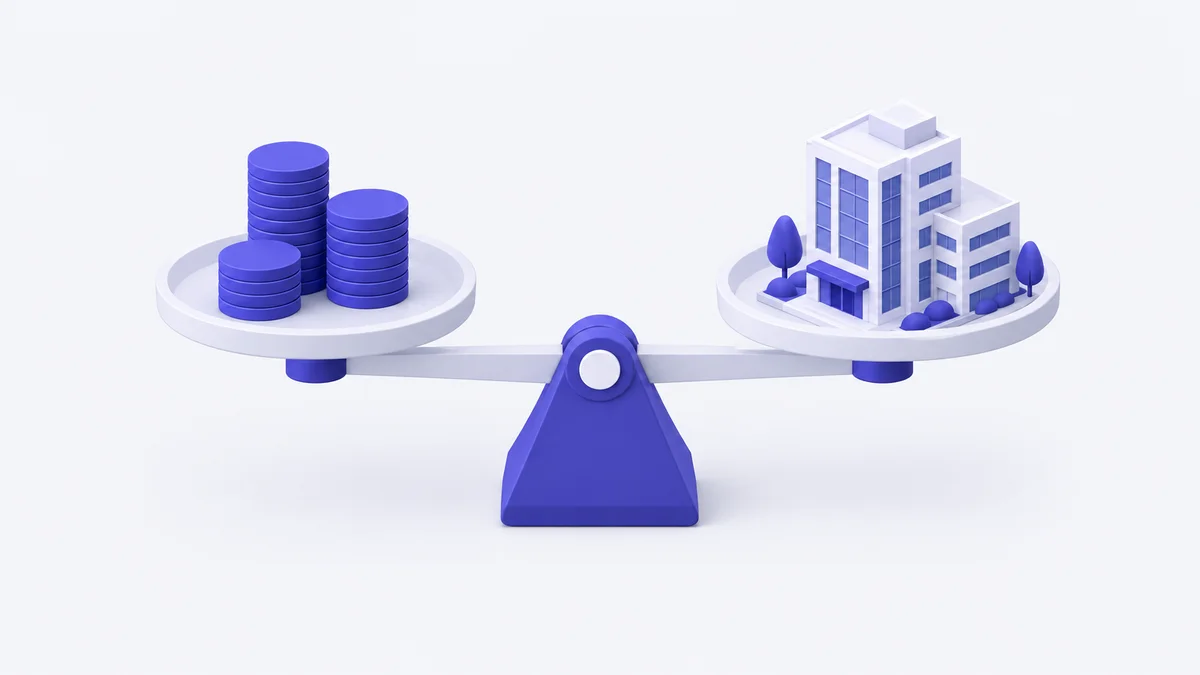
Isometric illustration of a balance scale weighing coin stacks against a single office tower model
Total addressable market (TAM) is the full set of companies that could buy the product. An ideal customer profile (ICP) is the description of the companies that buy, stay and expand.
Who this is not for
ABM is a poor fit for:
Teams with low-ACV products and a long list of small buyers.
Companies with no seller to work named accounts.
Companies that have not yet shown which customers close.
Teams that need lead volume next quarter.
Common failure modes
Forrester's 2024 research found that "A surprising percentage of firms continue to practice ABM in name only, without implementing the tried-and-true elements of an ABM approach" (destinationCRM, 2025). Targeting is a common culprit, as the audit below shows.
What we found: In an audit of 56 LinkedIn accounts with $9.4M in ad spend analyzed (GrowthSpree, "The State of Wasted LinkedIn Ads Spend in B2B SaaS", June 2026), decision-makers received 33% of LinkedIn ad budget against a target of 60% or more. Individual contributors and entry-level staff consumed 36% of budget. Non-buying job functions caused 30% of wasted spend, and 20% of spend reached firms under 50 employees.
A correct account list still fails when the wrong people see the ads.
Buyer behavior adds pressure: 67% of B2B buyers prefer a rep-free purchasing experience, up from 61% (Digital Commerce 360, 2026, reporting Gartner). Much evaluation happens before sales is involved, which is why ABM best practices put account-level content ahead of outreach.
How do you measure account-based marketing?
Account-based marketing is measured on pipeline per account and account-to-opportunity rate, compared against holdout accounts that received no ABM treatment. Engagement scores and accounts reached are activity metrics. Judge a program only after one full sales cycle, which published ranges put at 49 to 84 days for $25K to $100K deals (GrowthSpree's 2026 buying committee benchmarks, no stated sample).
Holdout accounts are a matched set of target accounts that get no ABM treatment, so the program's lift shows against a baseline. Measurement is where "ABM in name only" shows up. Forrester's 2024 State of ABM Survey found that "A surprising percentage of firms continue to practice ABM in name only" (destinationCRM, 2025). A program that reports reach and engagement without pipeline per account fits that description.
Account-based marketing is important because B2B purchases are made by groups, not single leads. Forrester's 2026 survey of nearly 18,000 buyers found the typical decision includes 13 internal stakeholders and nine external influencers (Forrester, 2026). Concentrating effort on named target accounts lets a B2B SaaS team reach more of that group and measure pipeline per account.
What are the three types of ABM?
The three types of account-based marketing are 1:1, 1:few and 1:many. 1:1 gives bespoke content and outreach to each top-value account. 1:few groups similar accounts into clusters of roughly 5 to 15 and builds content per cluster. 1:many applies programmatic tactics across a broader named list of 200 to 500 accounts.
Do I need an ABM platform to start?
No, an ABM platform is not required to start account-based marketing. A small B2B SaaS team can run ABM with a target account list, LinkedIn matched-company targeting and a CRM. The decision to buy a platform depends on deal size, team size and whether its data and orchestration justify the cost. See how to evaluate platforms.
How long does ABM take to show results?
Account-based marketing takes at least one full sales cycle to show pipeline results. Published ranges, with no stated sample, put cycles at 49 to 84 days for $25K to $100K deals, 84 to 126 days for $100K to $250K deals, and 126 to 180 days for $250K to $1M deals.
Conclusion
Account-based marketing is a choice about where to concentrate effort, and the evidence points to a short set of rules:
Define ABM as named target accounts, the whole buying group and pipeline per account.
Expect group decisions: 13 internal stakeholders and nine external influencers is the typical case.
Model the ACV break-even; practitioner guidance puts it near $20,000 to $30,000, as a range.
Size the list to the team, usually 100 to 300 accounts in tiers.
Prefer broad demand generation when deal size is low, the market is large or cycles are short.
The next step is to test your own list against those rules. Start with the ABM best practices guide, then bring your list to an expert.
Meet with an expert: A free consultation. Bring your target account list and brainstorm the next step with an ABM expert. (Booking link to confirm.)
Written by
Ishan Manchanda
Ishan Manchanda is co-founder of GrowthSpree, a B2B SaaS marketing consultancy founded in 2017 that has managed $60M+ in ad spend across 300+ B2B SaaS companies. He focuses on demand generation, go-to-market strategy and pipeline growth, and has been featured in Silicon Valley Times, SaaS Mag and the Unbounce podcast.
 Ishan Manchanda