How Account Based Marketing Companies Structure a First $50K-Plus Program
account based marketing companiesfirst ABM programABM account tiers
How Account Based Marketing Companies Structure a First $50K-Plus Program
Moving upmarket? See how account based marketing companies set up a first $50K-plus program: account tiers, buying group mapping, channels and cost per SQL.
Request a quote and our experts will contact you within 24 hours with tailored solutions and pricing.
How Account Based Marketing Companies Structure a First $50K-Plus Program
By ABM for B2B SaaS Editorial Team. Last updated October 28, 2026. Sources and method are described on the site's Methodology page.
Structuring a first account-based marketing (ABM) program for $50K-plus deals means making four decisions in order: which target accounts, which account tier, which buying group roles, and which channels.
Picture the moment. The first $50K-plus contract lands in the pipeline, and the inbound leads behind it come from companies too small to buy. Account based marketing companies start from a hard fact here: 92% of B2B buyers begin buying with at least one vendor in mind (Forrester, via Digital Commerce 360, 2025). The inbound playbook stops scaling at that deal size. This guide sets out the initial structure, with published ranges for list size, buying group size and cost.
Key Takeaways
A first ABM program for $50K-plus deals rests on four decisions: target accounts, account tier, buying group map and channels.
Published ranges suggest 100 to 300 target accounts for most teams, not the 500 to 2,000+ that many lists reach (GrowthSpree practitioner analysis, June 2026, no sample stated).
Procurement is a decision-maker in 53% of business buying cycles (Forrester, 2026), so a $50K-plus buying group map must include it from the start.
ABM results should be judged on pipeline per account after one full sales cycle, not on engagement scores.
How do account based marketing companies structure the first $50K-plus program?
A first account-based marketing (ABM) program for $50K-plus deals is structured as four decisions made in sequence. Choose a short list of target accounts, assign each an account tier, map the buying group at each account, and match channels to tier. A GrowthSpree practitioner analysis (June 2026, no sample stated) puts a workable list at 100 to 300 accounts.
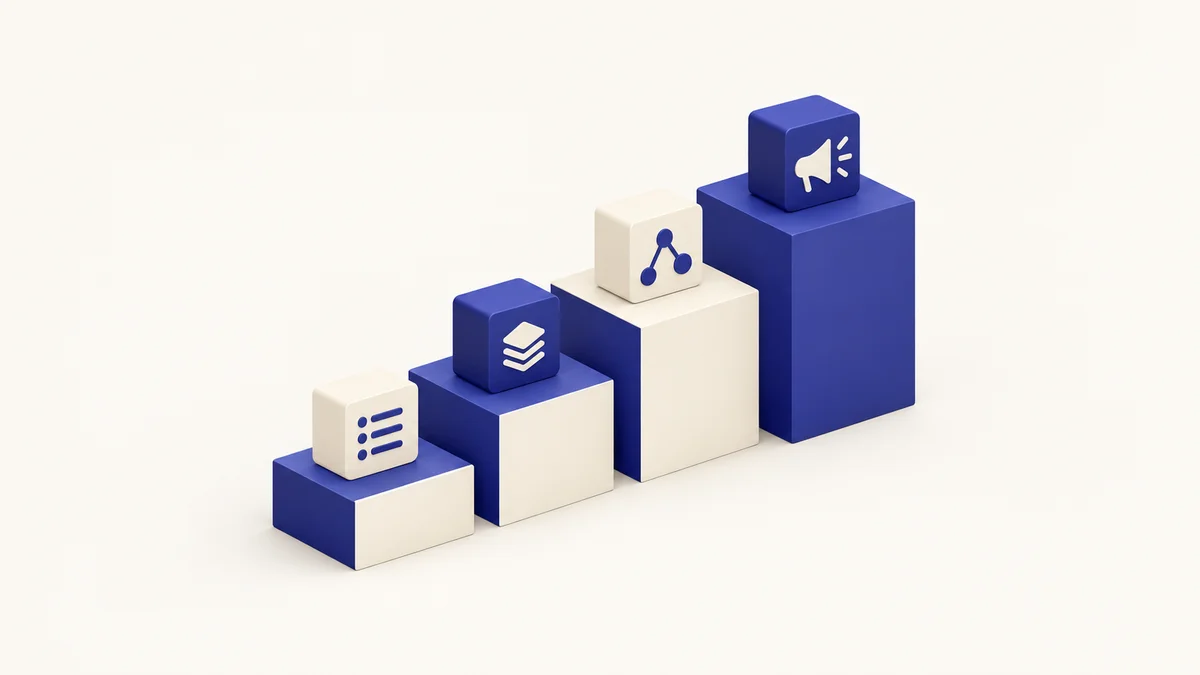
Four stacked isometric steps representing account selection, tiering, buying group mapping and channels
Account-based marketing (ABM) is a go-to-market approach that focuses sales and marketing effort on a defined list of named companies. It coordinates outreach across the whole buying group and measures success on pipeline per account. The table shows the four decisions and the rule behind each.
Decision
Question it answers
Starting rule
Account selection
Which companies get worked by name?
Score on deal size potential, fit, intent and sales capacity
Tier assignment
How much effort does each account get?
1:1, 1:few or 1:many, sized to team
Buying group mapping
Who must be reached inside each account?
One role map per tier, including procurement
Channel choice
Where do those roles pay attention?
Match channel to tier, with sales coordination
Why does the inbound playbook stop scaling at this deal size?
Inbound content works when buyers search for options. At $50K-plus, many have already chosen. The Forrester survey behind the 92% figure also found that 41% of buyers have a single preferred vendor before formal evaluation (Forrester, via Digital Commerce 360, 2025). Forrester's summary: "B2B buying today is a process of confirmation, not selection" (Forrester, via Digital Commerce 360, 2025).
The implication is practical. A program must reach the right companies before they shortlist, so those companies are picked in advance. For where demand generation ends and ABM begins, see ABM within demand generation.
How many target accounts and which account tiers should a first program use?
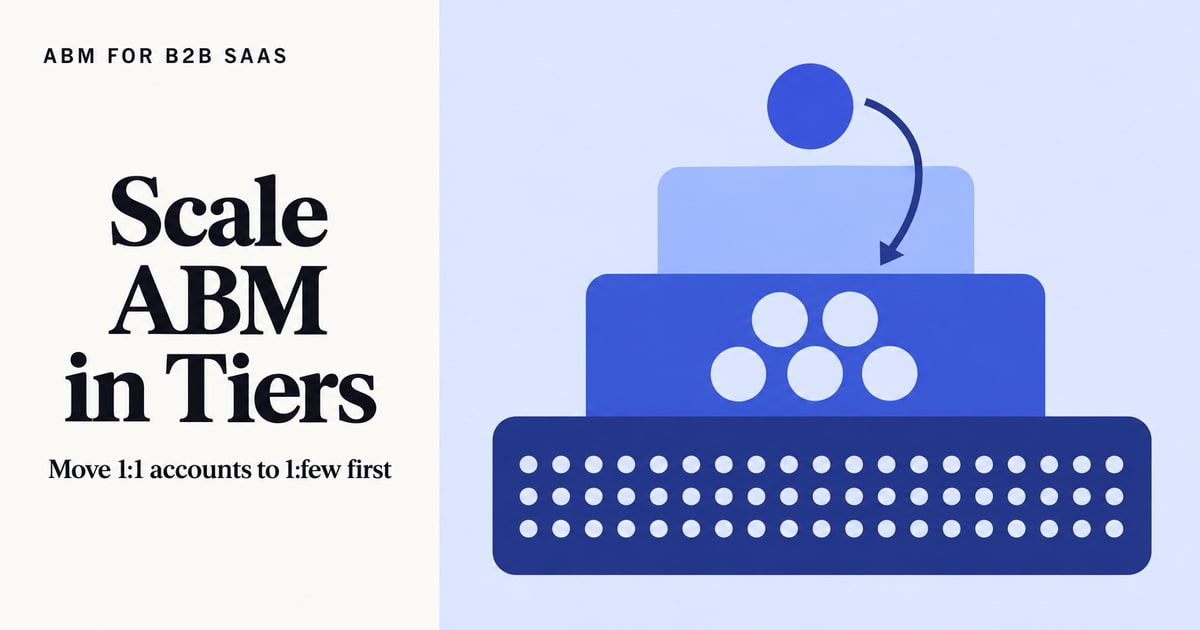
A first ABM program for $50K-plus deals should hold roughly 100 to 300 target accounts, split into account tiers. A GrowthSpree practitioner analysis (June 2026, no sample stated) gives 10 to 50 accounts for 1:1, 50 to 200 in 5 to 15 clusters for 1:few, and 200 to 500 for 1:many. Common lists run 500 to 2,000+ named accounts.
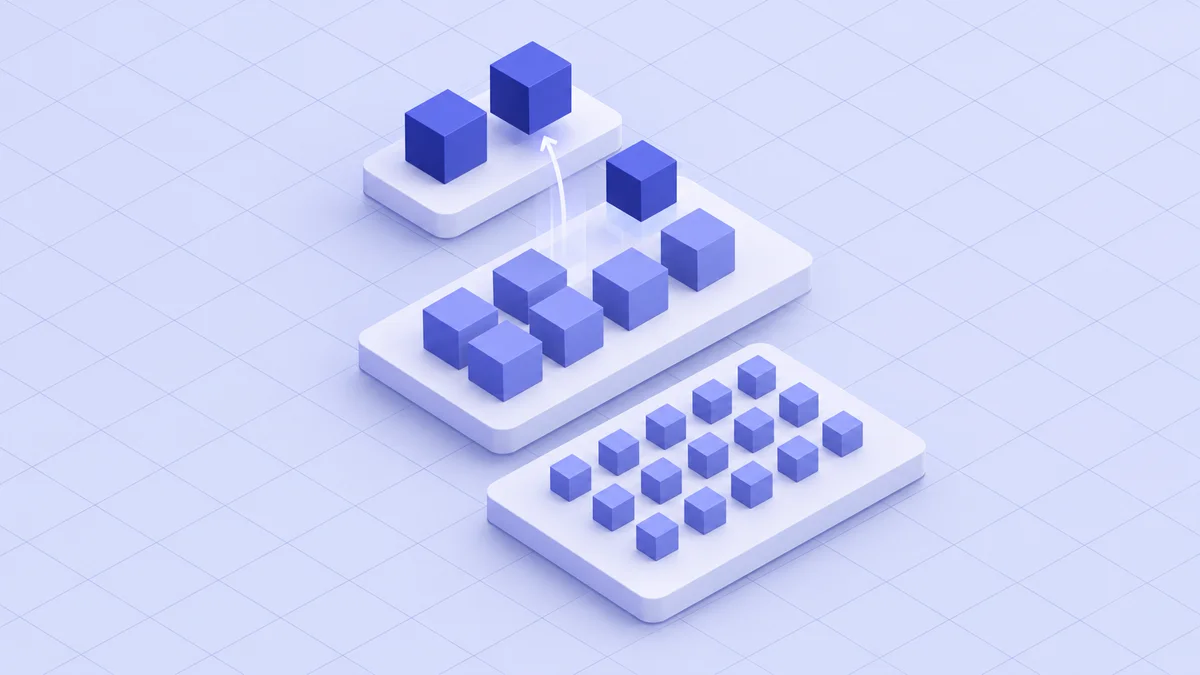
Isometric nested tiers of account blocks, a few large and many small
An account tier is a group of target accounts that receive the same level of treatment: 1:1, 1:few or 1:many. Oversized lists are the usual failure. One list, one campaign and one sequence for everyone looks like ordinary paid media with a new name. The practice is mainstream: nearly 80% of organizations were executing ABM in the 2026 benchmark survey (Demand Gen Report, 2026).
What we found: The tier sizes below come from a GrowthSpree practitioner analysis published in June 2026, which states no sample. It reports common lists of 500 to 2,000+ named accounts at companies that should run 100 to 300.
Tier
Published account range
Treatment
Fits best when
1:1
10 to 50
Bespoke content and outreach per account
Deal potential is highest and a seller owns the account
1:few
50 to 200 in 5 to 15 clusters
Content written per cluster
Accounts share industry, use case or trigger
1:many
200 to 500
Programmatic tactics across the list
Fit is confirmed but the team is small
How should target accounts be selected and scored?
Selection starts with the ideal customer profile (ICP), which is a description of the companies that buy, stay and expand. Firmographic criteria such as size, industry and region filter the market, and firmographic data is the usual starting layer. Fit alone makes a market map, not a workable list, so add intent and sales capacity.
Tier thresholds circulating online are inconsistent. One source puts 1:few at $50K to $250K ACV and 1:1 at $250K+. Others use $100K+ or $150K+ for 1:1, and most are unsourced. A transparent first rule is editorial judgment, not a published standard:
Score each account on ACV potential, fit, intent and the sales capacity available to work it.
Assign tiers from the score, and cap each tier at what the team can sustain.
Write demotion criteria in advance, for example moving a 1:1 account down if it opens no pipeline in six months.
Practitioners also disagree on where to start. Some begin at 1:few and promote the best 3 to 5 accounts to 1:1. Others pilot with 1:many and ramp up. For a small team, 1:few is the safer start because each cluster gets real content (editorial judgment).
How do you map the buying group for a $50K-plus deal?
Buying group mapping for a $50K-plus deal means listing every role that can approve, block or influence the purchase, not only the champion. GrowthSpree's 2026 buying committee benchmarks (published ranges, no sample stated) put 5 to 8 stakeholders on $25K to $100K deals, 7 to 10 on $100K to $250K deals, and 10 to 15 on $250K to $1M deals.
Isometric round table with many chairs surrounding a central document block
A buying group is the set of people inside and outside a company who approve, block or influence a purchase. The ranges below carry no stated sample, so read them as published ranges, not study findings.
What we found: In GrowthSpree's 2026 published ranges, a $250K to $1M deal involves 10 to 15 stakeholders over 126 to 180 days. A $25K to $100K deal involves 5 to 8 over 49 to 84 days. Procurement appears in 62% to 78% of US enterprise deals and 85% to 94% of Indian enterprise deals.
Deal size
Stakeholders
Sales cycle
$25K to $100K
5 to 8
49 to 84 days
$100K to $250K
7 to 10
84 to 126 days
$250K to $1M
10 to 15
126 to 180 days
Who sits in the group besides the champion?
Forrester's 2026 survey of nearly 18,000 business buyers reports 13 internal stakeholders plus nine external influencers in a typical decision (Forrester, 2026). Procurement is a decision-maker in 53% of buying cycles and engages from the start (Forrester, 2026). Purchases with genAI features double the group, at 14 members against seven (Forrester, 2026). Map security, finance, legal and procurement as roles, not afterthoughts.
Why does one persona per campaign backfire?
Gartner's survey of 632 buyers found 74% of buyer teams show "unhealthy conflict" (Gartner, via BizTechReports, 2025). Content aimed at individual relevance had a 59% negative impact on consensus (Gartner, via BizTechReports, 2025).
Gartner's conclusion: "This highlights the importance of prioritizing shared interests and goals over individual buyer priorities." (Gartner, via BizTechReports, 2025). Write messaging for the group, with role-specific proof underneath.
Which channels reach a $50K-plus buying group?
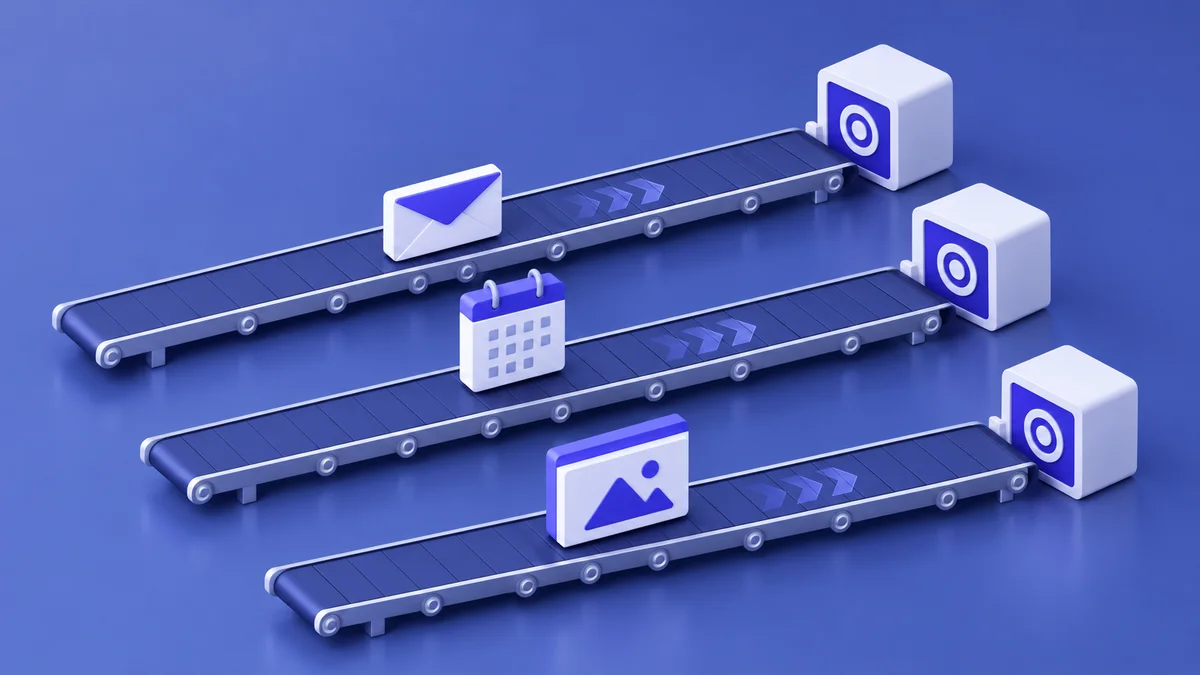
Channel choice for a first $50K-plus ABM program follows account tier. LinkedIn matched-company lists and sales development representative (SDR) outreach cover most target accounts. Events and direct mail typically go to 1:1 accounts that content does not reach. Budget discipline matters: in GrowthSpree's June 2026 audit of 56 LinkedIn accounts, individual contributors and entry-level staff consumed 36% of spend.
Isometric lanes carrying different channel icons toward tiered target blocks
The mapping below is editorial judgment, since no source ranks channels by tier.
Tier
Typical channel mix
Owner
1:1
Executive events, direct mail, tailored outbound, LinkedIn
Seller with marketing support
1:few
LinkedIn by cluster, SDR sequences, cluster events
SDR and marketing
1:many
LinkedIn matched lists, display, email
Marketing
Whatever the channel, the message should speak to the group. That is the practical reading of the 59% consensus penalty for individual-level content (Gartner, via BizTechReports, 2025).
How do you stop LinkedIn spend reaching the wrong people?
What we found: GrowthSpree's June 2026 audit of 56 LinkedIn accounts and $9.4M in ad spend found decision-makers received 33% of budget against a target of 60% or more. Individual contributors and entry-level staff took 36%, and non-buying job functions caused 30% of wasted spend.
The same audit found 20% of spend reached firms under 50 employees. LinkedIn clicks for B2B SaaS run $8 to $25 by vertical, per the audit. Set function, seniority and company-size exclusions on day one. Then weight budget toward the roles on the buying group map.
Where does sales coordination fit?
Every tier needs a named seller or SDR. Agree which accounts sales will work, which signals trigger outreach and who acts on each. An intent signal is a behavior, such as a topic search or review-site visit, that suggests an account may be researching a purchase. With no owner and no assigned action, it goes unused. For an automation view, see which ABM tasks can be automated.
How much should the first program cost, and when does pipeline show up?
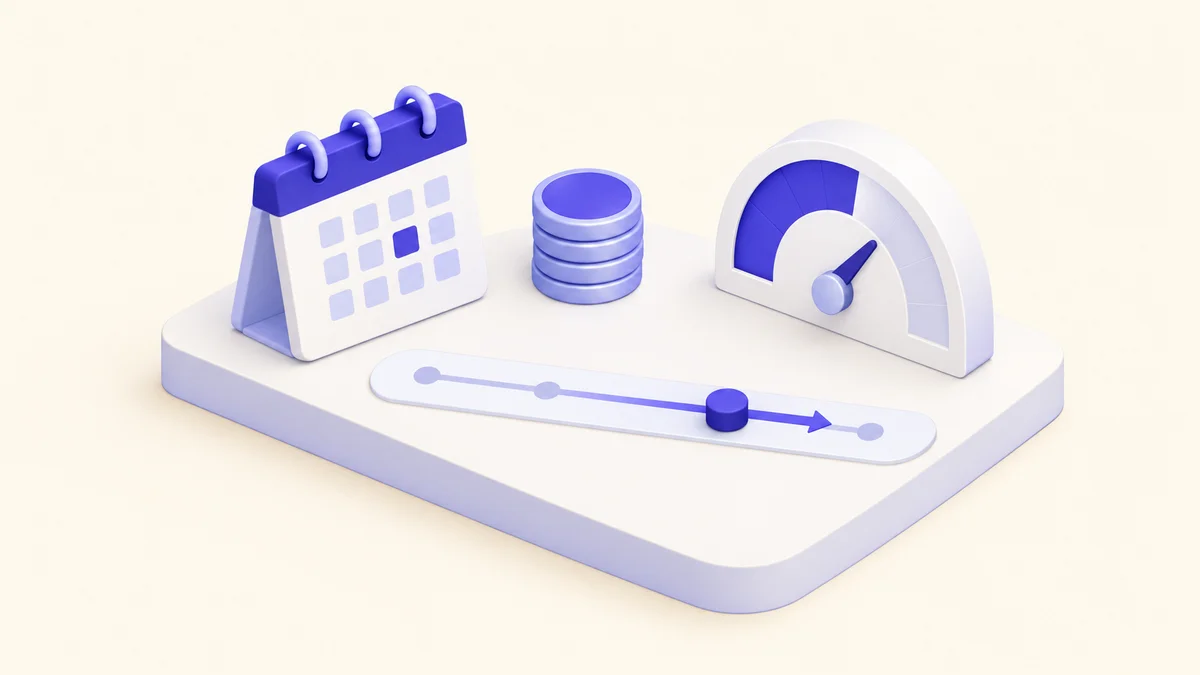
A first ABM program for $50K-plus deals should be budgeted against a target cost per sales-qualified lead (SQL) of $3,000 to $8,000 for $50K to $150K annual contract value (ACV) contracts, per GrowthSpree's 2026 published targets. Judge results only after one full sales cycle, which its published ranges put at 84 to 126 days for $100K to $250K deals.
Isometric calendar block beside a stack of coins and a gauge
A sales-qualified lead (SQL) is a contact or account that sales has accepted as a real opportunity worth working. Targets shift with ACV band.
What we found: GrowthSpree's 2026 published targets put cost per SQL at $1,000 to $3,000 for $15K to $50K ACV, $3,000 to $8,000 for $50K to $150K, and $8,000 to $20,000 for $150K+.
ACV band
Target cost per SQL
$15K to $50K
$1,000 to $3,000
$50K to $150K
$3,000 to $8,000
$150K+
$8,000 to $20,000
Per-account spend figures online range from hundreds of dollars to six figures with no stated method, so none are used here. A better approach is to size the pilot to the tier. Fund a small 1:1 group and one 1:few cluster, then expand. Forrester's Barbara Winters notes that "B2B buyers are under immense pressure to justify investments and minimize risk" (Barbara Winters, Forrester, via Branding in Asia, 2026). That pressure applies to the budget owner too.
How do you measure account based marketing on pipeline?
To measure account based marketing on pipeline, track account-to-opportunity rate and pipeline per target account, then compare both with holdout accounts that received no ABM treatment. Engagement scores and accounts reached are activity metrics, not outcomes. Judge results only after a full sales cycle, which GrowthSpree's 2026 published ranges put at 49 to 180 days depending on deal size.
Holdout accounts are a matched set of accounts that receive no ABM treatment. Without them, a rise in pipeline could come from the market, not the program. Report each tier separately, because a 1:1 account and a 1:many account should not share one benchmark.
Buying group consensus is a useful leading indicator to watch alongside pipeline. Gartner found that groups reaching consensus are 2.5 times more likely to report a high-quality deal, and groups that experience buying-group relevance are three times more likely (Gartner, via BizTechReports, 2025). Ask sales how many roles per account have engaged, not only whether a champion has. See measuring ABM on pipeline per account, why engaged accounts can produce zero SQLs and ABM attribution.
Who is a structured first ABM program not for?
A structured first ABM program is not for teams whose annual contract value sits below about $15K, that have no seller working named accounts, or that cannot sustain the account tier they pick. ABM typically pays above $15K ACV with at least one seller on named accounts, because coordination cost per account usually exceeds the return below that point.
Team capacity matters because the work scales with the buying group. In editorial judgment, a one-person team will struggle to thread 13 internal stakeholders and nine external influencers (Forrester, 2026) across 300 accounts. Honest limits apply to this guide as well:
No sample behind the ranges. The buying group ranges and list-size figures are published ranges or practitioner views, not study findings.
Benchmarks repeat without provenance. Treat any ABM statistic without a named publisher and date with caution.
Platform decisions are separate. A platform comparison belongs after the list and tiers are settled.
Regulated verticals differ. FinTech and cybersecurity buyers add security and legal blockers. Privacy rules around intent data and outreach vary, and this page gives no legal advice.
Frequently Asked Questions
What is the difference between 1:1, 1:few and 1:many ABM?
1:1 ABM dedicates bespoke content and outreach to each individual account, usually reserved for the highest-value targets. 1:few groups accounts with shared characteristics into clusters of roughly 5 to 15 and creates content for each cluster. 1:many applies programmatic tactics across a broader named-account list of 200 to 500 accounts. Published ranges for these tiers are 10 to 50, 50 to 200 and 200 to 500 accounts.
Should a first ABM program start with 1:1, 1:few or 1:many?
A first ABM program on a small team usually starts with 1:few, then promotes the best 3 to 5 accounts to 1:1 once they show engagement from several roles. Practitioners disagree: some pilot with 1:many and ramp up instead. No source ties the choice to team size, so the pick should match how many accounts the team can work by name.
Who belongs in the buying group for a $50K-plus software deal?
A buying group for a $50K-plus software deal should include the champion, the economic buyer, procurement, security, finance and legal, plus end users and external influencers. Forrester's 2026 survey reports procurement as a decision-maker in 53% of business buying cycles, so procurement belongs on the map from the first outreach, not at contract stage.
Does a first ABM program need a platform?
A first ABM program does not need a dedicated platform. Many B2B SaaS teams start with a matched-company list on LinkedIn, a customer relationship management (CRM) system, and a shared account spreadsheet reviewed weekly with sales. The decision to buy a platform depends on deal size, team size and whether its data and orchestration justify the cost, so it can wait until the list and tiers are proven.
Conclusion
Structuring a first $50K-plus ABM program comes down to a short sequence, and the order matters.
Pick fewer accounts: 100 to 300 target accounts, tiered to what the team can sustain.
Map the whole buying group, including procurement, security and finance, and write messaging for the group.
Match channels to tier, exclude non-buying roles on day one, and put a seller on every tier.
Budget against a target cost per SQL for the ACV band, and judge results after one full sales cycle.
Report pipeline per account against holdout accounts, not engagement.
For the wider practice, see ABM best practices for B2B SaaS. To pressure-test a list before launch, Meet with an expert. A free consultation. Bring your target account list and brainstorm the next step with an ABM expert.
Written by
Ishan Manchanda
Ishan Manchanda is co-founder of GrowthSpree, a B2B SaaS marketing consultancy founded in 2017 that has managed $60M+ in ad spend across 300+ B2B SaaS companies. He focuses on demand generation, go-to-market strategy and pipeline growth, and has been featured in Silicon Valley Times, SaaS Mag and the Unbounce podcast.
 Ishan ManchandaNov 14, 2026