Blog
Account-Based Marketing Best Practices for B2B SaaS: The Complete Guide
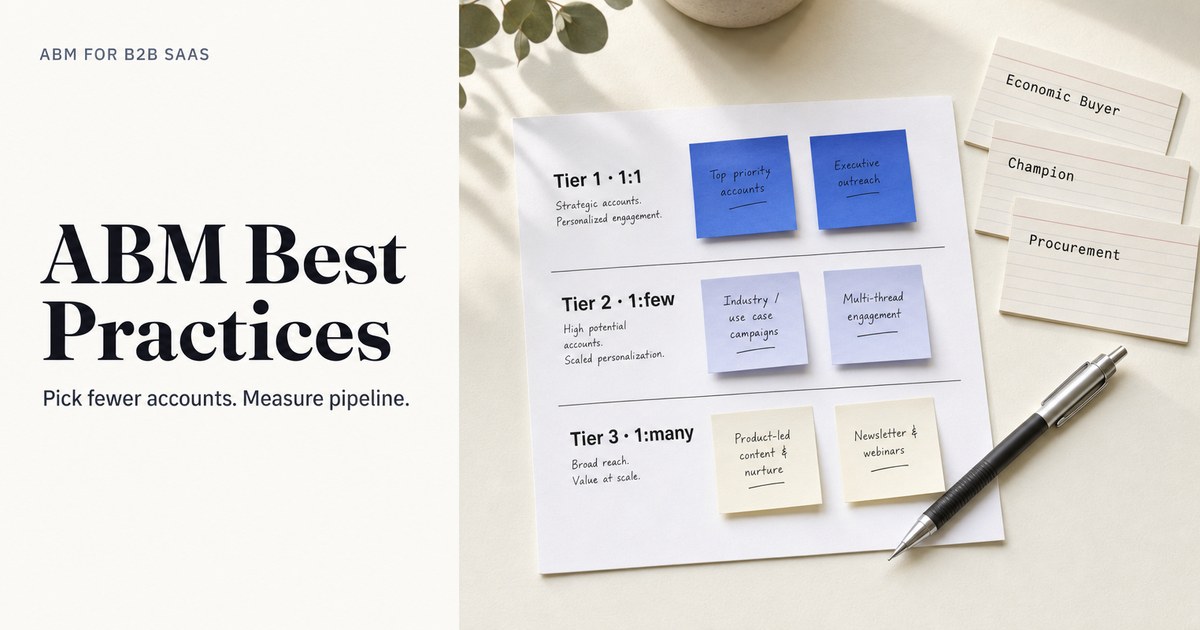
What ABM is, how the process works from target account selection to pipeline, and a deal-size test for whether it makes sense for your B2B SaaS team.
When LinkedIn, email, and sales outreach all touch the same account, standard attribution misses most of the story. Learn account-level attribution that works.
What ABM is, how the process works from target account selection to pipeline, and a deal-size test for whether it makes sense for your B2B SaaS team.

Your dashboard shows 600 engaged accounts but sales sees nothing. Learn which B2B marketing analytics metrics actually measure pipeline, with cost-per-SQL benchmarks by ACV.

Which ABM software shows pipeline, not just engagement scores? Evaluation criteria, the no-platform option, POC scorecard, and renewal contract terms.
Request a quote and our experts will contact you within 24 hours with tailored solutions and pricing.
abmforb2bsaas.com
Last updated: Oct 18, 2026
ABM for B2B SaaS Editorial Team
Account-based marketing (ABM) attribution is the practice of assigning pipeline and revenue credit to every channel that influenced a named target account's buying journey, measured at the account level rather than at the individual contact or form-fill level.
When LinkedIn ads, email sequences, direct mail, and sales outreach all reach the same account in the same quarter, the problem is rarely the program. The problem is the measurement layer. B2B lead-based attribution misses an estimated 60% of pipeline influence because channels active before a contact enters the CRM receive no credit (Machintel, 2025). The result is a familiar disconnect: the dashboard reports 600 accounts engaged, and sales says nothing changed.
This page covers account-level attribution logic, how to build a system that captures every channel's contribution, the holdout-account method for proving ABM's causal effect on pipeline, and the four features that separate attribution tools built for multi-stakeholder ABM from those that are not.
Key Takeaways
- Standard attribution software assigns credit to form fills and individual contacts, missing most of a multi-channel ABM program's influence; B2B lead-based attribution misses an estimated 60% of pipeline influence (Machintel, 2025).
- Account-level attribution uses a persistent account identifier to roll up every buying group touchpoint, including offline and untraceable interactions, to a single account record.
- The holdout-account method is the only ABM measurement approach that demonstrates causation rather than correlation, making it the standard most likely to satisfy a finance audience.
- Attribution software for multi-channel ABM must support account-level rollup, offline touch logging, identity resolution, and attribution windows of at least 180 days.
- ABM attribution at this level is not worth the setup cost for target account lists below 50 accounts or for annual contract values (ACV) below $15,000.
Standard attribution software fails account-based marketing (ABM) programs because it assigns credit to individual contacts and form fills, not to accounts. When LinkedIn ads, email sequences, direct mail, and sales outreach all touch the same account in the same quarter, a lead-based tool credits whichever interaction produced a trackable click and ignores the rest. B2B lead-based attribution misses an estimated 60% of pipeline influence because channels active before a contact enters the CRM receive no credit (Machintel, 2025).

The structural problem has a name. As the Tomba Blog puts it: "If you sell into committees with cycles longer than 30 days, lead-based attribution is actively lying to you" (Tomba Blog, 2026). That framing applies directly to most B2B SaaS deals, where sales cycles routinely run 49 to 84 days even at the $25,000 to $100,000 annual contract value (ACV) band (GrowthSpree, BC26, published ranges, no sample stated).
The most common symptom is a dashboard showing a large number of engaged accounts alongside a sales team reporting no pipeline change. Three reasons drive it:
In 2025, only 31% of B2B marketers said they were extremely confident in the accuracy of their attribution, yet 91% called attribution important to their success (RevSure and Ascend2, via Marketing LTB, 2025). That gap between importance and confidence describes what happens when a program is measured with the wrong tool.
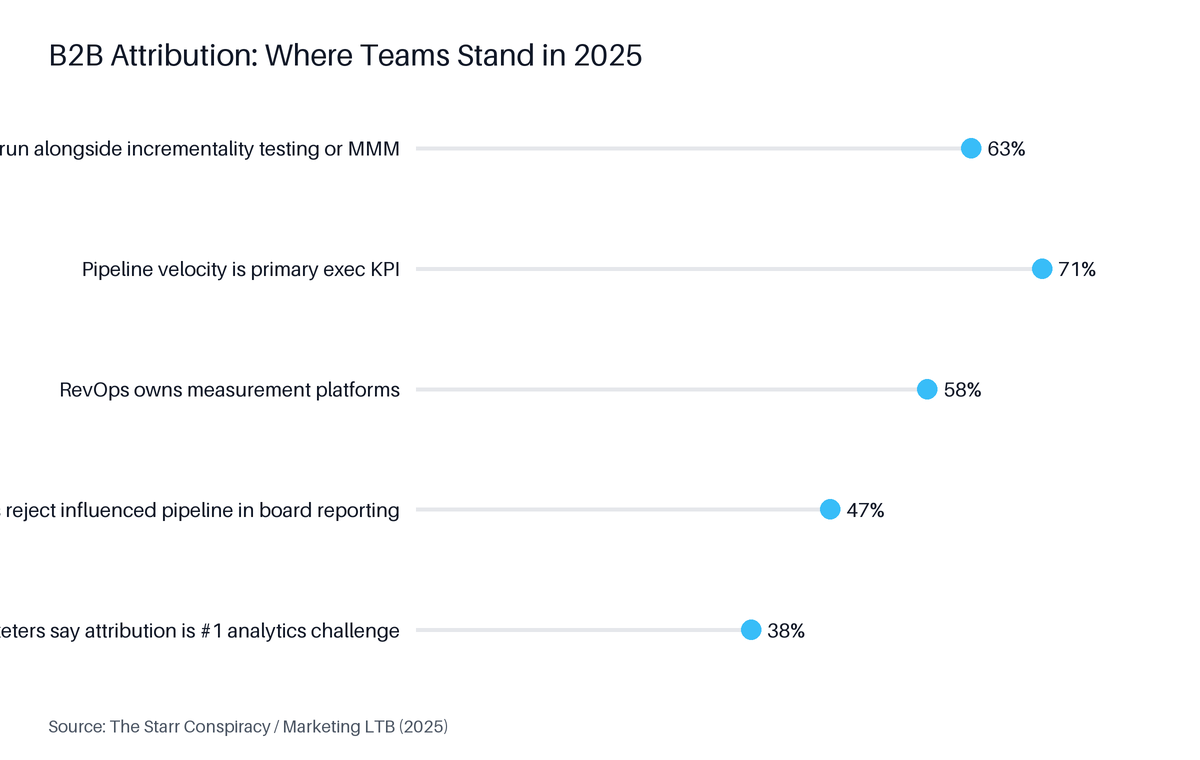
In 2025, pipeline velocity replaced MQL volume as the primary demand metric reported to executives in 71% of B2B marketing organizations (The Starr Conspiracy, 2025). Pipeline velocity is the rate at which target accounts move from first touch to closed revenue, combining account-to-opportunity rate, deal size, win rate, and sales cycle length. It is an account-level metric that connects ABM activity to revenue in a way both marketing and sales accept.
As of 2025, 63% of B2B revenue teams run multi-touch attribution alongside incrementality testing or media mix modeling, and 47% of finance leaders reject marketing-influenced pipeline in board reporting (The Starr Conspiracy, 2025).
Source: The Starr Conspiracy / Marketing LTB, 2025
Account-level attribution is the practice of rolling up every buying group touchpoint across all contacts at a named account into a single account timeline, then tying that timeline to pipeline and closed revenue at the account level. The account is the unit of measurement, not the individual lead. As of 2025, the average B2B purchase involves 13 internal stakeholders and 9 external participants (Forrester, 2025), making contact-level models structurally incomplete for multi-stakeholder deals.

Each model distributes credit differently. The right choice depends on deal cycle length, the number of active channels, and what the team needs to prove.
| Model | How credit is distributed | Best fit for ABM when |
|---|---|---|
| First-touch | 100% to the first recorded interaction | Proving which channel generated initial awareness of a target account |
| Last-touch | 100% to the interaction before opportunity creation | Short cycles (under 30 days) with a single dominant channel |
| Linear (equal weight) | Credit divided equally across all touches | Early programs where no single channel dominates |
| W-shaped | 40% first touch, 40% opportunity creation, 20% all other touches | Multi-channel ABM where both awareness and conversion matter |
| Time-decay | More credit to recent touches | Long cycles where late-stage engagement is the priority signal |
| Holdout / incrementality | Compares treated vs. control accounts | Proving causal ABM contribution to a finance audience |
Buying groups now generate more than 4,000 digital interactions on average before a deal closes (6sense, via Yirla, 2025). At that volume, no single-touch model captures the real picture. The account-to-opportunity rate (the share of target accounts that progress to a qualified sales opportunity within a defined window) is the primary metric that connects model outputs to pipeline reality.
Building an account-level attribution system requires four steps: establishing a persistent account identifier in the CRM, rolling up all contact-level touchpoints to that account record, logging offline and untraceable touches manually, and setting an attribution window that matches the actual sales cycle. In 2025, only 31% of B2B marketers said they were extremely confident in the accuracy of their attribution, yet 91% called attribution important to their success (RevSure and Ascend2, via Marketing LTB, 2025). Skipping any step produces the same result: high engagement counts, no visible pipeline.
Every target account needs a single, stable identifier in the CRM, usually the company domain or a CRM account ID. All contacts at that account must link to the same parent record. Without this, touchpoints from different buying group members accumulate in separate contact records and never roll up to an account timeline.
Common blockers:
Resolve these before configuring any attribution tool. Identity resolution (the process of matching anonymous web visits, ad impressions, email addresses, and IP addresses to a single persistent account record) is the upstream prerequisite for every other step.
Once identifiers are clean, configure the CRM or attribution tool to aggregate all interactions from contacts at an account into a single account-level timeline. Record for each touch:
Sales calls, direct mail deliveries, event conversations, and executive briefings leave no digital record unless a sales development representative (SDR) or account executive logs them explicitly. This requires a defined protocol: a standard activity type in the CRM, a required field for the account name, and a weekly check that the log is current.
Sales teams will not log touches without a clear reason. The reason is simple: if a touch is not logged, it receives zero credit, and the channel that produced it looks like it contributed nothing.
Attribution window is the time period within which a touchpoint is eligible to receive pipeline credit. Default windows in most off-the-shelf tools run 30 to 90 days. Published benchmarks put sales cycles at 49 to 84 days for $25,000 to $100,000 deals, 84 to 126 days for $100,000 to $250,000 deals, and 126 to 180 days for $250,000 to $1,000,000 deals (GrowthSpree, BC26, published ranges, no sample stated). Set the window to at least the 90th percentile of the observed cycle length. For enterprise deals, 180 days is a minimum.
The holdout-account method proves ABM's causal contribution to pipeline by withholding the program from a matched set of target accounts for a defined period and comparing pipeline outcomes between the two groups. It is the only ABM measurement approach that demonstrates causation rather than correlation. Describing the holdout method, The B2B Stack notes: "It is the only method in this glossary that measures causation rather than correlation, which is exactly why finance teams trust it" (The B2B Stack, 2025).

"Marketing-influenced pipeline is losing CFO acceptance, with 47% of finance leaders rejecting it in board reporting" (The Starr Conspiracy, 2025). The holdout-account method is the practical answer to that rejection.
Follow these steps in order:
Report three numbers: the account-to-opportunity rate in treated accounts, the same rate in holdout accounts, and the difference with its confidence interval. Do not report engagement scores, impressions, or accounts reached. Those are activity metrics. The CFO question is causal: did the program produce pipeline that would not have existed without it?
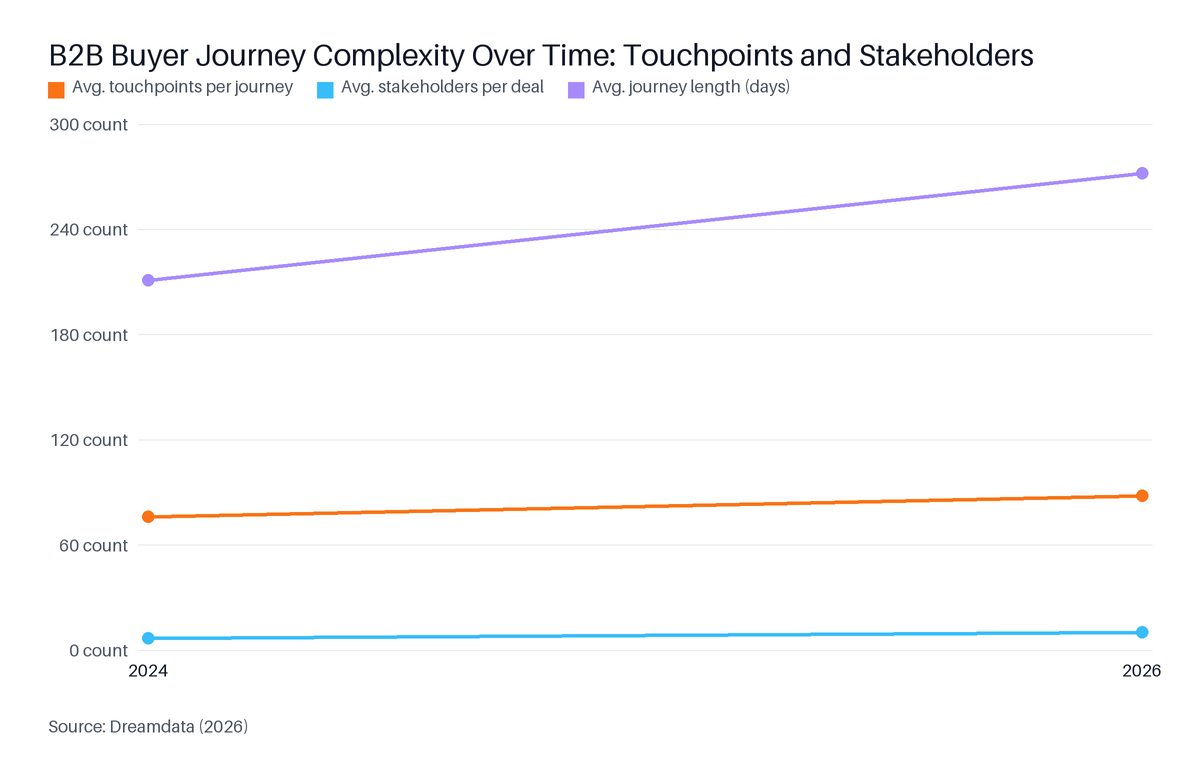
Dark funnel and offline touches are ABM interactions that leave no trackable click: LinkedIn impressions, podcast listeners, Slack community mentions, and direct mail pieces. Dreamdata's 2026 analysis across 66 million B2B sessions recorded an average of 88 touchpoints per deal, up from 76 in 2024, and found that "81% of the B2B customer journey now happens outside the sales pipeline - up from 70% last year" (Dreamdata, 2026). Three practical methods exist for capturing this influence.
Source: Dreamdata, 2026

When a new opportunity is created in the CRM, ask the sales rep to record how the account became aware of the company. Include a field with a predefined list: LinkedIn ads, direct mail, referral, event, outbound, inbound content, other. This is imprecise but directionally useful for channels with no digital trace.
For LinkedIn campaigns, use view-through attribution to flag accounts that received a minimum number of impressions within the attribution window, even if no click occurred. Set a minimum threshold, for example 5 impressions across 2 or more contacts at the account, to avoid crediting incidental exposure. Log these as "LinkedIn influenced" on the account record, separate from click-based attribution.
Assign each direct mail piece a unique URL, phone number, or QR code that maps to a specific account. When a response occurs, the source is traceable. For pieces without a response mechanism, log the send date and account in the CRM and use the holdout-account method to measure the channel's aggregate effect rather than tracking individual piece responses.
Attribution software for multi-channel ABM must satisfy four baseline requirements: account-level rollup across all contacts, offline touch logging, identity resolution across email addresses, IP addresses, and CRM company names, and a configurable attribution window of at least 180 days. Without all four, the tool measures some channel activity accurately while leaving the rest invisible. As of 2026, only 52% of organizations running ABM actually measure ABM return on investment (Demand Gen Report 2026, via Market Intelligence Tools, 2026).

GrowthSpree audit (June 2026): A GrowthSpree audit of 56 LinkedIn accounts and $9.4M in ad spend found that decision-makers received only 33% of the LinkedIn budget against a target of 60% or more (GrowthSpree, L26, published ranges, no sample stated). Individual contributors and entry-level staff consumed 36% of that budget. Attribution models that count only clicks credit LinkedIn at its full registered spend, while two-thirds of that spend reached people outside the buying group.
| Capability | What it must do | Why it matters for ABM |
|---|---|---|
| Account-level rollup | Aggregate all contact touches to a parent account record | Multi-stakeholder deals produce contact-level data that is meaningless without account aggregation |
| Offline touch logging | Accept manual or API-pushed entries for calls, direct mail, and events | Without this, all untraceable channels receive zero credit |
| Identity resolution | Match email, IP, CRM domain, and ad platform IDs to a single account | Gaps here split the attribution history across duplicate account records |
| Configurable attribution window | Support windows of 90, 180, and 365 days | Short default windows cut off early-stage channel credit for long-cycle deals |
Three capabilities that attribution tool vendors frequently emphasize add little value for ABM-specific programs:
Account-level ABM attribution is not worth the setup cost when the target account list has fewer than 50 accounts, the annual contract value (ACV) is below $15,000, or the sales cycle is shorter than 30 days. At those parameters, the statistical sample is too small to separate signal from noise. A simple account-to-opportunity rate tracked manually in a spreadsheet is more honest than an elaborate attribution system built on insufficient data volume.
In 2025, 63% of B2B revenue teams supplemented multi-touch attribution with incrementality testing or media mix modeling (The Starr Conspiracy, 2025). Smaller programs that cannot sustain a holdout test are better served by clear manual tracking than by a tool that produces false precision.
Marketing attribution software works for multi-stakeholder B2B SaaS when it rolls up all contact-level touches to the account, logs offline interactions such as direct mail and sales calls, resolves identity across email addresses, IP addresses, and CRM company names, and supports attribution windows of at least 180 days. If a tool reports only on form fills or individual contacts, it will miss most of the buying committee's activity and produce misleading channel credit.
Attribution software that shows pipeline from named target accounts must be configured to use accounts, not contacts or leads, as the unit of measurement. The tool needs a persistent account identifier in the CRM, the ability to match anonymous web visits and ad impressions to that identifier, and a pipeline field that ties opportunities back to the account record. Without account-level rollup, the tool reports clicks and form fills, not pipeline per target account.
Before switching tools, check whether the underlying problem is configuration rather than capability. Most attribution tools default to lead-level reporting. Fix the data layer first: ensure every opportunity in the CRM is linked to an account record, every target account has a consistent identifier, and offline touches are logged by the sales team. Once account-level data is clean, re-evaluate whether the existing tool can be reconfigured before purchasing a replacement.
Account-based marketing attribution is not a tool purchase. It is a measurement architecture built on clean CRM data, account-level rollup, and a consistent commitment from the sales team to log what happened offline. The four steps in this page, persistent account identifiers, contact-to-account rollup, offline touch logging, and a correctly sized attribution window, produce an attribution system that reflects what the program actually did.
When that system is in place, the holdout-account method provides the one number finance teams consistently accept: the difference in account-to-opportunity rate between accounts that received the ABM program and matched accounts that did not.
Start with the CRM audit before evaluating any new tool. A clean data layer makes any tool work better. A fragmented one makes every tool look broken.
A free consultation. Bring your target account list and brainstorm the next step with an ABM expert.
Meet with an expert
© 2026 abmforb2bsaas.com All rights reserved.